
Panel
ca. 1540 (made)
| Artist/Maker | |
| Place of origin |
From the middle of the 14th century, it became more common for people in England who had the right to bear coats of arms and badges to display them in their homes and in public institutions such as churches and guildhalls. Equally, churches and guildhalls would display coats of arms and badges of the royal and leading families of the realm to show their allegiance.
These displays of heraldic alliances could be constructed as paintings (on woodwork and on walls in fresco), on cloths, as stone sculpture and in stained glass.
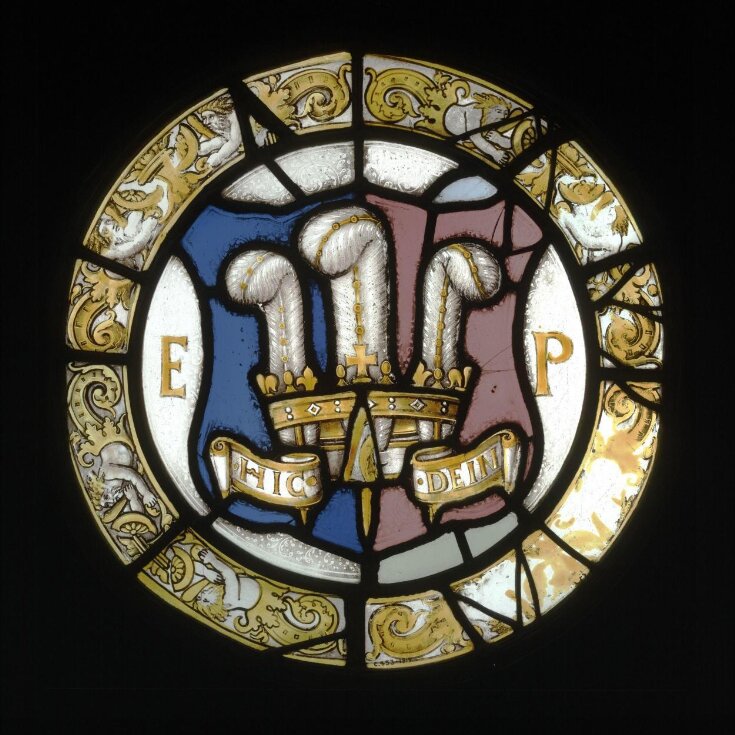
This stained glass panel displays the badge and motto of Edward Tudor prior to his ascending the throne in 1547 as Edward VI. The badge of three white ostrich feathers emerging from a gold coronet with the motto of ‘Ich Dien’ (‘I serve’) became officially associated with the Prince of Wales, the heir apparent to the English crown, in the early 17th century. However, Edward Tudor did display a badge in this form even though he was never formally created ‘Prince of Wales’.
The title ‘Prince of Wales’ pertained to the person who claimed overlordship of the various states in Wales. The last Welsh Prince of Wales to be recognized by the English crown was Llywelyn ap Gruffydd. Llywelyn died in battle against the English in 1282 and his successor was not acknowledged as Prince. Instead, the English king, Edward I, conferred the title on his son, the future Edward II, who was born in Caernarfon Castle in 1284. It was during the reign of Edward III, son of Edward II, that the ostrich feather becomes associated with the heir apparent. Edward Plantagenet, the eldest son of Edward III and better known as the ‘Black Prince’, adopted the ostrich feather as a personal emblem. His shield is displayed above his tomb in Canterbury Cathedral and bears three white ostrich feathers on a black ground, the feathers bearing scrolls with the motto ‘Ich Dien’.
Subsequently, the badge appears in various forms by succeeding monarchs and members of the high nobility, not all related to the royal family. Prince Arthur, eldest son of Henry VII, was the first to use the badge in the form displayed in this panel but it did not become ‘official’ until the Stuart dynasty of the following century.
The usually spelling of the motto is ‘Ich Dien’ although exceptions do exist and the spelling here of ‘Ich Dein’ is not uncommon.
This panel was acquired by a collector of stained glass who lived in Devon and who stated the panel came from Cowick Priory outside Exeter. We can tell from the glass, the technique of construction and the appearance of the decoration that the panel dates to around 1540. At that time, just after the dissolution of religious houses in England, the priory was owned by Baron Russell, later to become the first Earl of Bedford. Baron Russell owed his position to the Tudor family and so it would be expected that he would display that family’s arms and badges in his new property.
These displays of heraldic alliances could be constructed as paintings (on woodwork and on walls in fresco), on cloths, as stone sculpture and in stained glass.
This stained glass panel displays the badge and motto of Edward Tudor prior to his ascending the throne in 1547 as Edward VI. The badge of three white ostrich feathers emerging from a gold coronet with the motto of ‘Ich Dien’ (‘I serve’) became officially associated with the Prince of Wales, the heir apparent to the English crown, in the early 17th century. However, Edward Tudor did display a badge in this form even though he was never formally created ‘Prince of Wales’.
The title ‘Prince of Wales’ pertained to the person who claimed overlordship of the various states in Wales. The last Welsh Prince of Wales to be recognized by the English crown was Llywelyn ap Gruffydd. Llywelyn died in battle against the English in 1282 and his successor was not acknowledged as Prince. Instead, the English king, Edward I, conferred the title on his son, the future Edward II, who was born in Caernarfon Castle in 1284. It was during the reign of Edward III, son of Edward II, that the ostrich feather becomes associated with the heir apparent. Edward Plantagenet, the eldest son of Edward III and better known as the ‘Black Prince’, adopted the ostrich feather as a personal emblem. His shield is displayed above his tomb in Canterbury Cathedral and bears three white ostrich feathers on a black ground, the feathers bearing scrolls with the motto ‘Ich Dien’.
Subsequently, the badge appears in various forms by succeeding monarchs and members of the high nobility, not all related to the royal family. Prince Arthur, eldest son of Henry VII, was the first to use the badge in the form displayed in this panel but it did not become ‘official’ until the Stuart dynasty of the following century.
The usually spelling of the motto is ‘Ich Dien’ although exceptions do exist and the spelling here of ‘Ich Dein’ is not uncommon.
This panel was acquired by a collector of stained glass who lived in Devon and who stated the panel came from Cowick Priory outside Exeter. We can tell from the glass, the technique of construction and the appearance of the decoration that the panel dates to around 1540. At that time, just after the dissolution of religious houses in England, the priory was owned by Baron Russell, later to become the first Earl of Bedford. Baron Russell owed his position to the Tudor family and so it would be expected that he would display that family’s arms and badges in his new property.
Object details
| Categories | |
| Object type | |
| Materials and techniques | Clear and coloured glass with painted and stained decoration. |
| Brief description | Clear and coloured glass panel painted in brown/black pigment and silver stain. Depicting the badge of Edward Tudor, later Edward VI. Said to be from Cowick Manor in Devon. English, about 1540. |
| Physical description | Medallion. The badge of Edward VI as Prince of Wales (before 1549). Shield charged with coronet and three feathers, the motto, Hic Dein, on a scroll, the whole surrounded by grotesques. A shield azure and murrey, parted per pale, charge with a coronet or and three feathers argent. Motto, "HIC DEIN" on a scroll, and the initials 'EP' flanking the shield (for Edward, Prince of Wales, afterwards Edward VI). The whole surrounded by a border of grotesque men whose bodies end in scrolls, painted in silver-yellow stain. |
| Dimensions |
|
| Gallery label |
|
| Credit line | Bought |
| Object history | From Cowick Priory, Devon. Bought from Arthur L. Radford. |
| Historical context | Note in Register: The vendor informed Mr. Rackham (RP...) that this medallion came from Cowick Priory, Devonshire. Note in Register: See C.452-1919 on further portions of this window coming to light. Letter in Register on type of ostrich feathers badge. |
| Summary | From the middle of the 14th century, it became more common for people in England who had the right to bear coats of arms and badges to display them in their homes and in public institutions such as churches and guildhalls. Equally, churches and guildhalls would display coats of arms and badges of the royal and leading families of the realm to show their allegiance. These displays of heraldic alliances could be constructed as paintings (on woodwork and on walls in fresco), on cloths, as stone sculpture and in stained glass. This stained glass panel displays the badge and motto of Edward Tudor prior to his ascending the throne in 1547 as Edward VI. The badge of three white ostrich feathers emerging from a gold coronet with the motto of ‘Ich Dien’ (‘I serve’) became officially associated with the Prince of Wales, the heir apparent to the English crown, in the early 17th century. However, Edward Tudor did display a badge in this form even though he was never formally created ‘Prince of Wales’. The title ‘Prince of Wales’ pertained to the person who claimed overlordship of the various states in Wales. The last Welsh Prince of Wales to be recognized by the English crown was Llywelyn ap Gruffydd. Llywelyn died in battle against the English in 1282 and his successor was not acknowledged as Prince. Instead, the English king, Edward I, conferred the title on his son, the future Edward II, who was born in Caernarfon Castle in 1284. It was during the reign of Edward III, son of Edward II, that the ostrich feather becomes associated with the heir apparent. Edward Plantagenet, the eldest son of Edward III and better known as the ‘Black Prince’, adopted the ostrich feather as a personal emblem. His shield is displayed above his tomb in Canterbury Cathedral and bears three white ostrich feathers on a black ground, the feathers bearing scrolls with the motto ‘Ich Dien’. Subsequently, the badge appears in various forms by succeeding monarchs and members of the high nobility, not all related to the royal family. Prince Arthur, eldest son of Henry VII, was the first to use the badge in the form displayed in this panel but it did not become ‘official’ until the Stuart dynasty of the following century. The usually spelling of the motto is ‘Ich Dien’ although exceptions do exist and the spelling here of ‘Ich Dein’ is not uncommon. This panel was acquired by a collector of stained glass who lived in Devon and who stated the panel came from Cowick Priory outside Exeter. We can tell from the glass, the technique of construction and the appearance of the decoration that the panel dates to around 1540. At that time, just after the dissolution of religious houses in England, the priory was owned by Baron Russell, later to become the first Earl of Bedford. Baron Russell owed his position to the Tudor family and so it would be expected that he would display that family’s arms and badges in his new property. |
| Bibliographic references |
|
| Collection | |
| Accession number | C.453-1919 |
About this object record
Explore the Collections contains over a million catalogue records, and over half a million images. It is a working database that includes information compiled over the life of the museum. Some of our records may contain offensive and discriminatory language, or reflect outdated ideas, practice and analysis. We are committed to addressing these issues, and to review and update our records accordingly.
You can write to us to suggest improvements to the record.
Suggest feedback
You can write to us to suggest improvements to the record.
Suggest feedback
| Record created | June 8, 1998 |
| Record URL |
Download as: JSONIIIF Manifest
