
Bed Curtain
ca. 1700 (made)
| Artist/Maker | |
| Place of origin |
Object Type
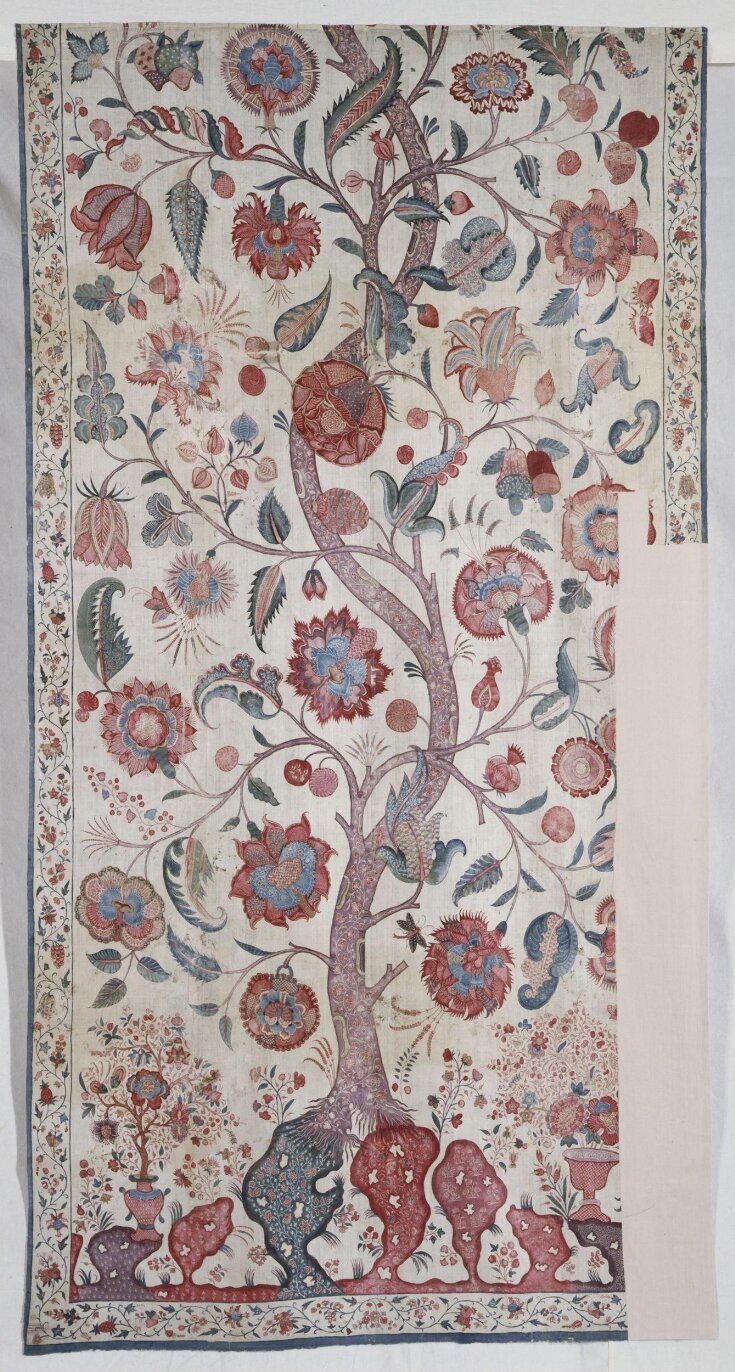
This chintz (painted cotton) bed hanging was made in south-east India by unknown craftsmen in about 1700. It is a very fine example of the complex painting and dyeing processes for which this part of India was renowned. These fabrics successfully competed with crewel-work (an embroidery technique named for the crewel or worsted wool used); bed hangings were made in Britain using that technique from the late 17th century onwards.
Materials & Making
The processes involved in making chintzes are based on the ancient Indian skills of mordant-dyeing and resist-dyeing. Mordants allow certain dyestuffs to release their colours, and resists prevent others fixing to the fabric. The areas to be red in the finished piece are painted with an alum mordant, and the black areas with an iron mordant. These then react with the dyes to give fast colours and the unmordanted areas can be rinsed clean of excess dye. As the indigo dye does not require mordanting, it is necessary to protect (resist) those areas that are not to become blue. The entire cloth is then immersed in the dye vat, and the resist material (usually wax) can then be removed from the non-blue areas. Green is achieved by over-painting yellow dye onto indigo-dyed areas, and purple shades by combining red and blue dyes.
Design & Designing
The flowering tree pattern was the most popular design for chintz hangings and 'palampores' (a type of chintz bed cover formerly made in India) exported from India to Europe from the late 17th century. It is a hybrid design that evolved out of Islamic, Chinese and European sources, which had travelled back and forth through trade and diplomacy over the preceding centuries. In some cases the Indian chintz examples were faithful renditions of English crewel-work embroideries, which in turn drew on 'exotic' prototypes.
This chintz (painted cotton) bed hanging was made in south-east India by unknown craftsmen in about 1700. It is a very fine example of the complex painting and dyeing processes for which this part of India was renowned. These fabrics successfully competed with crewel-work (an embroidery technique named for the crewel or worsted wool used); bed hangings were made in Britain using that technique from the late 17th century onwards.
Materials & Making
The processes involved in making chintzes are based on the ancient Indian skills of mordant-dyeing and resist-dyeing. Mordants allow certain dyestuffs to release their colours, and resists prevent others fixing to the fabric. The areas to be red in the finished piece are painted with an alum mordant, and the black areas with an iron mordant. These then react with the dyes to give fast colours and the unmordanted areas can be rinsed clean of excess dye. As the indigo dye does not require mordanting, it is necessary to protect (resist) those areas that are not to become blue. The entire cloth is then immersed in the dye vat, and the resist material (usually wax) can then be removed from the non-blue areas. Green is achieved by over-painting yellow dye onto indigo-dyed areas, and purple shades by combining red and blue dyes.
Design & Designing
The flowering tree pattern was the most popular design for chintz hangings and 'palampores' (a type of chintz bed cover formerly made in India) exported from India to Europe from the late 17th century. It is a hybrid design that evolved out of Islamic, Chinese and European sources, which had travelled back and forth through trade and diplomacy over the preceding centuries. In some cases the Indian chintz examples were faithful renditions of English crewel-work embroideries, which in turn drew on 'exotic' prototypes.
Object details
| Categories | |
| Object type | |
| Materials and techniques | Painted and dyed cotton chintz |
| Brief description | Bed curtain of painted and dyed cotton chintz, Coromandel Coast, ca. 1700 |
| Physical description | Bed curtain of painted and dyed cotton chintz. A tall tree with exposed roots and slender branches with exotic and stylised flowers and foliage. The trunk is patterned with a floral meander which extends along the branches. At intervals along the edges, there are flattened ovals indicating where branches had been severed. The tree is poised on the two highest points of a chinoiserie rockery. On the outermost hillocks stand vases of flowering plants. The narrow border is a repeating flower and fruit meander. Edged with a blue band. There is a selvage at the left side and in the lower corner is a group of shots of red cotton. |
| Dimensions |
|
| Gallery label | British Galleries:
BED CURTAINS These two curtains illustrate how design ideas were passed backwards and forwards between India and England. Both are based on the Indian flowering tree pattern. The Indian makers of the painted chintz used textile designs from Britain to adapt their traditional designs for a British market. The British makers of the embroidered curtain were, in turn, imitating fashionable Indian chintzes and re-created them with embroidery.(27/03/2003) |
| Credit line | Given by G. P. Baker |
| Object history | Made in south-east India (Coromandel Coast) |
| Summary | Object Type This chintz (painted cotton) bed hanging was made in south-east India by unknown craftsmen in about 1700. It is a very fine example of the complex painting and dyeing processes for which this part of India was renowned. These fabrics successfully competed with crewel-work (an embroidery technique named for the crewel or worsted wool used); bed hangings were made in Britain using that technique from the late 17th century onwards. Materials & Making The processes involved in making chintzes are based on the ancient Indian skills of mordant-dyeing and resist-dyeing. Mordants allow certain dyestuffs to release their colours, and resists prevent others fixing to the fabric. The areas to be red in the finished piece are painted with an alum mordant, and the black areas with an iron mordant. These then react with the dyes to give fast colours and the unmordanted areas can be rinsed clean of excess dye. As the indigo dye does not require mordanting, it is necessary to protect (resist) those areas that are not to become blue. The entire cloth is then immersed in the dye vat, and the resist material (usually wax) can then be removed from the non-blue areas. Green is achieved by over-painting yellow dye onto indigo-dyed areas, and purple shades by combining red and blue dyes. Design & Designing The flowering tree pattern was the most popular design for chintz hangings and 'palampores' (a type of chintz bed cover formerly made in India) exported from India to Europe from the late 17th century. It is a hybrid design that evolved out of Islamic, Chinese and European sources, which had travelled back and forth through trade and diplomacy over the preceding centuries. In some cases the Indian chintz examples were faithful renditions of English crewel-work embroideries, which in turn drew on 'exotic' prototypes. |
| Bibliographic references |
|
| Collection | |
| Accession number | IS.121-1950 |
About this object record
Explore the Collections contains over a million catalogue records, and over half a million images. It is a working database that includes information compiled over the life of the museum. Some of our records may contain offensive and discriminatory language, or reflect outdated ideas, practice and analysis. We are committed to addressing these issues, and to review and update our records accordingly.
You can write to us to suggest improvements to the record.
Suggest feedback
You can write to us to suggest improvements to the record.
Suggest feedback
| Record created | March 27, 2003 |
| Record URL |
Download as: JSONIIIF Manifest
