Pin-Prick Picture
ca. 1830 (made)
| Artist/Maker | |
| Place of origin |
Object Type
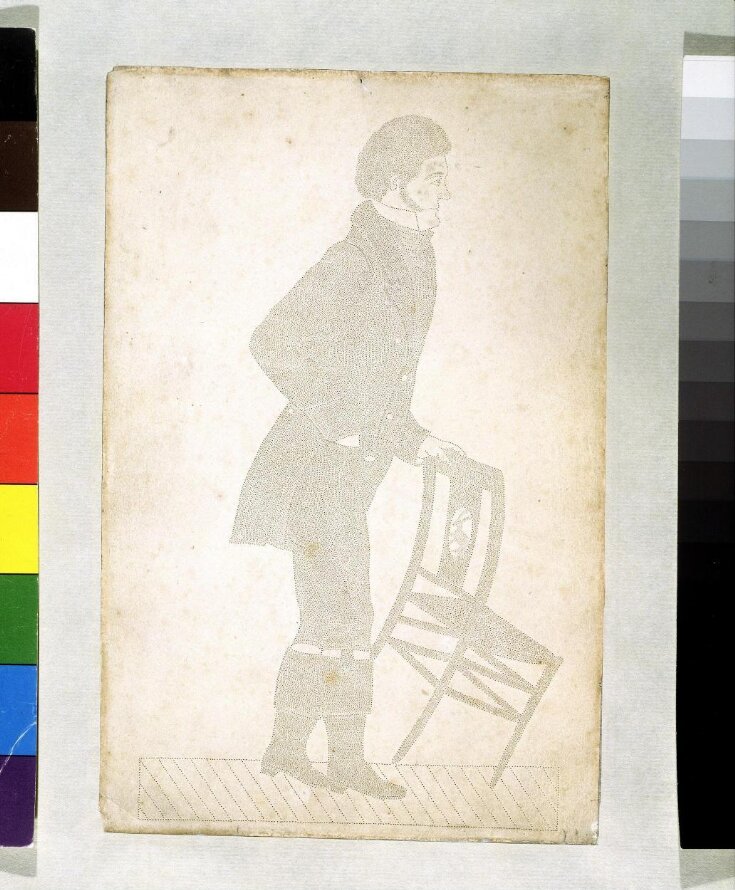
This unusual image of a man holding a chair has been created by pricking holes in a piece of paper. Pin-prick pictures were just one of many ways in which paper was used without paint or pencil to create images as a genteel way to pass the time.
Materials & Making
On the back of this piece of paper is a very light sketch in graphite of the figure and chair. The outline of the figure has been pricked from the front of the paper. The figure's shadowing has been pricked from the back. It appears dark because of the density of the pricks and the shadows cast by the raised edges of the pushed-through paper.
Paper
By the end of the 18th century it was a favourite pastime to work in paper using a variety of techniques to create images and decorative effects. Special shops sprang up to cater for this taste, most famously Rudolph Ackermann's 'Repository' in London's Strand. This shop, and others such as Fuller's 'Temple of Fancy', stocked materials for amateur painters but also what were called fancy papers: coloured and embossed paper designed to allow amateurs to create decorative work in paper. This pin-prick picture is an example of a more simple but equally challenging use of paper.
This unusual image of a man holding a chair has been created by pricking holes in a piece of paper. Pin-prick pictures were just one of many ways in which paper was used without paint or pencil to create images as a genteel way to pass the time.
Materials & Making
On the back of this piece of paper is a very light sketch in graphite of the figure and chair. The outline of the figure has been pricked from the front of the paper. The figure's shadowing has been pricked from the back. It appears dark because of the density of the pricks and the shadows cast by the raised edges of the pushed-through paper.
Paper
By the end of the 18th century it was a favourite pastime to work in paper using a variety of techniques to create images and decorative effects. Special shops sprang up to cater for this taste, most famously Rudolph Ackermann's 'Repository' in London's Strand. This shop, and others such as Fuller's 'Temple of Fancy', stocked materials for amateur painters but also what were called fancy papers: coloured and embossed paper designed to allow amateurs to create decorative work in paper. This pin-prick picture is an example of a more simple but equally challenging use of paper.
Object details
| Category | |
| Object type | |
| Materials and techniques | Pin-pricked paper |
| Brief description | Pin-prick picture of a gentleman |
| Physical description | Depiction on paper of a gentleman. The image has been created by pricking through the paper with a pin, so there is an uneven surface and many tiny holes making up the image. |
| Dimensions |
|
| Gallery label | British Galleries:
Pin-prick drawing was one of the many forms of small scale domestic handiwork that was undertaken in 'polite society'. According to 'The Young Ladies' Book', by A. Lady, published in 1829, the outline was drawn on the paper. This was then laid on a piece of cloth or blotting paper and the details punctured through from the back with a needle fixed to a short handle.(27/03/2003) |
| Credit line | Bequeathed by Mrs E. Bardsley |
| Object history | Made in England |
| Summary | Object Type This unusual image of a man holding a chair has been created by pricking holes in a piece of paper. Pin-prick pictures were just one of many ways in which paper was used without paint or pencil to create images as a genteel way to pass the time. Materials & Making On the back of this piece of paper is a very light sketch in graphite of the figure and chair. The outline of the figure has been pricked from the front of the paper. The figure's shadowing has been pricked from the back. It appears dark because of the density of the pricks and the shadows cast by the raised edges of the pushed-through paper. Paper By the end of the 18th century it was a favourite pastime to work in paper using a variety of techniques to create images and decorative effects. Special shops sprang up to cater for this taste, most famously Rudolph Ackermann's 'Repository' in London's Strand. This shop, and others such as Fuller's 'Temple of Fancy', stocked materials for amateur painters but also what were called fancy papers: coloured and embossed paper designed to allow amateurs to create decorative work in paper. This pin-prick picture is an example of a more simple but equally challenging use of paper. |
| Bibliographic reference | Victoria and Albert Museum, Department of Prints and Drawings and Department of Paintings, Accessions 1949, London: HMSO, 1961. |
| Collection | |
| Accession number | E.763-1949 |
About this object record
Explore the Collections contains over a million catalogue records, and over half a million images. It is a working database that includes information compiled over the life of the museum. Some of our records may contain offensive and discriminatory language, or reflect outdated ideas, practice and analysis. We are committed to addressing these issues, and to review and update our records accordingly.
You can write to us to suggest improvements to the record.
Suggest feedback
You can write to us to suggest improvements to the record.
Suggest feedback
| Record created | March 27, 2003 |
| Record URL |
Download as: JSONIIIF Manifest
