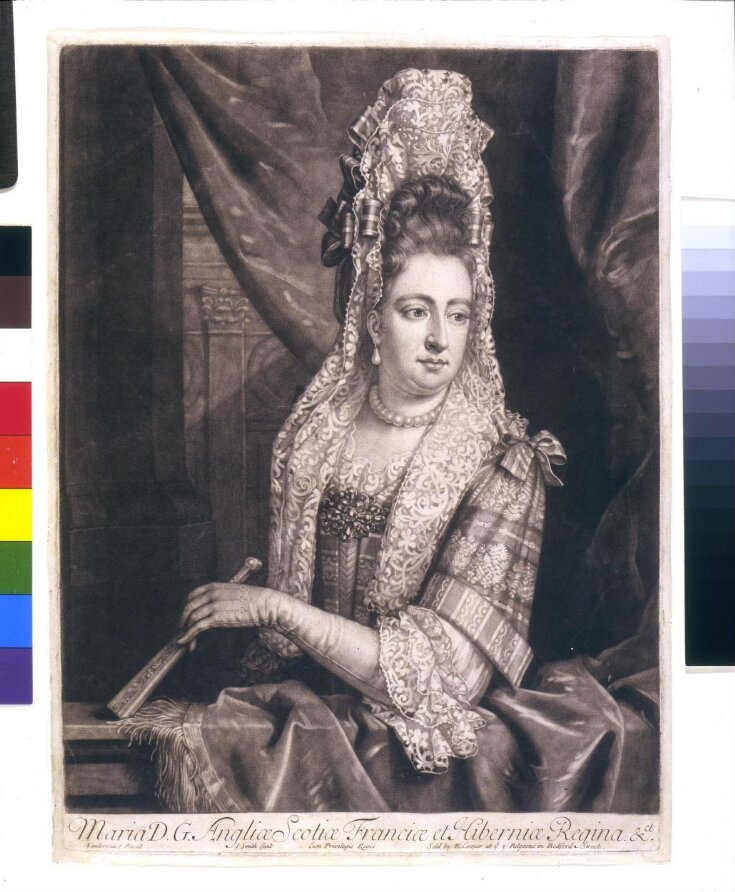
Maria D.G. Angliae Scotiae Franciae et Hiberniae Regina &ct.
Mezzotint
1690s (published)
1690s (published)
| Artist/Maker | |
| Place of origin |
Object Type
A mezzotint is a form of tonal engraving. To make the design, the surface of a metal plate is pitted with a serrated tool called a 'rocker', then scraped and smoothed so that different areas of the plate will hold varying quantities of ink. This creates a range of velvety tones and white highlights when the image is printed onto paper. The rougher areas of the plate hold more ink and print dark tones, while the smooth areas hold little or no ink and print light.
People
The print is taken from a portrait of the Queen painted in 1688 by the Dutch painter and engraver Jan van der Vaardt, who moved to England in 1674. The portrait is now at Audley End, Essex.
John Smith, the printmaker, was one of the most important mezzotinters of the period and published a large number of portraits using the technique. Although the mezzotint was invented in Holland, it was perfected in England and became known on the Continent as the manière anglaise. Prince Rupert, a nephew of Charles I, is said to have introduced it to England.
Subject Depicted
Images of royalty were always a staple of print production. This example shows the Queen dressed in the height of fashion, in the style set by the French court. She is wearing a formal gown or 'mantua' made of striped and figured silk. Her highly elaborate lace headdress was called a frelange, while the ribbon bows behind the lace were known as fontanges. The whole ensemble was held up by a wire frame called a commode.
A mezzotint is a form of tonal engraving. To make the design, the surface of a metal plate is pitted with a serrated tool called a 'rocker', then scraped and smoothed so that different areas of the plate will hold varying quantities of ink. This creates a range of velvety tones and white highlights when the image is printed onto paper. The rougher areas of the plate hold more ink and print dark tones, while the smooth areas hold little or no ink and print light.
People
The print is taken from a portrait of the Queen painted in 1688 by the Dutch painter and engraver Jan van der Vaardt, who moved to England in 1674. The portrait is now at Audley End, Essex.
John Smith, the printmaker, was one of the most important mezzotinters of the period and published a large number of portraits using the technique. Although the mezzotint was invented in Holland, it was perfected in England and became known on the Continent as the manière anglaise. Prince Rupert, a nephew of Charles I, is said to have introduced it to England.
Subject Depicted
Images of royalty were always a staple of print production. This example shows the Queen dressed in the height of fashion, in the style set by the French court. She is wearing a formal gown or 'mantua' made of striped and figured silk. Her highly elaborate lace headdress was called a frelange, while the ribbon bows behind the lace were known as fontanges. The whole ensemble was held up by a wire frame called a commode.
Object details
| Categories | |
| Object type | |
| Title | Maria D.G. Angliae Scotiae Franciae et Hiberniae Regina &ct. (generic title) |
| Materials and techniques | Mezzotint on paper |
| Brief description | Portrait, half-length of Queen Mary II. Mezzotint by John Smith after Jan van der Vaardt, 1690s. |
| Physical description | Half-length portrait, turned slightly to left, looking to right, her left arm leaning on a parapet. The sitter is wearing a lace headdress and is holding a fan in her left hand. The portrait is set in an architectural setting. |
| Dimensions |
|
| Styles | |
| Copy number | 2nd state |
| Marks and inscriptions | 'Maria D.G. Angliae Scotiae Franciae et Hiberniae Regina &ct. Vandervaart Pinxit I. Smith fecit Cum Privilegio Regis Sold by E. Copper at ye 3 Pidgeons in Bedford Street.' (Lettered) |
| Gallery label | British Galleries:
Queen Mary was popular, both for her beauty and her accomplishments. Her appearance was recorded in numerous paintings and in cheaper formats such as prints. Mezzotint was a relatively new printing technique, which captured some of the range of tones of a painted portrait, but at a fraction of the price.(27/03/2003) |
| Subjects depicted | |
| Summary | Object Type A mezzotint is a form of tonal engraving. To make the design, the surface of a metal plate is pitted with a serrated tool called a 'rocker', then scraped and smoothed so that different areas of the plate will hold varying quantities of ink. This creates a range of velvety tones and white highlights when the image is printed onto paper. The rougher areas of the plate hold more ink and print dark tones, while the smooth areas hold little or no ink and print light. People The print is taken from a portrait of the Queen painted in 1688 by the Dutch painter and engraver Jan van der Vaardt, who moved to England in 1674. The portrait is now at Audley End, Essex. John Smith, the printmaker, was one of the most important mezzotinters of the period and published a large number of portraits using the technique. Although the mezzotint was invented in Holland, it was perfected in England and became known on the Continent as the manière anglaise. Prince Rupert, a nephew of Charles I, is said to have introduced it to England. Subject Depicted Images of royalty were always a staple of print production. This example shows the Queen dressed in the height of fashion, in the style set by the French court. She is wearing a formal gown or 'mantua' made of striped and figured silk. Her highly elaborate lace headdress was called a frelange, while the ribbon bows behind the lace were known as fontanges. The whole ensemble was held up by a wire frame called a commode. |
| Collection | |
| Accession number | E.673-1910 |
About this object record
Explore the Collections contains over a million catalogue records, and over half a million images. It is a working database that includes information compiled over the life of the museum. Some of our records may contain offensive and discriminatory language, or reflect outdated ideas, practice and analysis. We are committed to addressing these issues, and to review and update our records accordingly.
You can write to us to suggest improvements to the record.
Suggest feedback
You can write to us to suggest improvements to the record.
Suggest feedback
| Record created | March 27, 2003 |
| Record URL |
Download as: JSONIIIF Manifest
