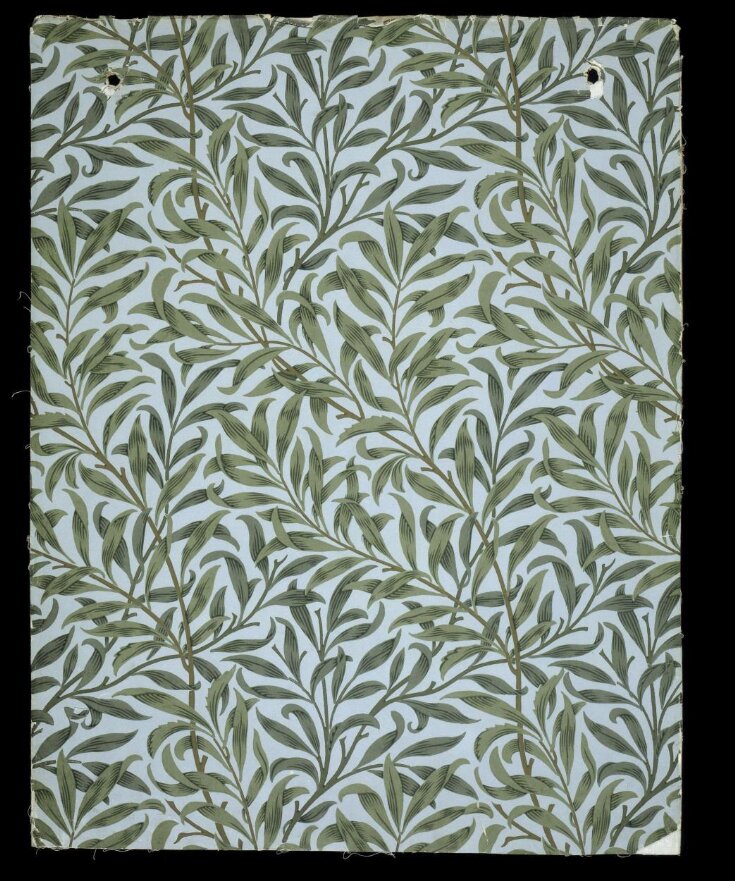

Willow Bough
Wallpaper
1887 (made), 1887 (published)
1887 (made), 1887 (published)
| Artist/Maker | |
| Place of origin |
Object Type
In Britain, paper printed with patterns has been used for decorating walls since the 16th century. By the late 19th century wallpapers were widely used by all classes, in homes and also in public buildings. William Morris designed a number of wallpapers, all with repeating patterns based on natural forms.
Design & Designing
Many of Morris's wallpaper designs were based on plant forms which he studied at first hand. Some of his patterns, such as 'Trellis' and 'Garden Tulip' were drawn from plants in his own gardens. Others - such as 'Willow Bough' - were inspired by wild flowers and trees which he had seen on country walks. In 1881 he gave a lecture entitled 'Some Hints on Pattern Designing' in which he argued that the ideal pattern should have 'unmistakable suggestions of gardens and fields.' Morris also found ideas for his designs in the simple woodcut illustrations in 16th-century herbals (books describing plants and their various uses in medicine and cookery). He owned several books of this kind, including a copy of Gerard's Herball (published 1597) in which a willow branch is illustrated.
Subjects Depicted
The willow was one of Morris's favourite motifs and he used it in several of his designs for wallpaper and for textiles. Sometimes he used a small-scale pattern of simplified willow leaves as a background to other motifs, as in 'Lily' (1873) and 'Powdered' (1874). Also in 1874 he designed 'Willow', a simple stylised representation of willow branches on a dark ground. 'Willow Bough' is a more naturalistic version of this earlier pattern.
In Britain, paper printed with patterns has been used for decorating walls since the 16th century. By the late 19th century wallpapers were widely used by all classes, in homes and also in public buildings. William Morris designed a number of wallpapers, all with repeating patterns based on natural forms.
Design & Designing
Many of Morris's wallpaper designs were based on plant forms which he studied at first hand. Some of his patterns, such as 'Trellis' and 'Garden Tulip' were drawn from plants in his own gardens. Others - such as 'Willow Bough' - were inspired by wild flowers and trees which he had seen on country walks. In 1881 he gave a lecture entitled 'Some Hints on Pattern Designing' in which he argued that the ideal pattern should have 'unmistakable suggestions of gardens and fields.' Morris also found ideas for his designs in the simple woodcut illustrations in 16th-century herbals (books describing plants and their various uses in medicine and cookery). He owned several books of this kind, including a copy of Gerard's Herball (published 1597) in which a willow branch is illustrated.
Subjects Depicted
The willow was one of Morris's favourite motifs and he used it in several of his designs for wallpaper and for textiles. Sometimes he used a small-scale pattern of simplified willow leaves as a background to other motifs, as in 'Lily' (1873) and 'Powdered' (1874). Also in 1874 he designed 'Willow', a simple stylised representation of willow branches on a dark ground. 'Willow Bough' is a more naturalistic version of this earlier pattern.
Object details
| Categories | |
| Object type | |
| Title | Willow Bough (generic title) |
| Materials and techniques | block-printed in distemper colours, on paper |
| Brief description | Specimen of 'Willow Bough' wallpaper, a foliate pattern of intertwined willow leaves, green on pale-blue ground; Block-printed in distemper colours, on paper; Designed by William Morris; Printed by Jeffrey & Co. for Morris & Co.; Part of 'Volume 2', a pattern book containing 27 Morris & Co. patterns from 1882-96 (E.530-608-1919); England; First issued 1887. |
| Physical description | Specimen of 'Willow Bough' wallpaper, a foliate pattern of intertwined willow leaves, green on pale-blue ground; Block-printed in distemper colours, on paper; Inscribed on the back in ink with title, number and price. Part of 'Volume 2', a pattern book containing 27 Morris & Co. patterns from 1862-81 (E.530-608-1919). |
| Dimensions |
|
| Style | |
| Marks and inscriptions | Willow Bough 229 / 6/- (Inscribed in ink on the back) |
| Gallery label | British Galleries:
This late design shows Morris's favourite natural theme, willows. His daughter May Morris wrote 'We were walking one day by our little stream that runs into the Thames, and my Father pointed out details and variety in the leaf forms and soon afterwards this paper was done, a keenly observed rendering of our willows'. It became the firm's most popular wallpaper.(27/03/2003) |
| Credit line | Given by Morris & Co. |
| Object history | Printed in London by Jeffrey & Co. for Morris & Co. The willow branch motif is basd on direct observation from nature. May Morris describes a walk with her father that inspired this design (see V&A Morris Catalogue, L.24). |
| Production | Within pattern book Volume 2 (1882-96). |
| Subjects depicted | |
| Summary | Object Type In Britain, paper printed with patterns has been used for decorating walls since the 16th century. By the late 19th century wallpapers were widely used by all classes, in homes and also in public buildings. William Morris designed a number of wallpapers, all with repeating patterns based on natural forms. Design & Designing Many of Morris's wallpaper designs were based on plant forms which he studied at first hand. Some of his patterns, such as 'Trellis' and 'Garden Tulip' were drawn from plants in his own gardens. Others - such as 'Willow Bough' - were inspired by wild flowers and trees which he had seen on country walks. In 1881 he gave a lecture entitled 'Some Hints on Pattern Designing' in which he argued that the ideal pattern should have 'unmistakable suggestions of gardens and fields.' Morris also found ideas for his designs in the simple woodcut illustrations in 16th-century herbals (books describing plants and their various uses in medicine and cookery). He owned several books of this kind, including a copy of Gerard's Herball (published 1597) in which a willow branch is illustrated. Subjects Depicted The willow was one of Morris's favourite motifs and he used it in several of his designs for wallpaper and for textiles. Sometimes he used a small-scale pattern of simplified willow leaves as a background to other motifs, as in 'Lily' (1873) and 'Powdered' (1874). Also in 1874 he designed 'Willow', a simple stylised representation of willow branches on a dark ground. 'Willow Bough' is a more naturalistic version of this earlier pattern. |
| Associated objects |
|
| Bibliographic references |
|
| Collection | |
| Accession number | E.558-1919 |
About this object record
Explore the Collections contains over a million catalogue records, and over half a million images. It is a working database that includes information compiled over the life of the museum. Some of our records may contain offensive and discriminatory language, or reflect outdated ideas, practice and analysis. We are committed to addressing these issues, and to review and update our records accordingly.
You can write to us to suggest improvements to the record.
Suggest feedback
You can write to us to suggest improvements to the record.
Suggest feedback
| Record created | March 27, 2003 |
| Record URL |
Download as: JSONIIIF Manifest
