
Acanthus
Wallpaper
1875 (published)
1875 (published)
| Artist/Maker | |
| Place of origin |
Object Type
In Britain, paper printed with patterns has been used for decorating walls since the 16th century. By the late 19th century wallpapers were widely used by all classes, in homes and also in public buildings. William Morris designed a number of wallpapers all with repeating patterns based on natural forms.
Materials & Making
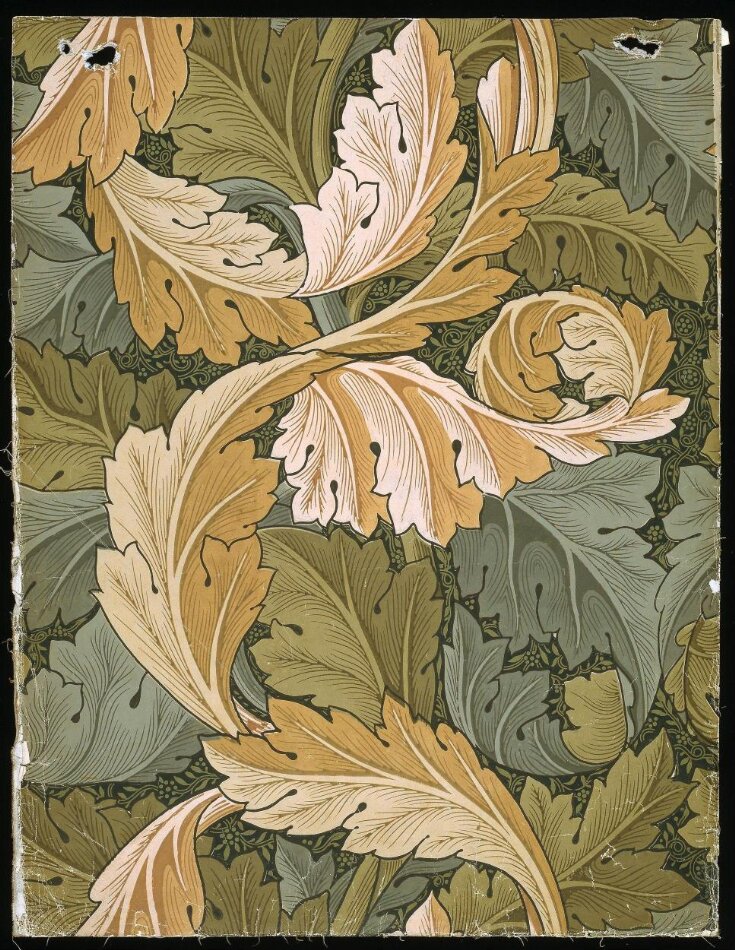
This wallpaper was printed for Morris's company by the London firm Jeffrey & Co., who specialised in high quality 'Art' wallpapers. It required thirty wood blocks to print the full repeat, and used fifteen subtly different colours (more than any previous design by Morris). 'Acanthus' was issued in two colour combinations - one in shades of green and the other in predominantly reddish-brown tones.
Ownership & Use
'Acanthus' is a large-scale repeat which would appear to be most appropriate for large rooms. However Morris believed that a large pattern actually worked well in a small room. He explained that if it was well designed, a large pattern was more restful to look at than a small one. By the 1880s Morris wallpapers had become fashionable. When the wealthy Mander family furnished their newly built house, Wightwick Manor near Wolverhampton, they used Morris wallpapers in 13 of the rooms. 'Acanthus' was hung in one of the bedrooms.
In Britain, paper printed with patterns has been used for decorating walls since the 16th century. By the late 19th century wallpapers were widely used by all classes, in homes and also in public buildings. William Morris designed a number of wallpapers all with repeating patterns based on natural forms.
Materials & Making
This wallpaper was printed for Morris's company by the London firm Jeffrey & Co., who specialised in high quality 'Art' wallpapers. It required thirty wood blocks to print the full repeat, and used fifteen subtly different colours (more than any previous design by Morris). 'Acanthus' was issued in two colour combinations - one in shades of green and the other in predominantly reddish-brown tones.
Ownership & Use
'Acanthus' is a large-scale repeat which would appear to be most appropriate for large rooms. However Morris believed that a large pattern actually worked well in a small room. He explained that if it was well designed, a large pattern was more restful to look at than a small one. By the 1880s Morris wallpapers had become fashionable. When the wealthy Mander family furnished their newly built house, Wightwick Manor near Wolverhampton, they used Morris wallpapers in 13 of the rooms. 'Acanthus' was hung in one of the bedrooms.
Delve deeper
Discover more about this object
Object details
| Categories | |
| Object type | |
| Title | Acanthus (manufacturer's title) |
| Materials and techniques | block-printed in distemper colours, on paper |
| Brief description | Specimen of 'Acanthus' wallpaper, foliate pattern of intertwined acanthus leaves in shades of green and brown; Block-printed in distemper colours, on paper; William Morris; Part of 'Volume 1', a pattern book containing 25 Morris & Co. patterns from 1862-81 (E.441-529-1919); England; 1875. |
| Physical description | Specimen of 'Acanthus' wallpaper, foliate pattern of intertwined acanthus leaves in shades of green; Block-printed in distemper colours, on paper; Inscribed on the back in ink with title, number and price. Part of 'Volume 1', a pattern book containing 25 Morris & Co. patterns from 1862-81 (E.441-529-1919) |
| Dimensions |
|
| Style | |
| Marks and inscriptions | (Inscribed on the back in ink with title, number and price.) |
| Gallery label | British Galleries:
This is an example of the finished wallpaper taken from the design on the left. It is printed with distemper colour and took thirty separate wood blocks to print the pattern. Consequently, it was expensive to buy, at 16s (80p) a roll. This large scale, dense, darkly coloured design is characteristic of patterns drawn by Morris in the mid-1870s.(27/03/2003) |
| Credit line | Given by Morris & Co. |
| Object history | The 'Acanthus' design requires thirty separate woodblocks to complete the pattern. Parry (see references) notes that: 'Acanthus was the first of a group of large-scale, heavily patterned and deep coloured papers: the others were Pimpernel (1876), Wreath (1876), Rose (1877) and Chrysanthemum (1877). The large size of this design requires thirty blocks to complete the pattern, making it an expensive paper costing 16s. a roll.' |
| Production | Part of 'Volume 1', a pattern book containing 25 Morris & Co. patterns from 1862-81 (E.441-529-1919). |
| Subjects depicted | |
| Summary | Object Type In Britain, paper printed with patterns has been used for decorating walls since the 16th century. By the late 19th century wallpapers were widely used by all classes, in homes and also in public buildings. William Morris designed a number of wallpapers all with repeating patterns based on natural forms. Materials & Making This wallpaper was printed for Morris's company by the London firm Jeffrey & Co., who specialised in high quality 'Art' wallpapers. It required thirty wood blocks to print the full repeat, and used fifteen subtly different colours (more than any previous design by Morris). 'Acanthus' was issued in two colour combinations - one in shades of green and the other in predominantly reddish-brown tones. Ownership & Use 'Acanthus' is a large-scale repeat which would appear to be most appropriate for large rooms. However Morris believed that a large pattern actually worked well in a small room. He explained that if it was well designed, a large pattern was more restful to look at than a small one. By the 1880s Morris wallpapers had become fashionable. When the wealthy Mander family furnished their newly built house, Wightwick Manor near Wolverhampton, they used Morris wallpapers in 13 of the rooms. 'Acanthus' was hung in one of the bedrooms. |
| Associated objects |
|
| Bibliographic references |
|
| Collection | |
| Accession number | E.496-1919 |
About this object record
Explore the Collections contains over a million catalogue records, and over half a million images. It is a working database that includes information compiled over the life of the museum. Some of our records may contain offensive and discriminatory language, or reflect outdated ideas, practice and analysis. We are committed to addressing these issues, and to review and update our records accordingly.
You can write to us to suggest improvements to the record.
Suggest feedback
You can write to us to suggest improvements to the record.
Suggest feedback
| Record created | March 27, 2003 |
| Record URL |
Download as: JSONIIIF Manifest
