Furniture Design
1806-1831 (made)
| Artist/Maker | |
| Place of origin |
Object Type
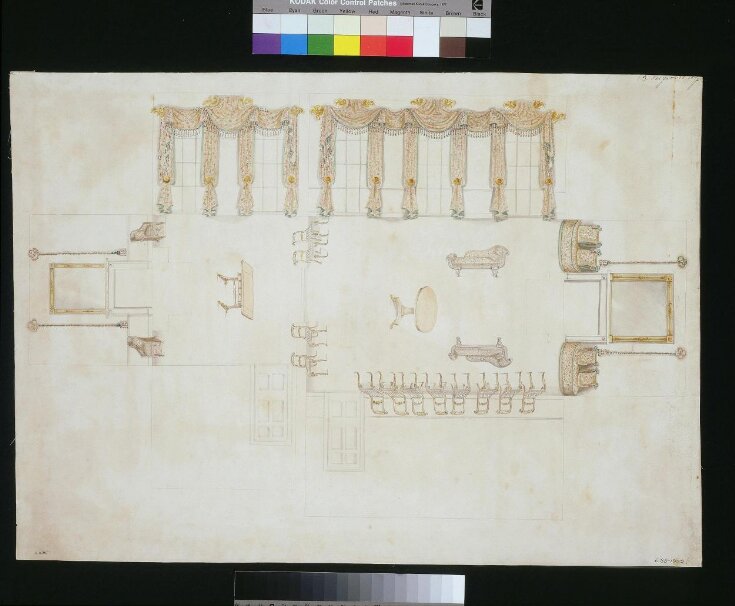
This design is typical example of the interiors executed by Gillow & Co. The flattened elevations of all four walls allow the whole room to be viewed together on one sheet. Producing a design in this form allowed the client to visualise the finished room. It also allowed the designers to create and place furniture within the room setting.
People
Gillow & Co. had many wealthy and famous clients. This design was undertaken for Sir Benjamin Heywood, a member of a Manchester banking family.
Design & Designing
These designs were intended to be shown to the customer. They would have been shown along with separate, more detailed sketches and designs of the individual pieces of furniture.
Trading
Gillow & Co. was originally founded in Lancaster in 1730. The London branch was opened in 1775. This drawing was produced by the London office. In the period 1813-1820 the Gillow family gradually withdrew from personal involvement with the business, and possibly this design was created after that phase. In 1897 Gillow & Co. merged with a Liverpool firm and they henceforth traded as Waring & Gillow.
This design is typical example of the interiors executed by Gillow & Co. The flattened elevations of all four walls allow the whole room to be viewed together on one sheet. Producing a design in this form allowed the client to visualise the finished room. It also allowed the designers to create and place furniture within the room setting.
People
Gillow & Co. had many wealthy and famous clients. This design was undertaken for Sir Benjamin Heywood, a member of a Manchester banking family.
Design & Designing
These designs were intended to be shown to the customer. They would have been shown along with separate, more detailed sketches and designs of the individual pieces of furniture.
Trading
Gillow & Co. was originally founded in Lancaster in 1730. The London branch was opened in 1775. This drawing was produced by the London office. In the period 1813-1820 the Gillow family gradually withdrew from personal involvement with the business, and possibly this design was created after that phase. In 1897 Gillow & Co. merged with a Liverpool firm and they henceforth traded as Waring & Gillow.
Object details
| Categories | |
| Object type | |
| Materials and techniques | Drawing in pen and ink, and watercolour |
| Brief description | Design, from a set of 94, for furniture and interiors, made in the studio of Gillow & Co., London, 1806-1831. |
| Physical description | Design for the furniture and interior decoration of a room, with elevations of the walls and details of woodwork, curtains etc. |
| Dimensions |
|
| Marks and inscriptions |
|
| Gallery label | British Galleries:
This watercolour is an example of the complete interior design service offered by the large-scale furniture manufacturer, Gillow & Co. It was produced for the Manchester banker and philanthropist, Sir Benjamin Heywood (1793-1865). Although originally based in Lancaster, Gillows increasingly ran their business through their London showroom in Oxford Street.(27/03/2003) |
| Credit line | Given by the directors of Messrs Waring and Gillow Ltd. |
| Subjects depicted | |
| Summary | Object Type This design is typical example of the interiors executed by Gillow & Co. The flattened elevations of all four walls allow the whole room to be viewed together on one sheet. Producing a design in this form allowed the client to visualise the finished room. It also allowed the designers to create and place furniture within the room setting. People Gillow & Co. had many wealthy and famous clients. This design was undertaken for Sir Benjamin Heywood, a member of a Manchester banking family. Design & Designing These designs were intended to be shown to the customer. They would have been shown along with separate, more detailed sketches and designs of the individual pieces of furniture. Trading Gillow & Co. was originally founded in Lancaster in 1730. The London branch was opened in 1775. This drawing was produced by the London office. In the period 1813-1820 the Gillow family gradually withdrew from personal involvement with the business, and possibly this design was created after that phase. In 1897 Gillow & Co. merged with a Liverpool firm and they henceforth traded as Waring & Gillow. |
| Bibliographic reference | Victoria and Albert Museum Department of Prints and Drawings and Department of Paintings, Accessions 1952. London: HMSO, 1963. |
| Collection | |
| Accession number | E.35-1952 |
About this object record
Explore the Collections contains over a million catalogue records, and over half a million images. It is a working database that includes information compiled over the life of the museum. Some of our records may contain offensive and discriminatory language, or reflect outdated ideas, practice and analysis. We are committed to addressing these issues, and to review and update our records accordingly.
You can write to us to suggest improvements to the record.
Suggest feedback
You can write to us to suggest improvements to the record.
Suggest feedback
| Record created | March 27, 2003 |
| Record URL |
Download as: JSONIIIF Manifest
