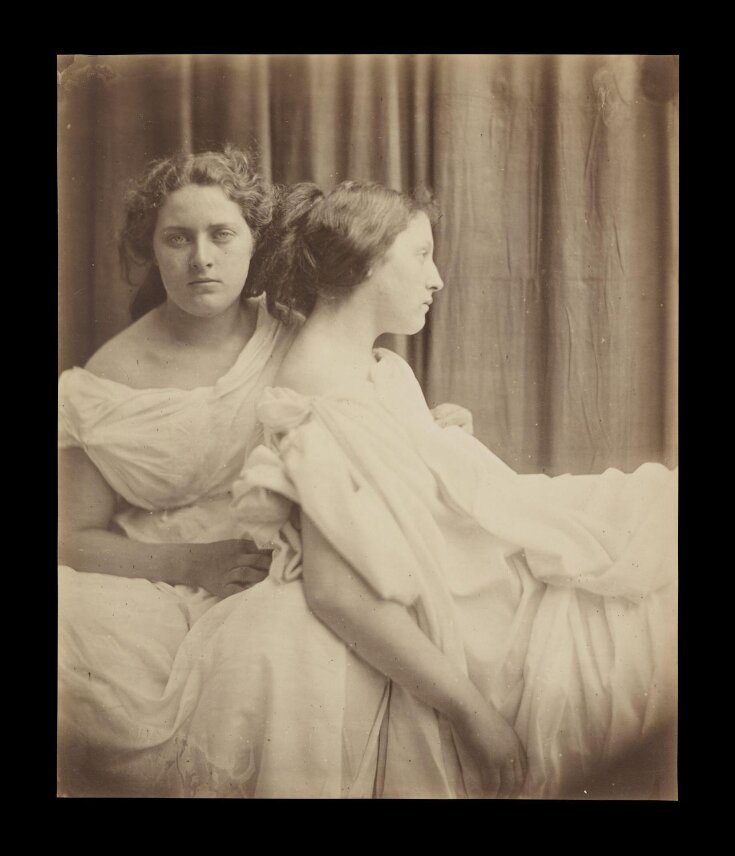

2d. Version of Study after the Elgin Marbles
Photograph
1867 (photographed)
1867 (photographed)
| Artist/Maker | |
| Place of origin |
Just as she modelled her Madonna photographs on Renaissance art, Julia Margaret Cameron looked to painting and sculpture as inspiration for her allegorical and narrative subjects. Some works are photographic interpretations of specific paintings by artists such as Raphael and Michelangelo. Others aspired more generally to create ‘Pictorial Effect’.
Cameron's harshest critics attacked her for using the supposedly truthful medium of photography to depict imaginary subject matter. Some suggested that at best her photographs could serve as studies for painters. The South Kensington Museum, however, purchased only 'Madonnas' and 'Fancy Subjects', and exhibited them as pictures in their own right.
Cameron's harshest critics attacked her for using the supposedly truthful medium of photography to depict imaginary subject matter. Some suggested that at best her photographs could serve as studies for painters. The South Kensington Museum, however, purchased only 'Madonnas' and 'Fancy Subjects', and exhibited them as pictures in their own right.
Object details
| Categories | |
| Object type | |
| Title | 2d. Version of Study after the Elgin Marbles (assigned by artist) |
| Materials and techniques | Albumen print from wet collodion glass negative |
| Brief description | Photograph by Julia Margaret Cameron, '2d. Version of Study after the Elgin Marbles' (sitters Cyllena Wilson, Mary Hillier), albumen print, 1867 |
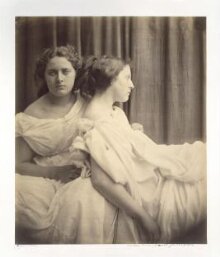
| Physical description | A photograph of two seated woman, in flowing light coloured dresses, one facing the camera (Cyllena Wilson), the other (Mary Hillier) in profile, leaning against her. |
| Dimensions |
|
| Style | |
| Gallery label |
|
| Credit line | Nevinson Bequest, 1990 |
| Object history | Julia Margaret Cameron's career as a photographer began in 1863 when her daughter gave her a camera. Cameron began photographing everyone in sight. Because of the newness of photography as a practice, she was free to make her own rules and not be bound to convention. The kinds of images being made at the time did not interest Cameron. She was interested in capturing another kind of photographic truth. Not one dependent on accuracy of sharp detail, but one that depicted the emotional state of her sitter. Cameron liked the soft focus portraits and the streak marks on her negatives, choosing to work with these irregularities, making them part of her pictures. Although at the time Cameron was seen as an unconventional and experimental photographer, her images have a solid place in the history of photography. Most of Cameron's photographs are portraits. She used members of her family as sitters and made photographs than concentrated on their faces. She was interested in conveying their natural beauty, often asking female sitters to let down their hair so as to show them in a way that they were not accustomed to presenting themselves. In addition to making stunning and evocative portraits both of male and female subjects, Cameron also staged tableaux and posed her sitters in situations that simulated allegorical paintings. |
| Subjects depicted | |
| Summary | Just as she modelled her Madonna photographs on Renaissance art, Julia Margaret Cameron looked to painting and sculpture as inspiration for her allegorical and narrative subjects. Some works are photographic interpretations of specific paintings by artists such as Raphael and Michelangelo. Others aspired more generally to create ‘Pictorial Effect’. Cameron's harshest critics attacked her for using the supposedly truthful medium of photography to depict imaginary subject matter. Some suggested that at best her photographs could serve as studies for painters. The South Kensington Museum, however, purchased only 'Madonnas' and 'Fancy Subjects', and exhibited them as pictures in their own right. |
| Bibliographic reference | Cox, Julian and Colin Ford, with contributions by Joanne Lukitsh and Philippa Wright. Julia Margaret Cameron: The Complete Photographs. London: Thames & Hudson, in association with The J. Paul Getty Museum, Los Angeles and The National Museum of Photography, Film & Television, Bradford, 2003. ISBN: 0-500-54265-1
Cat. no. 1111, p. 454 |
| Collection | |
| Accession number | E.2745-1990 |
About this object record
Explore the Collections contains over a million catalogue records, and over half a million images. It is a working database that includes information compiled over the life of the museum. Some of our records may contain offensive and discriminatory language, or reflect outdated ideas, practice and analysis. We are committed to addressing these issues, and to review and update our records accordingly.
You can write to us to suggest improvements to the record.
Suggest feedback
You can write to us to suggest improvements to the record.
Suggest feedback
| Record created | March 27, 2003 |
| Record URL |
Download as: JSONIIIF Manifest
