Arms of Tudors
Panel
ca. 1540 (made)
ca. 1540 (made)
| Artist/Maker | |
| Place of origin |
Object Type
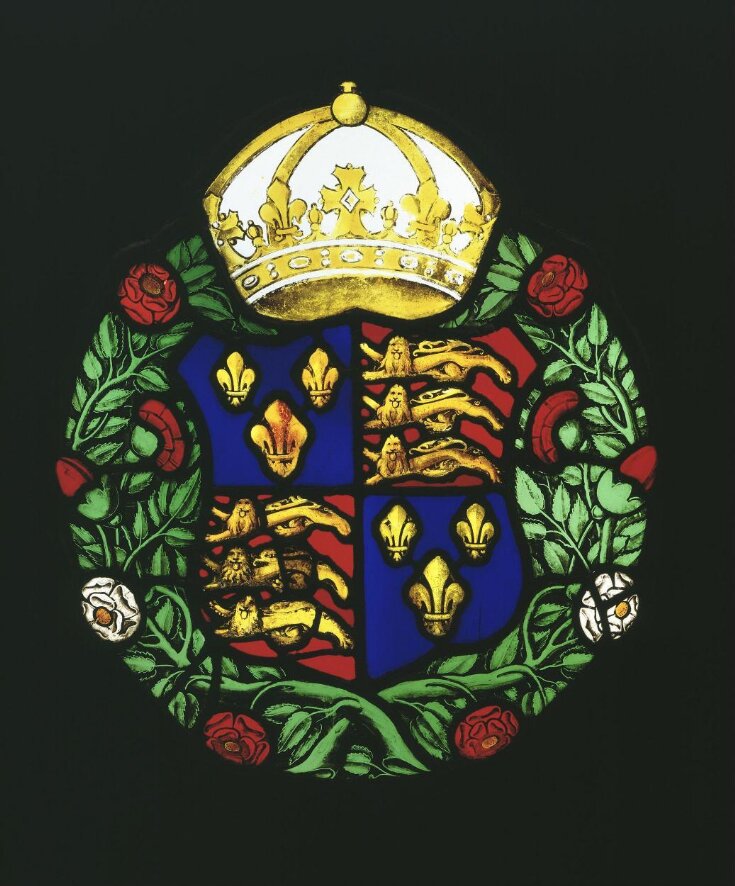
Encircled by a wreath of red and white roses (for the houses of York and Lancaster) and surmounted by the crown of England, this roundel displays the Tudor arms. It is thought to have come from the house at Cowick Barton in Devon, built by John Russell, 1st Earl of Bedford (1485-1555). The royal coat of arms was widely represented in windows of the period, both in the monarch's own residences and in those of his subjects, who sought to advertise their allegiance to the Crown in this way.
People
Russell was a favourite of Henry VIII, serving as the King's mediator and as commander of his armies during the wars with France. His allegiance to the King was further evident on Henry VIII's death, when Russell acted as one of the executors of the monarch's will. Created Earl in 1550 by Edward VI (ruled 1547-1553), Russell later served as Lord High Steward and Keeper of the Privy Seal.
Materials & Making
During Henry VIII's reign (1509-47) glaziers still used true stained glass, cutting and leading it together in complex heraldic designs. Here the golden fleurs-de-lis, made from clear glass painted with a silver stain, have been inserted into intricate holes drilled through the blue ground. 'Flashed' ruby glass (clear glass covered with a red glass layer which was then scratched to reveal the white below) has also been used. This in turn was sometimes painted, as can be seen in the centres of the roses.
Encircled by a wreath of red and white roses (for the houses of York and Lancaster) and surmounted by the crown of England, this roundel displays the Tudor arms. It is thought to have come from the house at Cowick Barton in Devon, built by John Russell, 1st Earl of Bedford (1485-1555). The royal coat of arms was widely represented in windows of the period, both in the monarch's own residences and in those of his subjects, who sought to advertise their allegiance to the Crown in this way.
People
Russell was a favourite of Henry VIII, serving as the King's mediator and as commander of his armies during the wars with France. His allegiance to the King was further evident on Henry VIII's death, when Russell acted as one of the executors of the monarch's will. Created Earl in 1550 by Edward VI (ruled 1547-1553), Russell later served as Lord High Steward and Keeper of the Privy Seal.
Materials & Making
During Henry VIII's reign (1509-47) glaziers still used true stained glass, cutting and leading it together in complex heraldic designs. Here the golden fleurs-de-lis, made from clear glass painted with a silver stain, have been inserted into intricate holes drilled through the blue ground. 'Flashed' ruby glass (clear glass covered with a red glass layer which was then scratched to reveal the white below) has also been used. This in turn was sometimes painted, as can be seen in the centres of the roses.
Object details
| Categories | |
| Object type | |
| Titles |
|
| Materials and techniques | Clear, coloured and flashed glass |
| Brief description | Panel of clear, coloured and flashed glass painted with brown/black pigment and silver stain. Portraying the arms of the Tudors as borne by Henry VIII and Edward VI. English, about 1540. |
| Physical description | Roundel of clear, coloured and flashed glass painted in brown/black pigment and silver stain. The Tudor arms displayed in colours proper and surmounted by a crown with crosses-patee alternating with fleur de lys and with an orb and cross atop, the latter executed in brown/black pigment and silver stain on clear glass. The arms are surrounded by a wreath of green glass which includes the roses of Lancaster and York executed in red flashed and clear glass; details added to both in brown/black pigment. |
| Dimensions |
|
| Gallery label | British Galleries:
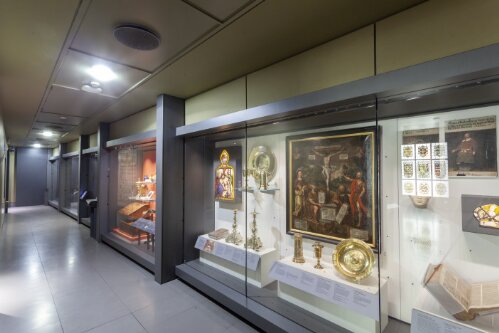
Royal arms were not confined to royal palaces or used only on royal objects. In many instances the display of the monarch's arms was a sign of gratitude for royal patronage. In an age of growing nationalism, the royal arms also acted as a symbol of national loyalty and pride, in much the same way as flags do today.(27/03/2003) |
| Object history | Said to have come from Cowick Priory - information supplied by last owner, Arthur Radford, who acquired the panel from the collection of Richard and Albert Lucas and who suggests that the collection was begun in the early decades of the 19th century. Nothing of the Priory survives. It was dissolved in 1538/9 and the manor and its holdings were granted to Sir John Russell who became Baron Russell, was appointed Lord President of the Council of the West and was made a knight of the garter in that same year. Cowick Barton, an Elizabethan mansion in outward form (now a pub), was erected on the lands formerly held by Cowick Priory. It is believed that the mansion was built in 1540 and by John Russell. It is possible that Cowick Barton was originally one of the priory buildings and was rebuilt around 1540 by John Russell. It would be expected practice to include armorials in the glazing. This panel was one of 6 English heraldic panels bought from Radford's stained glass collection. It was purchased for 100 pounds. |
| Associations | |
| Summary | Object Type Encircled by a wreath of red and white roses (for the houses of York and Lancaster) and surmounted by the crown of England, this roundel displays the Tudor arms. It is thought to have come from the house at Cowick Barton in Devon, built by John Russell, 1st Earl of Bedford (1485-1555). The royal coat of arms was widely represented in windows of the period, both in the monarch's own residences and in those of his subjects, who sought to advertise their allegiance to the Crown in this way. People Russell was a favourite of Henry VIII, serving as the King's mediator and as commander of his armies during the wars with France. His allegiance to the King was further evident on Henry VIII's death, when Russell acted as one of the executors of the monarch's will. Created Earl in 1550 by Edward VI (ruled 1547-1553), Russell later served as Lord High Steward and Keeper of the Privy Seal. Materials & Making During Henry VIII's reign (1509-47) glaziers still used true stained glass, cutting and leading it together in complex heraldic designs. Here the golden fleurs-de-lis, made from clear glass painted with a silver stain, have been inserted into intricate holes drilled through the blue ground. 'Flashed' ruby glass (clear glass covered with a red glass layer which was then scratched to reveal the white below) has also been used. This in turn was sometimes painted, as can be seen in the centres of the roses. |
| Bibliographic reference | See Object Information File in Ceramics & Glass Office
|
| Collection | |
| Accession number | C.452-1919 |
About this object record
Explore the Collections contains over a million catalogue records, and over half a million images. It is a working database that includes information compiled over the life of the museum. Some of our records may contain offensive and discriminatory language, or reflect outdated ideas, practice and analysis. We are committed to addressing these issues, and to review and update our records accordingly.
You can write to us to suggest improvements to the record.
Suggest feedback
You can write to us to suggest improvements to the record.
Suggest feedback
| Record created | June 8, 1998 |
| Record URL |
Download as: JSONIIIF Manifest
