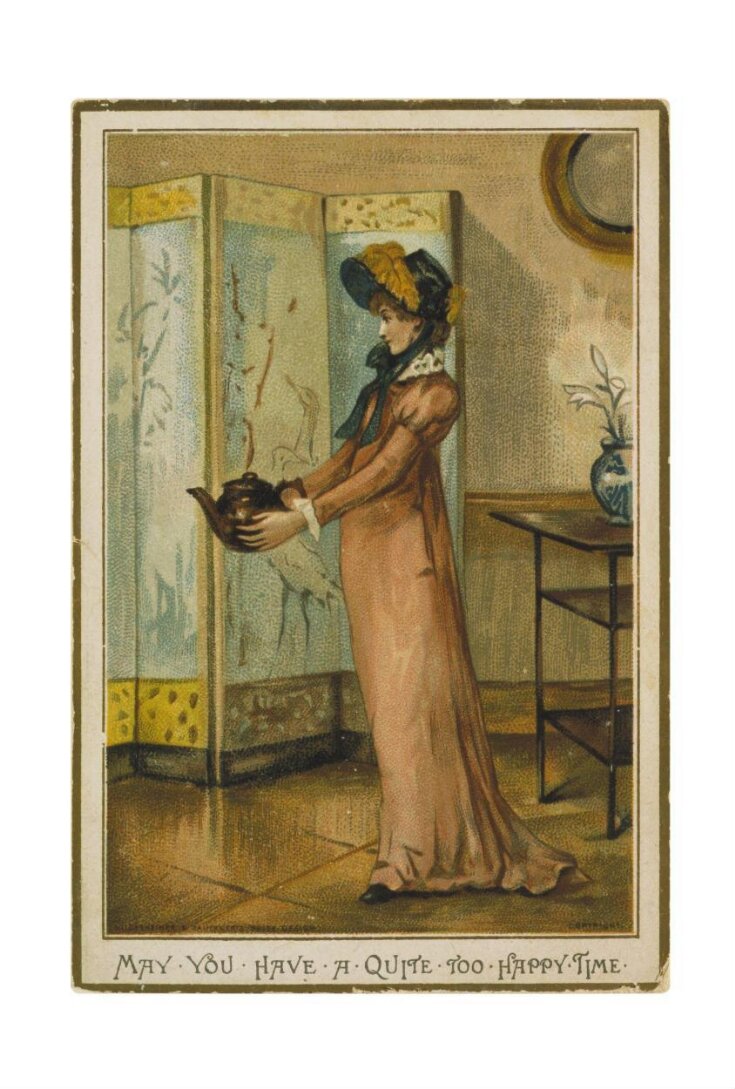

May you have a Quite Too Happy Time
Christmas Card
1881 (made)
1881 (made)
| Artist/Maker | |
| Place of origin |
Object Type
This card is one of a series of prize-winning greetings cards printed by colour lithography.
Time
The set of cards of which this is a part parodied the Aesthetic Movement, with its followers' love of Chinese and Japanese objects and certain plants, such as lilies and sunflowers. Their fascination with tea pots was satirised in particular. George du Maurier drew a number of cartoons satirising the Aesthetic Movement for 'Punch' magazine, including a cartoon entitled 'The Six-Mark Teapot'. In it, the 'Aesthetic Bridegroom' and his 'Intense Bride' are looking at a teapot. He declares 'It is quite consummate, is it not?' and she replies 'It is, indeed! Oh, Algernon, let us live up to it!'. Similarly in the contemporary play by F.C. Burnand, 'The Colonel', the leading character says, 'There is so much to be learned from a teapot'.
People
This is from a set of prize-winning designs by Albert Ludovici II (1852-1932). A number of printers awarded annual prizes for novel greeting card designs in order to acquire new designs for their next season's collection.
This card is one of a series of prize-winning greetings cards printed by colour lithography.
Time
The set of cards of which this is a part parodied the Aesthetic Movement, with its followers' love of Chinese and Japanese objects and certain plants, such as lilies and sunflowers. Their fascination with tea pots was satirised in particular. George du Maurier drew a number of cartoons satirising the Aesthetic Movement for 'Punch' magazine, including a cartoon entitled 'The Six-Mark Teapot'. In it, the 'Aesthetic Bridegroom' and his 'Intense Bride' are looking at a teapot. He declares 'It is quite consummate, is it not?' and she replies 'It is, indeed! Oh, Algernon, let us live up to it!'. Similarly in the contemporary play by F.C. Burnand, 'The Colonel', the leading character says, 'There is so much to be learned from a teapot'.
People
This is from a set of prize-winning designs by Albert Ludovici II (1852-1932). A number of printers awarded annual prizes for novel greeting card designs in order to acquire new designs for their next season's collection.
Object details
| Categories | |
| Object type | |
| Titles |
|
| Materials and techniques | Colour lithograph on card |
| Brief description | Albert Ludovici. An aesthetic lady with a teapot. One of four cards from the "Quite too-too!" set, published by Hildesheimer & Faulkner, London, 1881. |
| Physical description | Satirical card showing an aesthete in artistic dress. A woman in a terracotta-pink dress with high waist and puffed sleeves and black satin poke-bonnet with orange feathers holding a big brown teapot. Behind her, a Japanese four-fold screen with cranes painted on it and a blue and white porcelain vase with lilies on a table. |
| Dimensions |
|
| Gallery label | British Galleries:
GREETINGS CARDS caricaturing the Aesthetic style Inexpensive printed cards with Aesthetic themes like these show how widely recognised the movement had become by the 1880s. In one, the title and the pose of the young man ridicule the intensity of emotions associated with such individuals as Oscar Wilde. In the other, the importance of art for its own sake is made fun of with the woman's intense interest in an everyday object, a teapot. Her fashionable clothing shows the influence of classical dress.(27/03/2003) |
| Credit line | Bequeathed by Guy Tristram Little |
| Object history | Designed by Albert Ludovici, II (born in Prague,1852, died in1932); printed and published by Hildesheimer & Faulkner, London Designed by Albert Ludovici, II (born in Prague, 1852, died in 1932); printed and published by Hildesheimer & Faulkner, London |
| Summary | Object Type This card is one of a series of prize-winning greetings cards printed by colour lithography. Time The set of cards of which this is a part parodied the Aesthetic Movement, with its followers' love of Chinese and Japanese objects and certain plants, such as lilies and sunflowers. Their fascination with tea pots was satirised in particular. George du Maurier drew a number of cartoons satirising the Aesthetic Movement for 'Punch' magazine, including a cartoon entitled 'The Six-Mark Teapot'. In it, the 'Aesthetic Bridegroom' and his 'Intense Bride' are looking at a teapot. He declares 'It is quite consummate, is it not?' and she replies 'It is, indeed! Oh, Algernon, let us live up to it!'. Similarly in the contemporary play by F.C. Burnand, 'The Colonel', the leading character says, 'There is so much to be learned from a teapot'. People This is from a set of prize-winning designs by Albert Ludovici II (1852-1932). A number of printers awarded annual prizes for novel greeting card designs in order to acquire new designs for their next season's collection. |
| Bibliographic reference | Victoria and Albert Museum Department of Prints and Drawings and Department of Paintings Accessions 1953 London: HMSO, 1963 |
| Collection | |
| Accession number | E.2415-1953 |
About this object record
Explore the Collections contains over a million catalogue records, and over half a million images. It is a working database that includes information compiled over the life of the museum. Some of our records may contain offensive and discriminatory language, or reflect outdated ideas, practice and analysis. We are committed to addressing these issues, and to review and update our records accordingly.
You can write to us to suggest improvements to the record.
Suggest feedback
You can write to us to suggest improvements to the record.
Suggest feedback
| Record created | March 27, 2003 |
| Record URL |
Download as: JSONIIIF Manifest
