Trade Card
1738 (made)
| Artist/Maker | |
| Place of origin |
Object Type
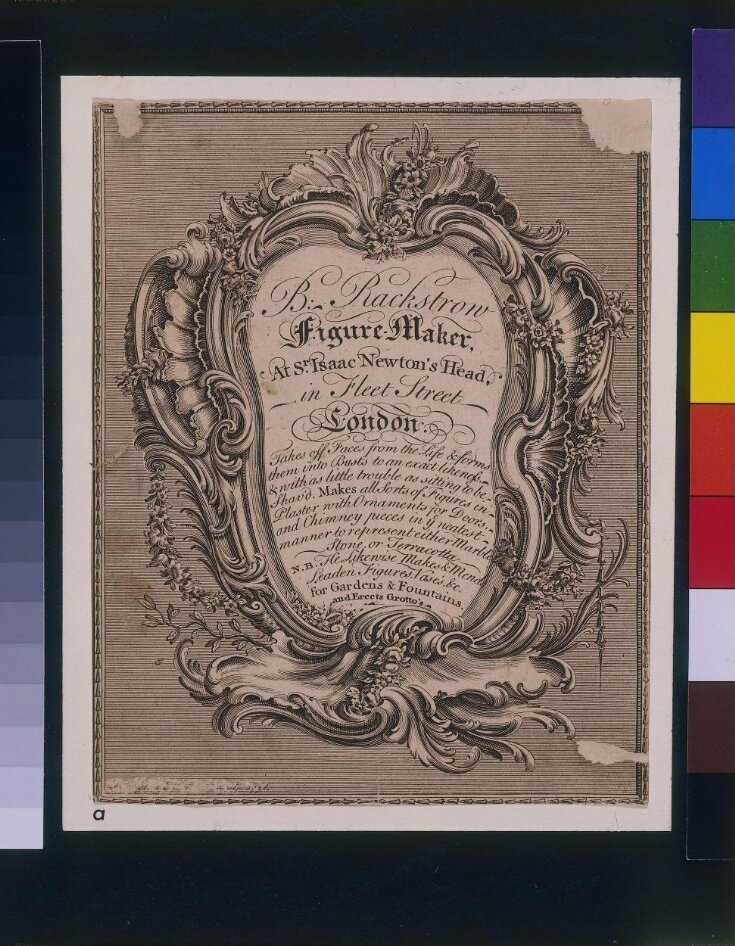
This is a trade card, a form of self-publicity that was widely used by tradesmen during the 18th century. They were known as 'shopkeepers' bills'. They were generally etched, that is the design was drawn onto a coated metal plate with an etching needle and then etched into the plate by immersion in an acid bath. The plate was then coated with ink, wiped (so that only the ink in the grooves was retained) and then pressed onto a sheet of paper to transfer the image.
People
Henry Copland (died 1753) was trained to engrave in goldsmiths' workshops, and was therefore able to engrave on gold or silver objects as well as on metal printing plates. During the Rococo period there was a close relationship between the style of trade cards and also pattern books and decorative art objects, such as furniture and metalwork. Copland is seen as particularly influential in the development of a distinctly English Rococo style, and this trade card is one of the earliest examples. The form of the cartouche recurs in many trade cards and examples of engraved metalwork in the 1740s.
There are two forms of this trade card, which differ in the description of Benjamin Rackstrow's profession. The other card describes him as a 'Cabinet and Picture-frame maker'. Here Rackstrow is described as a sculptor of portrait busts, as well as a creator of plaster decoration for interiors and lead sculptures for gardens.
This is a trade card, a form of self-publicity that was widely used by tradesmen during the 18th century. They were known as 'shopkeepers' bills'. They were generally etched, that is the design was drawn onto a coated metal plate with an etching needle and then etched into the plate by immersion in an acid bath. The plate was then coated with ink, wiped (so that only the ink in the grooves was retained) and then pressed onto a sheet of paper to transfer the image.
People
Henry Copland (died 1753) was trained to engrave in goldsmiths' workshops, and was therefore able to engrave on gold or silver objects as well as on metal printing plates. During the Rococo period there was a close relationship between the style of trade cards and also pattern books and decorative art objects, such as furniture and metalwork. Copland is seen as particularly influential in the development of a distinctly English Rococo style, and this trade card is one of the earliest examples. The form of the cartouche recurs in many trade cards and examples of engraved metalwork in the 1740s.
There are two forms of this trade card, which differ in the description of Benjamin Rackstrow's profession. The other card describes him as a 'Cabinet and Picture-frame maker'. Here Rackstrow is described as a sculptor of portrait busts, as well as a creator of plaster decoration for interiors and lead sculptures for gardens.
Object details
| Categories | |
| Object type | |
| Materials and techniques | Engraving, ink on paper |
| Brief description | Trade card of Benjamin Rackstrow, figure maker |
| Physical description | Trade card |
| Dimensions |
|
| Marks and inscriptions | Lettered 'B. Rackstrow Figure-Maker, At Sr. Isaac Newton's Head, in Fleet Street London. Takes off Faces from the Life & forms them into Busts to an exact likeness, & with as little trouble as sitting to be Shav'd. makes all Sorts of Figures in Plaster with Ornaments for Doors, and Chimney pieces in ye neatest manner to represent either Marble, Stone, or Terracotta NB. He Llikewise Makes & Mends Leaden Figures, Vases, &c, for Gardens & Fountains. and Erects Grotto's'
|
| Gallery label | British Galleries:
This is the earliest known dated Rococo trade card. The dynamic frame, with its vigorous, scrolled surround, fluttering leaves and outcrops of rockwork or 'rocaille', is close to Hubert Gravelot's ornamental manner. The later work of this engraver, Henry Copland, is in a more agitated, spikey style.(27/03/2003) |
| Object history | Engraved in London by Henry Copland (died in 1753) |
| Production | Dated 1738 |
| Summary | Object Type This is a trade card, a form of self-publicity that was widely used by tradesmen during the 18th century. They were known as 'shopkeepers' bills'. They were generally etched, that is the design was drawn onto a coated metal plate with an etching needle and then etched into the plate by immersion in an acid bath. The plate was then coated with ink, wiped (so that only the ink in the grooves was retained) and then pressed onto a sheet of paper to transfer the image. People Henry Copland (died 1753) was trained to engrave in goldsmiths' workshops, and was therefore able to engrave on gold or silver objects as well as on metal printing plates. During the Rococo period there was a close relationship between the style of trade cards and also pattern books and decorative art objects, such as furniture and metalwork. Copland is seen as particularly influential in the development of a distinctly English Rococo style, and this trade card is one of the earliest examples. The form of the cartouche recurs in many trade cards and examples of engraved metalwork in the 1740s. There are two forms of this trade card, which differ in the description of Benjamin Rackstrow's profession. The other card describes him as a 'Cabinet and Picture-frame maker'. Here Rackstrow is described as a sculptor of portrait busts, as well as a creator of plaster decoration for interiors and lead sculptures for gardens. |
| Collection | |
| Accession number | E.1646-1907 |
About this object record
Explore the Collections contains over a million catalogue records, and over half a million images. It is a working database that includes information compiled over the life of the museum. Some of our records may contain offensive and discriminatory language, or reflect outdated ideas, practice and analysis. We are committed to addressing these issues, and to review and update our records accordingly.
You can write to us to suggest improvements to the record.
Suggest feedback
You can write to us to suggest improvements to the record.
Suggest feedback
| Record created | March 27, 2003 |
| Record URL |
Download as: JSONIIIF Manifest
