
Wallpaper
1848 (made)
| Artist/Maker | |
| Place of origin |
Object Type
In Britain, paper printed with patterns has been used for decorating walls since the 16th century. By the late 19th century wallpapers were widely used by all classes, in homes and also in public buildings.
Places
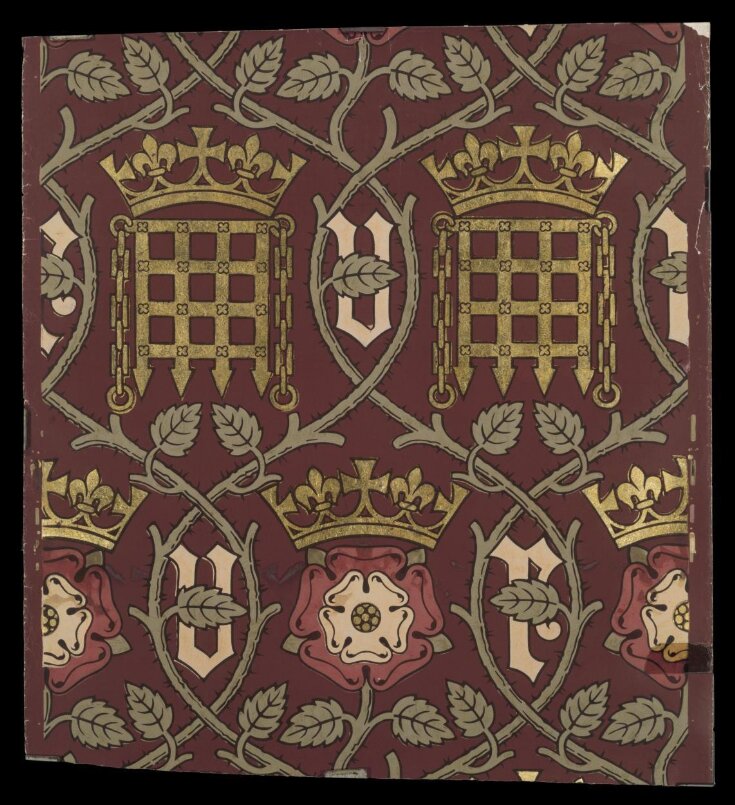
This wallpaper was designed especially for the Palace of Westminster. The pattern incorporates references to its purpose. The crowned portcullis is the symbol for the Palace, and the crowned flower is the Tudor rose, a Royal emblem. The letters 'V' and 'R' stand for Victoria Regina - Queen Victoria. The design was intended to symbolise the authority of Crown and Parliament.
Design & Designing
A.W.N. Pugin (1812-1852) was responsible for the design of almost all the furnishings of the Palace of Westminster, including more than a hundred wallpapers.Pugin was a leading design reformer. He held strong views on what was appropriate in the decoration of domestic furnishings. In particular he believed that flat surfaces such as walls should be decorated only with flat patterns, and not patterns that gave the illusion of depth and substance.
In Britain, paper printed with patterns has been used for decorating walls since the 16th century. By the late 19th century wallpapers were widely used by all classes, in homes and also in public buildings.
Places
This wallpaper was designed especially for the Palace of Westminster. The pattern incorporates references to its purpose. The crowned portcullis is the symbol for the Palace, and the crowned flower is the Tudor rose, a Royal emblem. The letters 'V' and 'R' stand for Victoria Regina - Queen Victoria. The design was intended to symbolise the authority of Crown and Parliament.
Design & Designing
A.W.N. Pugin (1812-1852) was responsible for the design of almost all the furnishings of the Palace of Westminster, including more than a hundred wallpapers.Pugin was a leading design reformer. He held strong views on what was appropriate in the decoration of domestic furnishings. In particular he believed that flat surfaces such as walls should be decorated only with flat patterns, and not patterns that gave the illusion of depth and substance.
Delve deeper
Discover more about this object

Object details
| Categories | |
| Object type | |
| Materials and techniques | Colour woodblock print, on paper |
| Brief description | Unused portion of a wallpaper, with a pattern of the Tudor rose and portcullis, and the initials 'VR'; gold, brown and red on a dark-red ground; Colour woodblock print, on paper; Designed by A. W. N. Pugin for the Houses of Parliament; Produced by Samuel Scott for J. G. Crace; England; 1848. |
| Physical description | Unused portion of a wallpaper, with a pattern of the Tudor rose and portcullis, and the initials VR; gold, brown and red on a dark-red ground; Colour woodblock print, on paper. |
| Dimensions |
|
| Marks and inscriptions | Coles 0147 (Inscribed in ink on the back.) |
| Gallery label | British Galleries:
This striking design is typical of A.W.N. Pugin's bold wallpaper patterns. The crowned portcullis is the symbol for the Palace of Westminster and the crowned flower is the Tudor rose. The letters 'V' and 'R' stand for Victoria Regina - Queen Victoria.(27/03/2003) |
| Credit line | Given by Cole & Son (Wallpapers) Ltd. |
| Object history | Given by Cole & Son (Wallpapers) Ltd. Designed by A.W. N. Pugin (born in London, 1812, died in Ramsgate, Kent, 1852); manufactured in London by Samuel Scott, for the firm of J.G. Crace. Designed for use in the Houses of Parliament. |
| Production | Designed for use in the Houses of Parliament. |
| Subjects depicted | |
| Association | |
| Summary | Object Type In Britain, paper printed with patterns has been used for decorating walls since the 16th century. By the late 19th century wallpapers were widely used by all classes, in homes and also in public buildings. Places This wallpaper was designed especially for the Palace of Westminster. The pattern incorporates references to its purpose. The crowned portcullis is the symbol for the Palace, and the crowned flower is the Tudor rose, a Royal emblem. The letters 'V' and 'R' stand for Victoria Regina - Queen Victoria. The design was intended to symbolise the authority of Crown and Parliament. Design & Designing A.W.N. Pugin (1812-1852) was responsible for the design of almost all the furnishings of the Palace of Westminster, including more than a hundred wallpapers.Pugin was a leading design reformer. He held strong views on what was appropriate in the decoration of domestic furnishings. In particular he believed that flat surfaces such as walls should be decorated only with flat patterns, and not patterns that gave the illusion of depth and substance. |
| Associated object | D.719-1908 (Design) |
| Bibliographic references |
|
| Collection | |
| Accession number | E.150-1976 |
About this object record
Explore the Collections contains over a million catalogue records, and over half a million images. It is a working database that includes information compiled over the life of the museum. Some of our records may contain offensive and discriminatory language, or reflect outdated ideas, practice and analysis. We are committed to addressing these issues, and to review and update our records accordingly.
You can write to us to suggest improvements to the record.
Suggest feedback
You can write to us to suggest improvements to the record.
Suggest feedback
| Record created | March 27, 2003 |
| Record URL |
Download as: JSONIIIF Manifest
