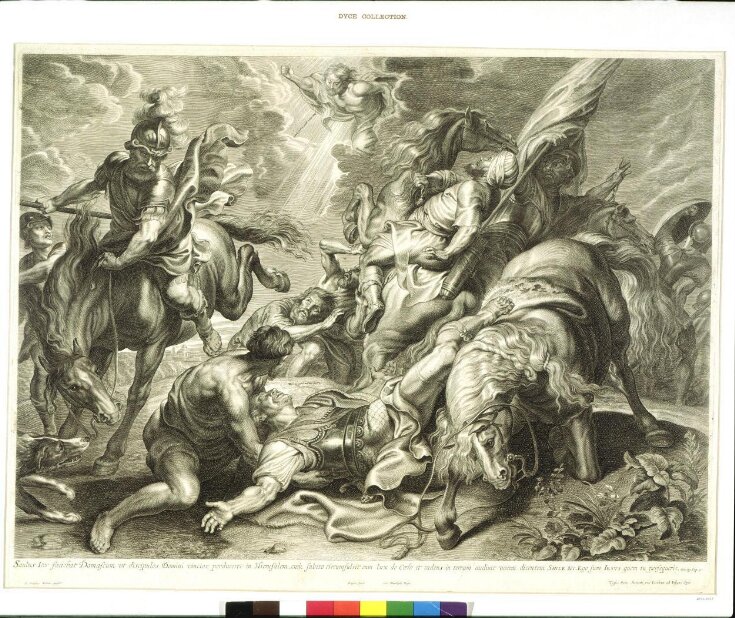
Conversion of St. Paul
Engraving
1650-70 (made)
1650-70 (made)
| Artist/Maker | |
| Place of origin |
Object Type
This is a print of a type known as an engraving. The image is made by cutting lines into the surface of a flat piece of metal, inking the plate and then transferring the ink held in the lines onto a sheet of paper.
Source
The print is entitled The Conversion of Saint Paul. It is a copy of another engraving based on a painting by the Flemish artist Peter Paul Rubens. The original oil painting dates from around 1621, and the V&A print was made sometime between then and 1657, when the publisher, Pierre Mariette, died.
The painting was in Berlin but was destroyed during the Second World War. An oil sketch of the same subject but with some differences in the composition, is in the collection of the Ashmolean Museum in Oxford.
Subject Depicted
This print depicts a dramatic event in the life of the apostle Paul described the Bible (Acts 9:1-9). Paul was Jewish by race but inherited Roman citizenship from his father. He was riding to Damascus to obtain authorisation from the synagogue to arrest Christians when he was blinded by a light from heaven, which also caused him to fall to the ground. He and his companions heard the voice of God asking him why he was persecuting Christians. Paul was later baptised as a Christian, and together with Peter, was seen as one of the joint founders of the Christian Church.
This is a print of a type known as an engraving. The image is made by cutting lines into the surface of a flat piece of metal, inking the plate and then transferring the ink held in the lines onto a sheet of paper.
Source
The print is entitled The Conversion of Saint Paul. It is a copy of another engraving based on a painting by the Flemish artist Peter Paul Rubens. The original oil painting dates from around 1621, and the V&A print was made sometime between then and 1657, when the publisher, Pierre Mariette, died.
The painting was in Berlin but was destroyed during the Second World War. An oil sketch of the same subject but with some differences in the composition, is in the collection of the Ashmolean Museum in Oxford.
Subject Depicted
This print depicts a dramatic event in the life of the apostle Paul described the Bible (Acts 9:1-9). Paul was Jewish by race but inherited Roman citizenship from his father. He was riding to Damascus to obtain authorisation from the synagogue to arrest Christians when he was blinded by a light from heaven, which also caused him to fall to the ground. He and his companions heard the voice of God asking him why he was persecuting Christians. Paul was later baptised as a Christian, and together with Peter, was seen as one of the joint founders of the Christian Church.
Object details
| Categories | |
| Object type | |
| Title | Conversion of St. Paul (generic title) |
| Materials and techniques | engraving print on paper |
| Brief description | Conversion of St. Paul; From the picture by Rubens in the Pinakothek at Munich; A copy of the print by Schelte Bolswert, see DYCE.2265; Engraving print on paper; By François Ragot; Published by Pierre Mariette (I); Paris; 1650-70. |
| Physical description | Conversion of St. Paul; From the picture by Rubens in the Pinakothek at Munich; A copy of the print by Schelte Bolswert, see DYCE.2265; Engraving print on paper; Signed 'Ragot fecit cum Priuilegio Regis'. |
| Dimensions |
|
| Marks and inscriptions | 'Ragot fecit cum Priuilegio Regis' (Signed.) |
| Gallery label | British Galleries:
THE CONVERSION OF SAINT PAUL: an embroidery and its printed source Before the embroiderer of this panel (top) began work, the design was drawn onto the silk by a specialist, professional pattern drawer. He took his design directly from the print but modified it. He raised the horizon, adding buildings and plants, and changed the positions of the figures in relation to one another. The embroiderer further adapted the print by choosing the colours to be used.(27/03/2003) |
| Credit line | Bequeathed by Rev. Alexander Dyce |
| Object history | By François Ragot (died in Paris, 1670) after a painting by Peter Paul Rubens (born in Siegen, Westphalia, Germany), 1577, died in Antwerp, Belgium, 1640); published in Paris by Pierre Mariette I (born in Paris, 1596, died there in 1657) |
| Subjects depicted | |
| Summary | Object Type This is a print of a type known as an engraving. The image is made by cutting lines into the surface of a flat piece of metal, inking the plate and then transferring the ink held in the lines onto a sheet of paper. Source The print is entitled The Conversion of Saint Paul. It is a copy of another engraving based on a painting by the Flemish artist Peter Paul Rubens. The original oil painting dates from around 1621, and the V&A print was made sometime between then and 1657, when the publisher, Pierre Mariette, died. The painting was in Berlin but was destroyed during the Second World War. An oil sketch of the same subject but with some differences in the composition, is in the collection of the Ashmolean Museum in Oxford. Subject Depicted This print depicts a dramatic event in the life of the apostle Paul described the Bible (Acts 9:1-9). Paul was Jewish by race but inherited Roman citizenship from his father. He was riding to Damascus to obtain authorisation from the synagogue to arrest Christians when he was blinded by a light from heaven, which also caused him to fall to the ground. He and his companions heard the voice of God asking him why he was persecuting Christians. Paul was later baptised as a Christian, and together with Peter, was seen as one of the joint founders of the Christian Church. |
| Associated object | DYCE.2265 (Source) |
| Bibliographic reference | DYCE COLLECTION. A Catalogue of the Paintings, Miniatures, Drawings, Engravings, Rings and Miscellaneous Objects Bequeathed by The Reverend Alexander Dyce. London : South Kensington Museum : Printed by G.E. Eyre and W. Spottiswoode for H.M.S.O., 1874. |
| Other number | 7 - Nagler. <u>Neues allgemeines Künstler-Lexicon</u>. München, 1835-1852. |
| Collection | |
| Accession number | DYCE.2457 |
About this object record
Explore the Collections contains over a million catalogue records, and over half a million images. It is a working database that includes information compiled over the life of the museum. Some of our records may contain offensive and discriminatory language, or reflect outdated ideas, practice and analysis. We are committed to addressing these issues, and to review and update our records accordingly.
You can write to us to suggest improvements to the record.
Suggest feedback
You can write to us to suggest improvements to the record.
Suggest feedback
| Record created | March 27, 2003 |
| Record URL |
Download as: JSONIIIF Manifest
