Christening Robe
ca. 1884 (made)
| Artist/Maker | |
| Place of origin |
Object Type
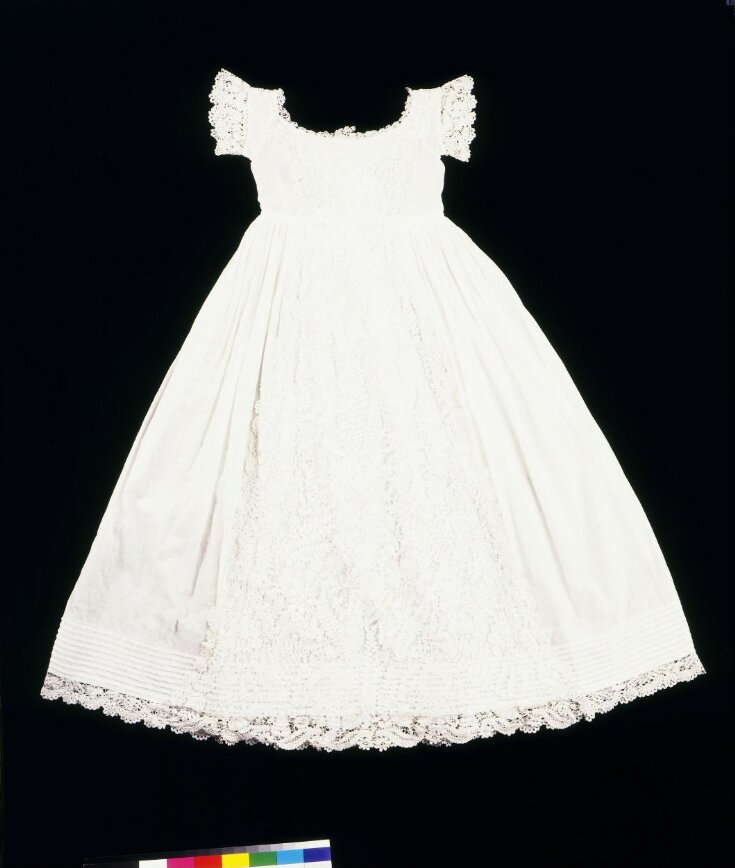
Christening robes tend to survive for sentimental reasons and are still handed down the family. They were usually made of fine white cotton or linen and were often decorated with whitework embroidery. Some, like this one, were overlaid with fine lace.
Ownership & Use
The birth of an infant was a very private event but its christening in church marked its first public appearance and was an occasion to be celebrated. From an early date the church decreed that a child should be baptised in a white garment to signify innocence and purity. By the beginning of the 19th century this was a long, white or cream robe. Often the one dress was used for all the children in the family. This christening robe was made specifically for Lieutenant Colonel H.P.L. Cart de Lafontaine for his christening in 1884. There is, however, evidence that it was reused at a later date.
Design & Designing
The shape of christening robes hardly changed from the beginning of the century to the 1890s. They still resembled fashionable women's dresses of the early 1800s with their low neckline, short sleeves and skirts made of delicate materials. The baby always wore a close-fitting white cap to complement the dress. It might also be carried in a christening cape, mantle or shawl to help keep it warm.
Historical Associations
Royal christenings were very elaborate affairs. The Illustrated London News of 5 December 1874 describes the christening of a grandson of Queen Victoria:
'The infant having been placed in the arms of the Queen and the Archbishop calling upon the sponsors to name the child, the Queen answered "Alfred Alexander William Ernest Albert " and his Grace baptised the child in those names. The infant was attired in a mantle, gown and cap of Honiton lace - being the same dress in which all the Queen's children and those of the Prince and Princess of Wales were christened.'
Christening robes tend to survive for sentimental reasons and are still handed down the family. They were usually made of fine white cotton or linen and were often decorated with whitework embroidery. Some, like this one, were overlaid with fine lace.
Ownership & Use
The birth of an infant was a very private event but its christening in church marked its first public appearance and was an occasion to be celebrated. From an early date the church decreed that a child should be baptised in a white garment to signify innocence and purity. By the beginning of the 19th century this was a long, white or cream robe. Often the one dress was used for all the children in the family. This christening robe was made specifically for Lieutenant Colonel H.P.L. Cart de Lafontaine for his christening in 1884. There is, however, evidence that it was reused at a later date.
Design & Designing
The shape of christening robes hardly changed from the beginning of the century to the 1890s. They still resembled fashionable women's dresses of the early 1800s with their low neckline, short sleeves and skirts made of delicate materials. The baby always wore a close-fitting white cap to complement the dress. It might also be carried in a christening cape, mantle or shawl to help keep it warm.
Historical Associations
Royal christenings were very elaborate affairs. The Illustrated London News of 5 December 1874 describes the christening of a grandson of Queen Victoria:
'The infant having been placed in the arms of the Queen and the Archbishop calling upon the sponsors to name the child, the Queen answered "Alfred Alexander William Ernest Albert " and his Grace baptised the child in those names. The infant was attired in a mantle, gown and cap of Honiton lace - being the same dress in which all the Queen's children and those of the Prince and Princess of Wales were christened.'
Object details
| Categories | |
| Object type | |
| Parts | This object consists of 4 parts.
|
| Materials and techniques | Lawn, overlaid and trimmed with lace, hand-sewn |
| Brief description | Christening robe of lawn with Honiton lace, England, ca. 1884 |
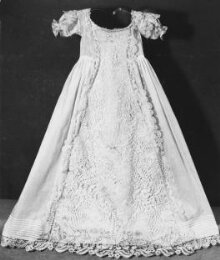
| Physical description | Christening robe of white lawn with a wide central panel of Honiton lace mounted on satin. The satin has been removed from the object (not original). |
| Dimensions |
|
| Gallery label | British Galleries:
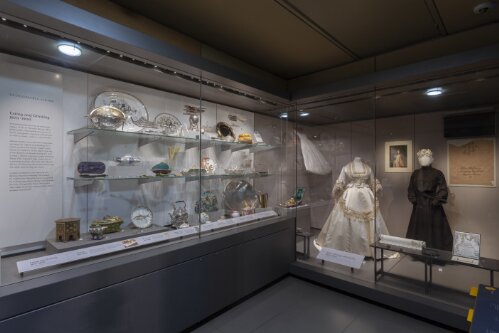
A christening was an important public occasion for the family and relatives of a child. This traditional robe is decorated with lace made in Honiton, Devon. Lace of this quality was often worn at royal christenings or by children of wealthy families.(27/03/2003) |
| Credit line | Given by Lt. Col. H. P. L. Cart de Lafontaine |
| Object history | Made for the christening of the donor, Lt Col Henry Philip Cart De Lafontaine, in 1884. Henry Philip Cart De Lafontaine (1884-1963) was born in Switzerland. Trained at Ecole des Beaux-Arts and articled to Guy Dawber 1911. Served in the World War I with Distinction; he was awarded the Victory Medal, the British War Medal, was Mentioned in Despatches and awarded the Oak Leaf Emblem for gallantry. On 25 July 1919 was appointed ‘Inspector of Works’ for the Commonwealth War Graves Commission. He designed the coloured and gilded gesso memorial tablets placed in cathedrals in Belgium and France. Left the Commission in February 1920. In 1937 Henry became Master of the Worshipful Company of Gold & Silver Wyre Drawers and in 1939 designed the Commonwealth Building in Holborn. President of the Town Planning Institute 1950-51. |
| Summary | Object Type Christening robes tend to survive for sentimental reasons and are still handed down the family. They were usually made of fine white cotton or linen and were often decorated with whitework embroidery. Some, like this one, were overlaid with fine lace. Ownership & Use The birth of an infant was a very private event but its christening in church marked its first public appearance and was an occasion to be celebrated. From an early date the church decreed that a child should be baptised in a white garment to signify innocence and purity. By the beginning of the 19th century this was a long, white or cream robe. Often the one dress was used for all the children in the family. This christening robe was made specifically for Lieutenant Colonel H.P.L. Cart de Lafontaine for his christening in 1884. There is, however, evidence that it was reused at a later date. Design & Designing The shape of christening robes hardly changed from the beginning of the century to the 1890s. They still resembled fashionable women's dresses of the early 1800s with their low neckline, short sleeves and skirts made of delicate materials. The baby always wore a close-fitting white cap to complement the dress. It might also be carried in a christening cape, mantle or shawl to help keep it warm. Historical Associations Royal christenings were very elaborate affairs. The Illustrated London News of 5 December 1874 describes the christening of a grandson of Queen Victoria: 'The infant having been placed in the arms of the Queen and the Archbishop calling upon the sponsors to name the child, the Queen answered "Alfred Alexander William Ernest Albert " and his Grace baptised the child in those names. The infant was attired in a mantle, gown and cap of Honiton lace - being the same dress in which all the Queen's children and those of the Prince and Princess of Wales were christened.' |
| Collection | |
| Accession number | CIRC.278:1 to 4-1958 |
About this object record
Explore the Collections contains over a million catalogue records, and over half a million images. It is a working database that includes information compiled over the life of the museum. Some of our records may contain offensive and discriminatory language, or reflect outdated ideas, practice and analysis. We are committed to addressing these issues, and to review and update our records accordingly.
You can write to us to suggest improvements to the record.
Suggest feedback
You can write to us to suggest improvements to the record.
Suggest feedback
| Record created | March 27, 2003 |
| Record URL |
Download as: JSONIIIF Manifest
