Architectural Model
ca. 1820 (made)
| Artist/Maker | |
| Place of origin |
Object Type
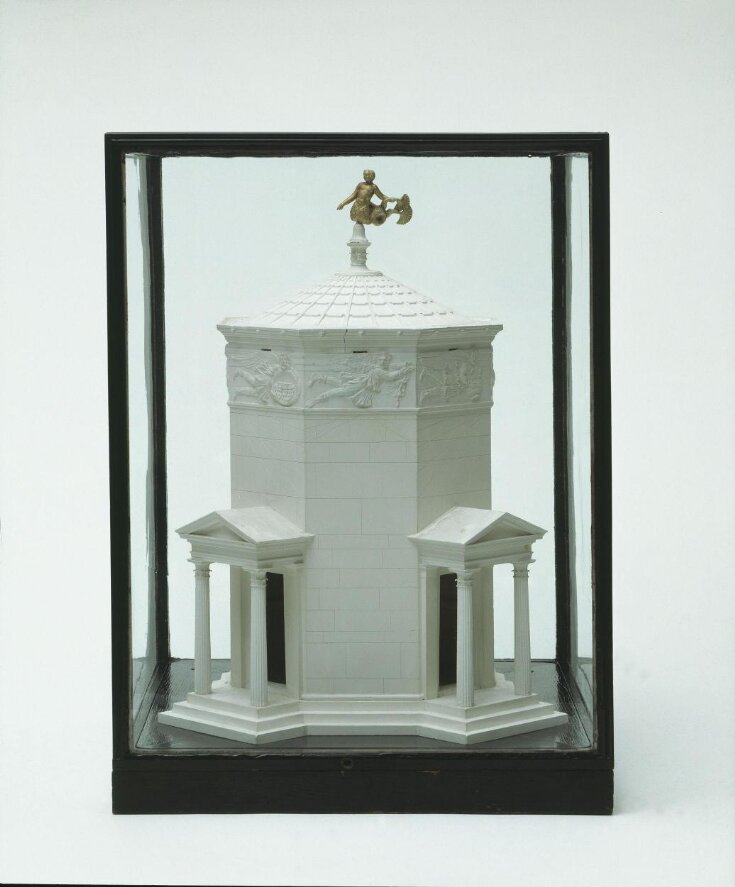
This is an architectural model of the Temple of the Winds, Athens. It was made in plaster with hidden iron supports by Jean Pierre Fouquet (1752-1829) as part of a commission by the British architect John Nash (1752-1835).
People
Jean-Pierre Fouquet was an architectural modeller whose clients included the American architect and statesman Thomas Jefferson (1743-1826) and various British architects, among them Sir John Soane (1753-1835) and Sir Robert Smirke (1780-1867). Nash, George IV's favourite architect, commissioned this model and 14 others during a visit to Paris in 1821.
Places
These models were made for Nash's London residence, 14-16 Lower Regent Street, and were exhibited in the Gallery there. Fouquet's works were also exhibited in the Paris Salon of 1817, and at the Bodleian Library, Oxford.
Subject Depicted
The Temple of the Winds, more properly the Horologion of Andronikos Kyrrhestes, was built by the astronomer Andronikos in Athens in the first century AD to serve as a sundial, water-clock and weather-vane. The winds featured on the eight panels are: Boreas (the North Wind); Kaikias (the N-E Wind); Skiron (the N-W Wind); Zephyrus (the West Wind); Lips (the S-W Wind); Notus (the South Wind); Agnaiotes (the S-E Wind); and Eurus (the East Wind). The weather-vane is in the form of a bronze triton.
This is an architectural model of the Temple of the Winds, Athens. It was made in plaster with hidden iron supports by Jean Pierre Fouquet (1752-1829) as part of a commission by the British architect John Nash (1752-1835).
People
Jean-Pierre Fouquet was an architectural modeller whose clients included the American architect and statesman Thomas Jefferson (1743-1826) and various British architects, among them Sir John Soane (1753-1835) and Sir Robert Smirke (1780-1867). Nash, George IV's favourite architect, commissioned this model and 14 others during a visit to Paris in 1821.
Places
These models were made for Nash's London residence, 14-16 Lower Regent Street, and were exhibited in the Gallery there. Fouquet's works were also exhibited in the Paris Salon of 1817, and at the Bodleian Library, Oxford.
Subject Depicted
The Temple of the Winds, more properly the Horologion of Andronikos Kyrrhestes, was built by the astronomer Andronikos in Athens in the first century AD to serve as a sundial, water-clock and weather-vane. The winds featured on the eight panels are: Boreas (the North Wind); Kaikias (the N-E Wind); Skiron (the N-W Wind); Zephyrus (the West Wind); Lips (the S-W Wind); Notus (the South Wind); Agnaiotes (the S-E Wind); and Eurus (the East Wind). The weather-vane is in the form of a bronze triton.
Object details
| Categories | |
| Object type | |
| Parts | This object consists of 2 parts.
|
| Materials and techniques | |
| Brief description | Architectural model of the Temple of the Winds, Athens; French, ca. 1820, made by Jean Pierre Fouquet as part of a commission by the British architect John Nash |
| Physical description | Plaster architectural model of the Temple of the Winds, Athens, over a metal rod |
| Gallery label | British Galleries:
Models were used by architects as a way of studying the details of classical buildings and their decoration. The architect John Nash (1752-1835) commissioned a set of models of famous Greek buildings while on a visit to Paris. He kept them in the gallery of his London house in Lower Regent Street, with his copies of classical sculptures.(27/03/2003) |
| Credit line | Transferred from the Science Museum |
| Summary | Object Type This is an architectural model of the Temple of the Winds, Athens. It was made in plaster with hidden iron supports by Jean Pierre Fouquet (1752-1829) as part of a commission by the British architect John Nash (1752-1835). People Jean-Pierre Fouquet was an architectural modeller whose clients included the American architect and statesman Thomas Jefferson (1743-1826) and various British architects, among them Sir John Soane (1753-1835) and Sir Robert Smirke (1780-1867). Nash, George IV's favourite architect, commissioned this model and 14 others during a visit to Paris in 1821. Places These models were made for Nash's London residence, 14-16 Lower Regent Street, and were exhibited in the Gallery there. Fouquet's works were also exhibited in the Paris Salon of 1817, and at the Bodleian Library, Oxford. Subject Depicted The Temple of the Winds, more properly the Horologion of Andronikos Kyrrhestes, was built by the astronomer Andronikos in Athens in the first century AD to serve as a sundial, water-clock and weather-vane. The winds featured on the eight panels are: Boreas (the North Wind); Kaikias (the N-E Wind); Skiron (the N-W Wind); Zephyrus (the West Wind); Lips (the S-W Wind); Notus (the South Wind); Agnaiotes (the S-E Wind); and Eurus (the East Wind). The weather-vane is in the form of a bronze triton. |
| Collection | |
| Accession number | CIRC.222:1, 2-1916 |
About this object record
Explore the Collections contains over a million catalogue records, and over half a million images. It is a working database that includes information compiled over the life of the museum. Some of our records may contain offensive and discriminatory language, or reflect outdated ideas, practice and analysis. We are committed to addressing these issues, and to review and update our records accordingly.
You can write to us to suggest improvements to the record.
Suggest feedback
You can write to us to suggest improvements to the record.
Suggest feedback
| Record created | March 27, 2003 |
| Record URL |
Download as: JSONIIIF Manifest
