
Punch Bowl
ca. 1900 (made)
| Artist/Maker | |
| Place of origin |
Object Type
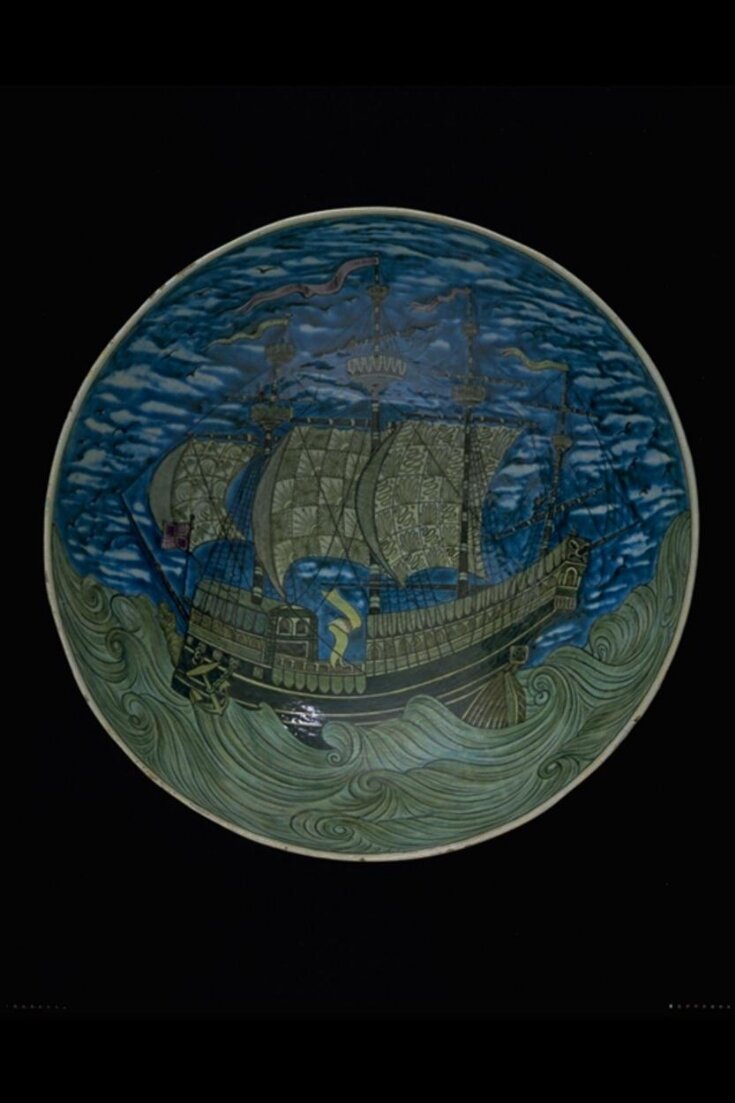
This substantial bowl was described on its acquisition as a punch bowl but it was certainly never used as such. Its generous proportions and the subject matter of the design are taken from the celebrated Hispano-Moresque ship bowls of 14th-century Malaga. these ship bowls are among the most prized of ceramics of collectors and museums. De Morgan's ceramics were also lovingly collected by admirers and this bowl would have been a prized possession.
People
William De Morgan (1839-1917) was a close friend of William Morris (1834-1896)and the two collected ceramics, textiles and other art works from Persia (modern-day Iran), Turkey and China, all of which influenced their own designs. The Reverend Stopford Brooke was clearly an admirer of De Morgan's work. His daughter, who presented this bowl in his memory, invited the Museum's Bernard Rackham, Keeper of Ceramics, to choose from 'many of the most beautiful pieces' in her father's collection. It was painted by Frederick Passenger who, with his brother Charles, was De Morgan's most talented decorator.
This substantial bowl was described on its acquisition as a punch bowl but it was certainly never used as such. Its generous proportions and the subject matter of the design are taken from the celebrated Hispano-Moresque ship bowls of 14th-century Malaga. these ship bowls are among the most prized of ceramics of collectors and museums. De Morgan's ceramics were also lovingly collected by admirers and this bowl would have been a prized possession.
People
William De Morgan (1839-1917) was a close friend of William Morris (1834-1896)and the two collected ceramics, textiles and other art works from Persia (modern-day Iran), Turkey and China, all of which influenced their own designs. The Reverend Stopford Brooke was clearly an admirer of De Morgan's work. His daughter, who presented this bowl in his memory, invited the Museum's Bernard Rackham, Keeper of Ceramics, to choose from 'many of the most beautiful pieces' in her father's collection. It was painted by Frederick Passenger who, with his brother Charles, was De Morgan's most talented decorator.
Object details
| Categories | |
| Object type | |
| Materials and techniques | Earthenware, painted |
| Brief description | Bowl, earthenware, decorated with the image of a ship, painted in colours, designed by William Frend De Morgan, made at the De Morgan Pottery, Merton Abbey, painted by Fred Passenger, England, ca. 1885 |
| Physical description | Bowl, earthenware, painted in colours, 46 cm diam., 15.5 cm deep. Marks: "F.P." painted in black. This substantial bowl, painted in deep turquoise blues and purples, is an example of De Morgan's "Persian" wares. Described as a punch bowl, in both its generous proportions and the subject of the decoration-fantastic ships were one of his favourite subjects-it refers most closely to the celebrated Hispano-Moresque "ship bowls" of Malaga. |
| Dimensions |
|
| Marks and inscriptions | 'F.P.' (Maker's identification; on the base; painted; paint) |
| Gallery label |
|
| Credit line | Given by Miss Evelyn Brooke, in memory of her father, the Rev. Stopford Brooke |
| Object history | Designed by William De Morgan (born in London, 1839, died there in 1917); made at the De Morgan pottery, Sands End, Fulham, London; painted by Frederick Passenger (probably working 1898-1907) |
| Subjects depicted | |
| Summary | Object Type This substantial bowl was described on its acquisition as a punch bowl but it was certainly never used as such. Its generous proportions and the subject matter of the design are taken from the celebrated Hispano-Moresque ship bowls of 14th-century Malaga. these ship bowls are among the most prized of ceramics of collectors and museums. De Morgan's ceramics were also lovingly collected by admirers and this bowl would have been a prized possession. People William De Morgan (1839-1917) was a close friend of William Morris (1834-1896)and the two collected ceramics, textiles and other art works from Persia (modern-day Iran), Turkey and China, all of which influenced their own designs. The Reverend Stopford Brooke was clearly an admirer of De Morgan's work. His daughter, who presented this bowl in his memory, invited the Museum's Bernard Rackham, Keeper of Ceramics, to choose from 'many of the most beautiful pieces' in her father's collection. It was painted by Frederick Passenger who, with his brother Charles, was De Morgan's most talented decorator. |
| Bibliographic reference | Baker, Malcolm, and Brenda Richardson (eds.), A Grand Design: The Art of the Victoria and Albert Museum, London: V&A Publications, 1999.
|
| Collection | |
| Accession number | C.78-1923 |
About this object record
Explore the Collections contains over a million catalogue records, and over half a million images. It is a working database that includes information compiled over the life of the museum. Some of our records may contain offensive and discriminatory language, or reflect outdated ideas, practice and analysis. We are committed to addressing these issues, and to review and update our records accordingly.
You can write to us to suggest improvements to the record.
Suggest feedback
You can write to us to suggest improvements to the record.
Suggest feedback
| Record created | March 27, 2003 |
| Record URL |
Download as: JSONIIIF Manifest
