Figure
ca. 1756 (made)
| Artist/Maker | |
| Place of origin |
Object Type
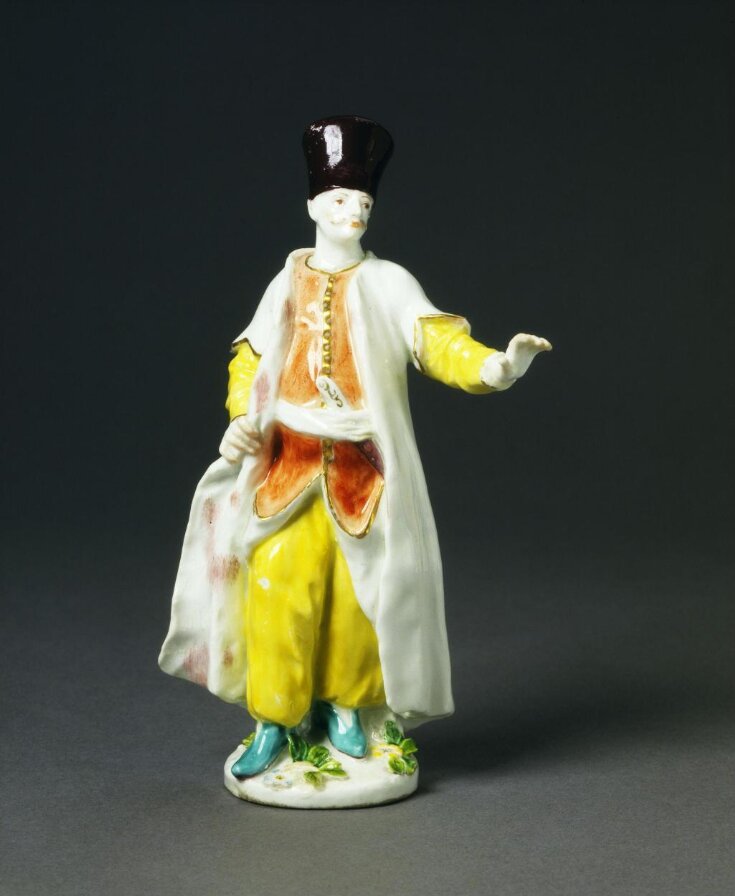
Sets and pairs of porcelain figures of men and women in Turkish dress were popular in mid-18th-century Europe. They were used as table decorations during the dessert courses of grand dinners. To judge from sales records, this one probably represents a theatrical figure in Turkish dress.
Design & Designing
The Meissen factory in Germany was the first to make porcelain figures of Turks. These were copied by the English porcelain factories and some were also made in Staffordshire salt-glazed stoneware. The Chelsea porcelain factory in London copied both this man and his female companion from Meissen figures modelled by Johann Joachim Kaendler (1706-1776). Kaendler in turn based his figures on an engraving included in M. de Ferriol's Receuil de cent estampes representant different nations du Levant ('Collection of 100 prints representing different nations of the Levant [Near East]'), published in Paris in 1714. The female companion in the V&A is the correct model, but is differently painted and was not the original pair to this piece.
Trading
Pairs of men and women in Turkish dress were included in London auctions of Chelsea porcelain held in 1755 and 1756. Others were offered for sale together with figure groups in theatrical dress. Some groups were described as 'theatrical figures in Turkish dress'.
Sets and pairs of porcelain figures of men and women in Turkish dress were popular in mid-18th-century Europe. They were used as table decorations during the dessert courses of grand dinners. To judge from sales records, this one probably represents a theatrical figure in Turkish dress.
Design & Designing
The Meissen factory in Germany was the first to make porcelain figures of Turks. These were copied by the English porcelain factories and some were also made in Staffordshire salt-glazed stoneware. The Chelsea porcelain factory in London copied both this man and his female companion from Meissen figures modelled by Johann Joachim Kaendler (1706-1776). Kaendler in turn based his figures on an engraving included in M. de Ferriol's Receuil de cent estampes representant different nations du Levant ('Collection of 100 prints representing different nations of the Levant [Near East]'), published in Paris in 1714. The female companion in the V&A is the correct model, but is differently painted and was not the original pair to this piece.
Trading
Pairs of men and women in Turkish dress were included in London auctions of Chelsea porcelain held in 1755 and 1756. Others were offered for sale together with figure groups in theatrical dress. Some groups were described as 'theatrical figures in Turkish dress'.
Object details
| Categories | |
| Object type | |
| Materials and techniques | Soft-paste porcelain painted with enamels and gilded |
| Brief description | Figure of a Turkish man in soft-paste porcelain painted with enamels and gilded, Chelsea Porcelain factory, Chelsea, ca. 1756 |
| Physical description | Figure of a Turkish or Polish man in soft-paste porcelain painted with enamels and gilded. He stands wearing a white fur-lined cloak with short sleeves and gold edging over a red-white lined sleeveless coat with the tails caught up about his waist. Full yellow trousers and sleeves, blue shoes and high fur hat. Small flat circular base with applied flowers. |
| Dimensions |
|
| Marks and inscriptions | An anchor (In red) |
| Gallery label | British Galleries:
Table figurines became widespread in England in the 1750s and were mostly based on prototypes from Meissen in Saxony (now Germany). Horace Walpole wrote in 1753 that displays of sugar plums and other confectionery had 'long given way to harlequins, gondoliers, Turks, Chinese, and sheperdesses of Saxon china'. Many of the Turkish figures were copied from French prints showing 'exotic' peoples and their costumes.(27/03/2003) |
| Credit line | Given by E. F. Broderip, Esq. |
| Subjects depicted | |
| Summary | Object Type Sets and pairs of porcelain figures of men and women in Turkish dress were popular in mid-18th-century Europe. They were used as table decorations during the dessert courses of grand dinners. To judge from sales records, this one probably represents a theatrical figure in Turkish dress. Design & Designing The Meissen factory in Germany was the first to make porcelain figures of Turks. These were copied by the English porcelain factories and some were also made in Staffordshire salt-glazed stoneware. The Chelsea porcelain factory in London copied both this man and his female companion from Meissen figures modelled by Johann Joachim Kaendler (1706-1776). Kaendler in turn based his figures on an engraving included in M. de Ferriol's Receuil de cent estampes representant different nations du Levant ('Collection of 100 prints representing different nations of the Levant [Near East]'), published in Paris in 1714. The female companion in the V&A is the correct model, but is differently painted and was not the original pair to this piece. Trading Pairs of men and women in Turkish dress were included in London auctions of Chelsea porcelain held in 1755 and 1756. Others were offered for sale together with figure groups in theatrical dress. Some groups were described as 'theatrical figures in Turkish dress'. |
| Collection | |
| Accession number | C.684-1925 |
About this object record
Explore the Collections contains over a million catalogue records, and over half a million images. It is a working database that includes information compiled over the life of the museum. Some of our records may contain offensive and discriminatory language, or reflect outdated ideas, practice and analysis. We are committed to addressing these issues, and to review and update our records accordingly.
You can write to us to suggest improvements to the record.
Suggest feedback
You can write to us to suggest improvements to the record.
Suggest feedback
| Record created | March 27, 2003 |
| Record URL |
Download as: JSONIIIF Manifest
