Teapot
ca. 1760 (made)
| Artist/Maker | |
| Place of origin |
Object Type
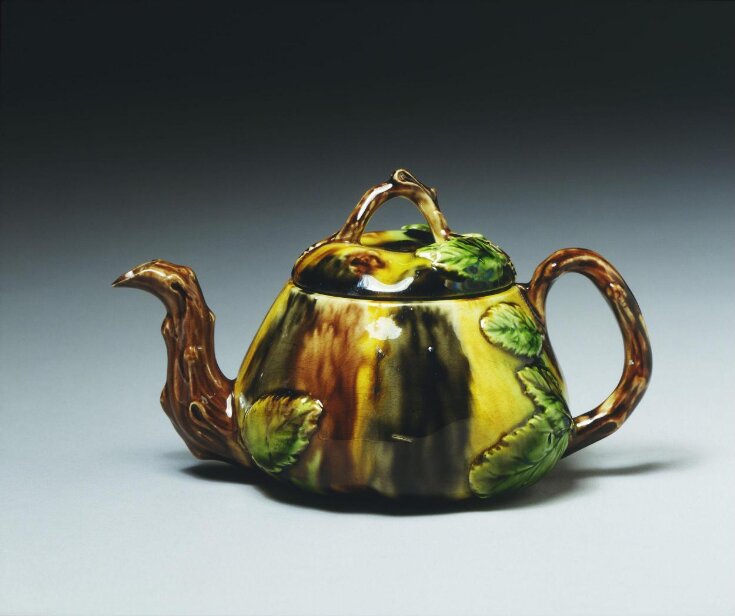
This is known as an apple teapot, as its form was loosely inspired by that fruit. Staffordshire teapots of the mid-18th century were usually small, being described in contemporary bills as 'one dish' or 'two dish' (meaning for one cup or two). This is probably a one-dish example.
Makers & Manufacturers
Apple and pear teapots are known to have been made by several Staffordshire potteries in the 1760s. An undated letter from the blockmaker and manufacturer William Greatbatch to Josiah Wedgwood casts some light on this: 'have sent you an apple tpt. Should be glad to know if you wou'd have leaves on the side the same as use to be'. On 21 January 1765 Greatbatch supplied Wedgwood with two of these teapots which, to judge from the fragments excavated at Greatbatch's pottery site at Fenton, probably did not have applied leaves on the body. Fragments have also been excavated on the site of Thomas Whieldon's pottery at Fenton (Stoke-on-Trent, Staffordshire) and at an unidentified site at Town Road, Hanley, Staffordshire.
Design & Designing
With the fashion for fruit and vegetable forms in the 1760s and 1770s - notably melon, cauliflower and pineapple - makers of teaware resorted to the humble and unexotic apple and pear as models for their tiny teapots. The quality of modelling differed widely between makers, and although the scale of this particular teapot is close to that of a large apple, the pot itself bears little resemblance to the fruit after which it was named.
This is known as an apple teapot, as its form was loosely inspired by that fruit. Staffordshire teapots of the mid-18th century were usually small, being described in contemporary bills as 'one dish' or 'two dish' (meaning for one cup or two). This is probably a one-dish example.
Makers & Manufacturers
Apple and pear teapots are known to have been made by several Staffordshire potteries in the 1760s. An undated letter from the blockmaker and manufacturer William Greatbatch to Josiah Wedgwood casts some light on this: 'have sent you an apple tpt. Should be glad to know if you wou'd have leaves on the side the same as use to be'. On 21 January 1765 Greatbatch supplied Wedgwood with two of these teapots which, to judge from the fragments excavated at Greatbatch's pottery site at Fenton, probably did not have applied leaves on the body. Fragments have also been excavated on the site of Thomas Whieldon's pottery at Fenton (Stoke-on-Trent, Staffordshire) and at an unidentified site at Town Road, Hanley, Staffordshire.
Design & Designing
With the fashion for fruit and vegetable forms in the 1760s and 1770s - notably melon, cauliflower and pineapple - makers of teaware resorted to the humble and unexotic apple and pear as models for their tiny teapots. The quality of modelling differed widely between makers, and although the scale of this particular teapot is close to that of a large apple, the pot itself bears little resemblance to the fruit after which it was named.
Delve deeper
Discover more about this object

Object details
| Categories | |
| Object type | |
| Parts | This object consists of 2 parts.
|
| Materials and techniques | Earthenware, with sprigged decoration and stained lead glaze |
| Brief description | Teapot with cover, earthenware with sprigged decoration and stained lead glaze, possibly made in Staffordshire by Thomas Whieldon (1719-1786), ca. 1760 |
| Physical description | Teapot and cover of buff earthenware with applied decoration under a green-yellow-and brown with stained glaze. Lobed, fruit-shaped body, spreading to the base, indefinately coloured yellow, grey, and brown; twig handle and spout and handle to the lid, all coloured brown; on the body applied leaves coloured green. |
| Dimensions |
|
| Gallery label |
|
| Credit line | Bequeathed by Mr Wallace Elliot |
| Object history | London, C. Andrade, 1919. From the T. Boynton Collection. Formerly the Sir T.W. Holburne Collection. Formerly the William Edkins Collection. |
| Summary | Object Type This is known as an apple teapot, as its form was loosely inspired by that fruit. Staffordshire teapots of the mid-18th century were usually small, being described in contemporary bills as 'one dish' or 'two dish' (meaning for one cup or two). This is probably a one-dish example. Makers & Manufacturers Apple and pear teapots are known to have been made by several Staffordshire potteries in the 1760s. An undated letter from the blockmaker and manufacturer William Greatbatch to Josiah Wedgwood casts some light on this: 'have sent you an apple tpt. Should be glad to know if you wou'd have leaves on the side the same as use to be'. On 21 January 1765 Greatbatch supplied Wedgwood with two of these teapots which, to judge from the fragments excavated at Greatbatch's pottery site at Fenton, probably did not have applied leaves on the body. Fragments have also been excavated on the site of Thomas Whieldon's pottery at Fenton (Stoke-on-Trent, Staffordshire) and at an unidentified site at Town Road, Hanley, Staffordshire. Design & Designing With the fashion for fruit and vegetable forms in the 1760s and 1770s - notably melon, cauliflower and pineapple - makers of teaware resorted to the humble and unexotic apple and pear as models for their tiny teapots. The quality of modelling differed widely between makers, and although the scale of this particular teapot is close to that of a large apple, the pot itself bears little resemblance to the fruit after which it was named. |
| Bibliographic reference | Young, Hilary (ed.). The Genius of Wedgwood. London : Victoria & Albert Museum, 1995
A7 |
| Collection | |
| Accession number | C.47&A-1938 |
About this object record
Explore the Collections contains over a million catalogue records, and over half a million images. It is a working database that includes information compiled over the life of the museum. Some of our records may contain offensive and discriminatory language, or reflect outdated ideas, practice and analysis. We are committed to addressing these issues, and to review and update our records accordingly.
You can write to us to suggest improvements to the record.
Suggest feedback
You can write to us to suggest improvements to the record.
Suggest feedback
| Record created | March 27, 2003 |
| Record URL |
Download as: JSONIIIF Manifest
