Alexander I
Bust
1805-1810 (made)
1805-1810 (made)
| Artist/Maker | |
| Place of origin |
Object Type
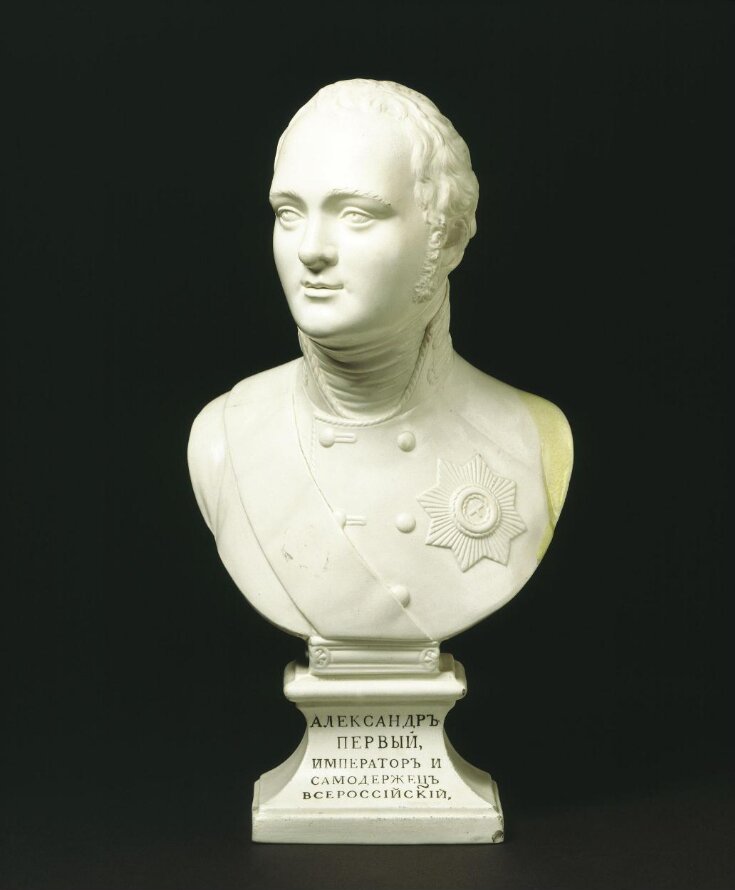
Pottery busts, along with a huge variety of figures, became fashionable at the end of the 18th century. High-quality portrait busts such as this example were certainly copied from engravings.
Trade & Trading
The Russian market was important not only to potteries in Staffordshire and Yorkshire, which were linked to the port of Hull by the canal system, but even to the Herculaneum Pottery in Liverpool. Normally Russia would have depended largely on France for the supply of fine ceramics, but after the invasion of Russia by Napoleon and the burning of Moscow in 1812 , trade ties with Britain were strengthened, accompanied also by a wave of sympathy for the Russians. After Waterloo (1815), trade links between British potteries and Russia continued to grow, when large quantities of blue-printed earthenware were exported via factory agents in some of the principal cities.
Materials & Making
The porcellaneous white stoneware developed about 1805 perfectly reproduced fine detail. When left in the white, it successfully imitated marble, and when embellished by enamelling, was an ideal material for small-scale ceramic busts. It was not, however, widely used for this purpose, perhaps because it was too expensive for the mass market for small mantepiece ornaments. The material was used instead for a great variety of jugs and teapots.
Pottery busts, along with a huge variety of figures, became fashionable at the end of the 18th century. High-quality portrait busts such as this example were certainly copied from engravings.
Trade & Trading
The Russian market was important not only to potteries in Staffordshire and Yorkshire, which were linked to the port of Hull by the canal system, but even to the Herculaneum Pottery in Liverpool. Normally Russia would have depended largely on France for the supply of fine ceramics, but after the invasion of Russia by Napoleon and the burning of Moscow in 1812 , trade ties with Britain were strengthened, accompanied also by a wave of sympathy for the Russians. After Waterloo (1815), trade links between British potteries and Russia continued to grow, when large quantities of blue-printed earthenware were exported via factory agents in some of the principal cities.
Materials & Making
The porcellaneous white stoneware developed about 1805 perfectly reproduced fine detail. When left in the white, it successfully imitated marble, and when embellished by enamelling, was an ideal material for small-scale ceramic busts. It was not, however, widely used for this purpose, perhaps because it was too expensive for the mass market for small mantepiece ornaments. The material was used instead for a great variety of jugs and teapots.
Object details
| Categories | |
| Object type | |
| Title | Alexander I (generic title) |
| Materials and techniques | Moulded stoneware |
| Brief description | Czar Alexander I |
| Physical description | BUST of Alexander I for the Russian market |
| Dimensions |
|
| Marks and inscriptions | 'Alexander the First Emperor and Autocrat of All the Russias' (Cyrillic; inscribed) |
| Gallery label |
|
| Credit line | Given by L. G. Clarke |
| Object history | Probably made at the Herculaneum Factory, Liverpool |
| Subject depicted | |
| Summary | Object Type Pottery busts, along with a huge variety of figures, became fashionable at the end of the 18th century. High-quality portrait busts such as this example were certainly copied from engravings. Trade & Trading The Russian market was important not only to potteries in Staffordshire and Yorkshire, which were linked to the port of Hull by the canal system, but even to the Herculaneum Pottery in Liverpool. Normally Russia would have depended largely on France for the supply of fine ceramics, but after the invasion of Russia by Napoleon and the burning of Moscow in 1812 , trade ties with Britain were strengthened, accompanied also by a wave of sympathy for the Russians. After Waterloo (1815), trade links between British potteries and Russia continued to grow, when large quantities of blue-printed earthenware were exported via factory agents in some of the principal cities. Materials & Making The porcellaneous white stoneware developed about 1805 perfectly reproduced fine detail. When left in the white, it successfully imitated marble, and when embellished by enamelling, was an ideal material for small-scale ceramic busts. It was not, however, widely used for this purpose, perhaps because it was too expensive for the mass market for small mantepiece ornaments. The material was used instead for a great variety of jugs and teapots. |
| Collection | |
| Accession number | C.215-1922 |
About this object record
Explore the Collections contains over a million catalogue records, and over half a million images. It is a working database that includes information compiled over the life of the museum. Some of our records may contain offensive and discriminatory language, or reflect outdated ideas, practice and analysis. We are committed to addressing these issues, and to review and update our records accordingly.
You can write to us to suggest improvements to the record.
Suggest feedback
You can write to us to suggest improvements to the record.
Suggest feedback
| Record created | March 27, 2003 |
| Record URL |
Download as: JSONIIIF Manifest
