
Pedestal
1772-1774 (made)
| Artist/Maker | |
| Place of origin |
Object Type
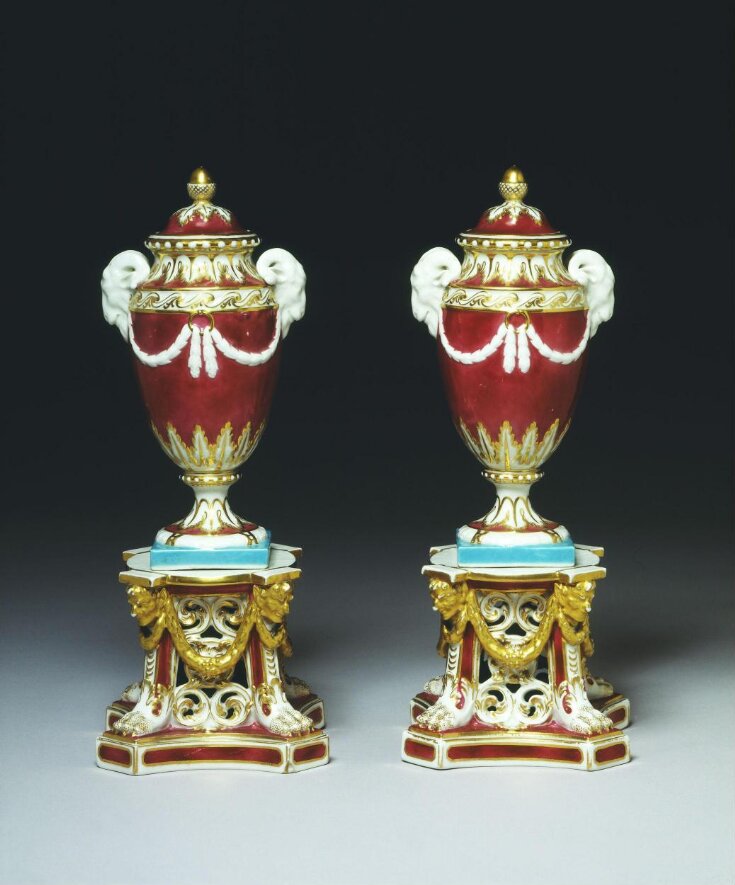
This pedestal is one of a pair (C.211A-1935) made to support a pair of small vases. They would probably have been displayed on a domestic chimneypiece, possibly in front of a mirror. Small vases on pedestals were also set out on dining tables during the dessert course of grand dinners, although such vases were usually unglazed. Pairs and sets of Derby porcelain figures were also sold with pedestals of this general type.
People
The Neo-classical sculptor John Bacon (1740-1799) may have designed these pedestals and the vases made to go on them. He was paid the remarkably large sum of £104 for models by William Duesbury (1725-1786), the owner of the Derby factory, between 1769 and 1771.
Trading
The Derby factory aimed at the top end of the market and sold much of its output from factory showrooms in Covent Garden, London. The factory also held auctions in London and had agents elsewhere, notably Bath. One London auction of 1773 included a pair of vases and pedestals similar to these. They were described as 'a pair of curious antique urns and pedestals' with goat's-head handles and gilding, and realized nearly £10. At that time, Chelsea and Derby modellers earned around £2 11s. per week.
This pedestal is one of a pair (C.211A-1935) made to support a pair of small vases. They would probably have been displayed on a domestic chimneypiece, possibly in front of a mirror. Small vases on pedestals were also set out on dining tables during the dessert course of grand dinners, although such vases were usually unglazed. Pairs and sets of Derby porcelain figures were also sold with pedestals of this general type.
People
The Neo-classical sculptor John Bacon (1740-1799) may have designed these pedestals and the vases made to go on them. He was paid the remarkably large sum of £104 for models by William Duesbury (1725-1786), the owner of the Derby factory, between 1769 and 1771.
Trading
The Derby factory aimed at the top end of the market and sold much of its output from factory showrooms in Covent Garden, London. The factory also held auctions in London and had agents elsewhere, notably Bath. One London auction of 1773 included a pair of vases and pedestals similar to these. They were described as 'a pair of curious antique urns and pedestals' with goat's-head handles and gilding, and realized nearly £10. At that time, Chelsea and Derby modellers earned around £2 11s. per week.
Object details
| Categories | |
| Object type | |
| Materials and techniques | Soft-paste porcelain painted with enamels and gilded |
| Brief description | Pedestal of soft-paste porcelain painted with enamels and gilded, model after John Bacon, Derby porcelain factory, Derby, 1772-1774. |
| Physical description | Pedestal of soft-paste porcelain painted with enamels and gilded. Consisting of a plinth with four incurved sides, from the corners of which rise legs each with a satyr's mask at the top. Festoons of laurel are suspended from the masks, and the panels between the legs are filled in with openwork of scrolled foliage. The pedestal is richly gilded and with a ground of claret-colour in places. |
| Dimensions |
|
| Marks and inscriptions | An anchor (In red) |
| Gallery label | British Galleries:
Vasemania Vases were a very important element of the Neo-classical style. The pottery manufacturer Josiah Wedgwood, who could hardly make them fast enough, spoke of 'vasemania'. They appeared as three-dimensional objects and as decorative motifs. Vase forms also influenced the shape of practical items of all sorts, from tea canisters to candlesticks. Designers plundered sources far and wide for new designs, from Greek pottery to 16th- and 17th-century prints.(27/03/2003) |
| Credit line | Bequeathed by Herbert Allen |
| Object history | One of a pair with C.211A-1935. Formerly in the collection of Captain Ernlé Warriner. Possibly after a model by the sculptor John Bacon the Elder (born in London, 1740, died there in 1799). |
| Subjects depicted | |
| Summary | Object Type This pedestal is one of a pair (C.211A-1935) made to support a pair of small vases. They would probably have been displayed on a domestic chimneypiece, possibly in front of a mirror. Small vases on pedestals were also set out on dining tables during the dessert course of grand dinners, although such vases were usually unglazed. Pairs and sets of Derby porcelain figures were also sold with pedestals of this general type. People The Neo-classical sculptor John Bacon (1740-1799) may have designed these pedestals and the vases made to go on them. He was paid the remarkably large sum of £104 for models by William Duesbury (1725-1786), the owner of the Derby factory, between 1769 and 1771. Trading The Derby factory aimed at the top end of the market and sold much of its output from factory showrooms in Covent Garden, London. The factory also held auctions in London and had agents elsewhere, notably Bath. One London auction of 1773 included a pair of vases and pedestals similar to these. They were described as 'a pair of curious antique urns and pedestals' with goat's-head handles and gilding, and realized nearly £10. At that time, Chelsea and Derby modellers earned around £2 11s. per week. |
| Associated object | 485-1875 (Set) |
| Bibliographic reference | Twitchett, John. Derby Porcelain. London : Barrie & Jenkins, 1980. pl. 108.
|
| Collection | |
| Accession number | C.211-1935 |
About this object record
Explore the Collections contains over a million catalogue records, and over half a million images. It is a working database that includes information compiled over the life of the museum. Some of our records may contain offensive and discriminatory language, or reflect outdated ideas, practice and analysis. We are committed to addressing these issues, and to review and update our records accordingly.
You can write to us to suggest improvements to the record.
Suggest feedback
You can write to us to suggest improvements to the record.
Suggest feedback
| Record created | March 27, 2003 |
| Record URL |
Download as: JSONIIIF Manifest
