Teapot
Teapot
1760-1765 (made)
1760-1765 (made)
| Artist/Maker | |
| Place of origin |
Object Type
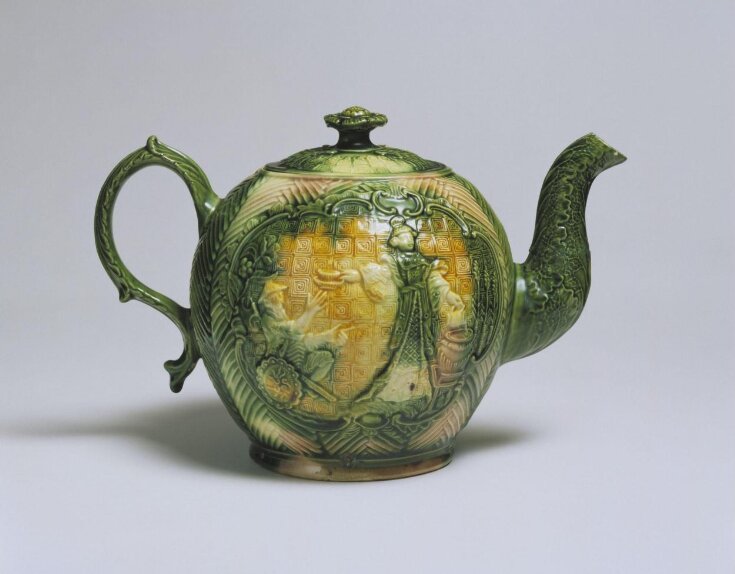
A typical 1760s teapot, this moulded example follows the simple globular form of thrown and turned creamware teapots, sharing the same moulded spout and handle.
People
Apart from the various members of the Wood family, William Greatbatch (1735-1813) was the most talented and prolific designer and maker of potters' moulds during the second half of the 18th century. Not only was his reputation such that the Staffordshire potter Josiah Wedgwood (1730-1795) employed him regularly to supply block-moulds, but he also ran his own pottery, apparently without any conflict of interest. Long before the Victorian Age, when ceramic designs could be patented, the close-knit fraternity of Staffordshire potters accepted the sharing and copying of designs. The advantage was that identical tablewares or figures could be made simultaneously by several potteries in order to fill urgent orders.
Recent excavations of Greatbatch's pottery site have revealed his distinctive style in his moulds, applied sprigs and engraved transfer-prints. Although the design of this particular teapot was not found there, its period and style make an attribution to Greatbatch most likely. And if the block-mould was made by Greatbatch, then the likely maker of the teapot would have been Wedgwood, or his partner during 1754-1759, Thomas Whieldon (1719-1795).
A typical 1760s teapot, this moulded example follows the simple globular form of thrown and turned creamware teapots, sharing the same moulded spout and handle.
People
Apart from the various members of the Wood family, William Greatbatch (1735-1813) was the most talented and prolific designer and maker of potters' moulds during the second half of the 18th century. Not only was his reputation such that the Staffordshire potter Josiah Wedgwood (1730-1795) employed him regularly to supply block-moulds, but he also ran his own pottery, apparently without any conflict of interest. Long before the Victorian Age, when ceramic designs could be patented, the close-knit fraternity of Staffordshire potters accepted the sharing and copying of designs. The advantage was that identical tablewares or figures could be made simultaneously by several potteries in order to fill urgent orders.
Recent excavations of Greatbatch's pottery site have revealed his distinctive style in his moulds, applied sprigs and engraved transfer-prints. Although the design of this particular teapot was not found there, its period and style make an attribution to Greatbatch most likely. And if the block-mould was made by Greatbatch, then the likely maker of the teapot would have been Wedgwood, or his partner during 1754-1759, Thomas Whieldon (1719-1795).
Object details
| Categories | |
| Object type | |
| Parts | This object consists of 2 parts.
|
| Title | Teapot (generic title) |
| Materials and techniques | Earthenware, moulded in relief, with lead glaze stained green, yellow and brown |
| Brief description | Teapot and cover of cream coloured earthenware, decorated with a lead-glaze in yellow, green and brown, made in Staffordshire, c.1760-65 |
| Physical description | Teapot and cover of lead-glazed earthenware and moulded. |
| Dimensions |
|
| Gallery label |
|
| Credit line | Bequeathed by Mr Arthur Hurst |
| Object history | Design attributed to William Greatbatch (born in 1735, died in 1813) |
| Production | From a block modelled by William Greatbatch possibly for Josiah Wedgwood. |
| Summary | Object Type A typical 1760s teapot, this moulded example follows the simple globular form of thrown and turned creamware teapots, sharing the same moulded spout and handle. People Apart from the various members of the Wood family, William Greatbatch (1735-1813) was the most talented and prolific designer and maker of potters' moulds during the second half of the 18th century. Not only was his reputation such that the Staffordshire potter Josiah Wedgwood (1730-1795) employed him regularly to supply block-moulds, but he also ran his own pottery, apparently without any conflict of interest. Long before the Victorian Age, when ceramic designs could be patented, the close-knit fraternity of Staffordshire potters accepted the sharing and copying of designs. The advantage was that identical tablewares or figures could be made simultaneously by several potteries in order to fill urgent orders. Recent excavations of Greatbatch's pottery site have revealed his distinctive style in his moulds, applied sprigs and engraved transfer-prints. Although the design of this particular teapot was not found there, its period and style make an attribution to Greatbatch most likely. And if the block-mould was made by Greatbatch, then the likely maker of the teapot would have been Wedgwood, or his partner during 1754-1759, Thomas Whieldon (1719-1795). |
| Collection | |
| Accession number | C.20&A-1940 |
About this object record
Explore the Collections contains over a million catalogue records, and over half a million images. It is a working database that includes information compiled over the life of the museum. Some of our records may contain offensive and discriminatory language, or reflect outdated ideas, practice and analysis. We are committed to addressing these issues, and to review and update our records accordingly.
You can write to us to suggest improvements to the record.
Suggest feedback
You can write to us to suggest improvements to the record.
Suggest feedback
| Record created | March 27, 2003 |
| Record URL |
Download as: JSONIIIF Manifest
