The Pitchford Hall Cup
Mug
1684 (made)
1684 (made)
| Place of origin |
Object Type
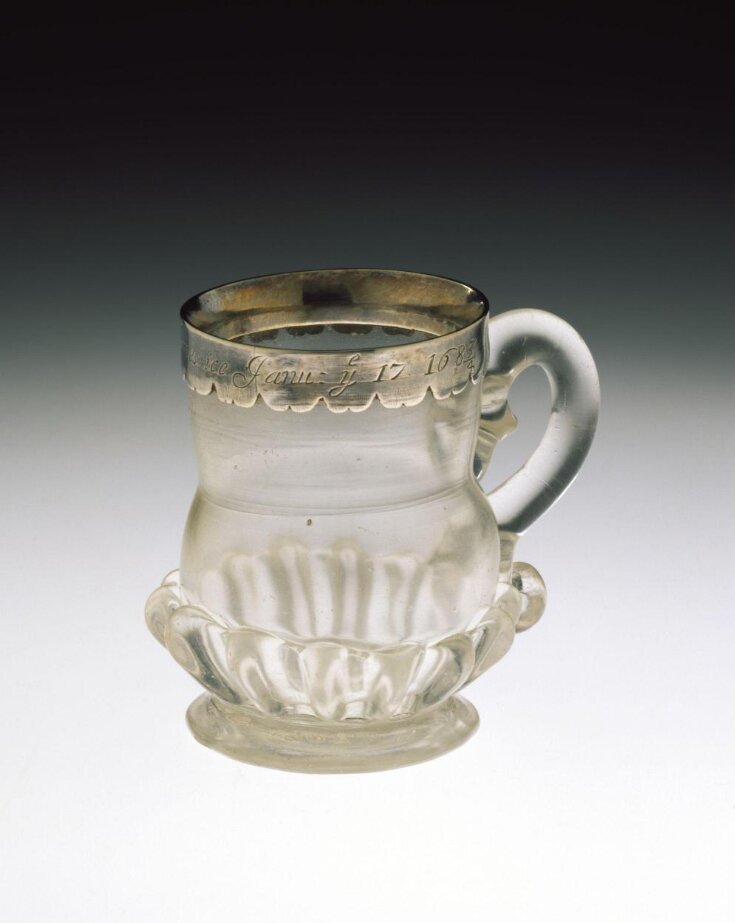
This tiny glass mug is a miniature replica of the glass mugs that were used for strong ale. Though quite impractical for use, it is made in the proper manner. The ribbing on the base was produced by partially dipping a hot bubble of glass into molten glass to increase its thickness, then inserted and blown in an open ribbed metal 'dip mould'. Finally, a ribbon of hot glass was applied and pincered to form the handle.
Historical Associations
The Frost Fairs occured six times between 1608 and 1814, with the very severe winters that froze the River Thames. A handful of poignant souvenirs survive from the winter of 1683-1684, which was particularly hard. The most important of them is certainly this small glass mug. It was probably engraved in one of the 'toy' booths on 'Temple Street', a row of temporary buildings and tents erected across the Thames. Coffee houses and taverns were built for shoppers and the spectators of several types of sport on the ice, which apparently included fox hunting and football. Souvenirs engraved 'while-you-wait', or woodcuts printed on a press set up on the ice, served as permanent remindes of an essentially ephemeral event.
Ownership & Use
This object has no practical function. Although it would have been called a 'toy' at the time it was acquired, it was never intended as a child's plaything. It may be seen as a souvenir and was probably taken back to the countryside for the owner to declare 'I was there'. Kept as an heirloom, it eventually became a collector's item at a picturesque country house in Shropshire, where it was known as the 'Pitchford Hall Cup'.
This tiny glass mug is a miniature replica of the glass mugs that were used for strong ale. Though quite impractical for use, it is made in the proper manner. The ribbing on the base was produced by partially dipping a hot bubble of glass into molten glass to increase its thickness, then inserted and blown in an open ribbed metal 'dip mould'. Finally, a ribbon of hot glass was applied and pincered to form the handle.
Historical Associations
The Frost Fairs occured six times between 1608 and 1814, with the very severe winters that froze the River Thames. A handful of poignant souvenirs survive from the winter of 1683-1684, which was particularly hard. The most important of them is certainly this small glass mug. It was probably engraved in one of the 'toy' booths on 'Temple Street', a row of temporary buildings and tents erected across the Thames. Coffee houses and taverns were built for shoppers and the spectators of several types of sport on the ice, which apparently included fox hunting and football. Souvenirs engraved 'while-you-wait', or woodcuts printed on a press set up on the ice, served as permanent remindes of an essentially ephemeral event.
Ownership & Use
This object has no practical function. Although it would have been called a 'toy' at the time it was acquired, it was never intended as a child's plaything. It may be seen as a souvenir and was probably taken back to the countryside for the owner to declare 'I was there'. Kept as an heirloom, it eventually became a collector's item at a picturesque country house in Shropshire, where it was known as the 'Pitchford Hall Cup'.
Object details
| Categories | |
| Object type | |
| Title | The Pitchford Hall Cup (series title) |
| Materials and techniques | Glass, with engraved silver mount, blown and wrought |
| Brief description | Mug of glass with silver mount, "The Pitchford Hall Cup", Frost Fair Glass, blown and wrought, designed and made in 1684 in England. |
| Physical description | Frost fair glass, globular shape with straight neck, the base with mould-blown ribbing, with applied silver rim engraved with "Bought on ye Thames ice Janu: ye 1683/4". |
| Dimensions |
|
| Marks and inscriptions | 'Bought on ye Thames ice Janu: ye 17 1683/4' (on silver mount; engraved) |
| Gallery label | British Galleries:
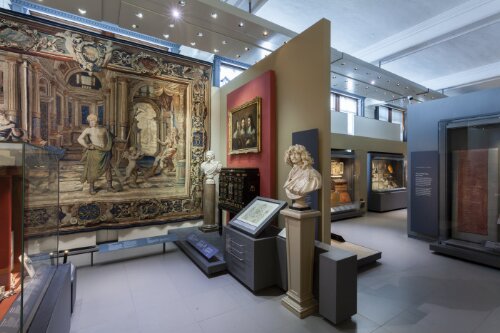
LEAD-GLASS DRINKING VESSELS By the 1680s lead glass was common and cheap enough to provide souvenir toys, such as the tiny glass celebrating the Frost Fair on the River Thames in London. At the same time it was grand enough for the giant ceremonial goblets that were passed around a company of drinkers. The jelly and sweetmeat glasses, dwarf ale glasses and globular mugs for strong ale were typical of the wider range of table glass that was produced from the late 17th century. 'State Glasses & Covers' were listed in the Hampton Court inventory as late as 1736. Such grand goblets were sometimes used as chalices for communion.(27/03/2003) |
| Credit line | Purchased with the assistance of The National Art Collections Fund |
| Object history | Made in London, perhaps Southwark |
| Summary | Object Type This tiny glass mug is a miniature replica of the glass mugs that were used for strong ale. Though quite impractical for use, it is made in the proper manner. The ribbing on the base was produced by partially dipping a hot bubble of glass into molten glass to increase its thickness, then inserted and blown in an open ribbed metal 'dip mould'. Finally, a ribbon of hot glass was applied and pincered to form the handle. Historical Associations The Frost Fairs occured six times between 1608 and 1814, with the very severe winters that froze the River Thames. A handful of poignant souvenirs survive from the winter of 1683-1684, which was particularly hard. The most important of them is certainly this small glass mug. It was probably engraved in one of the 'toy' booths on 'Temple Street', a row of temporary buildings and tents erected across the Thames. Coffee houses and taverns were built for shoppers and the spectators of several types of sport on the ice, which apparently included fox hunting and football. Souvenirs engraved 'while-you-wait', or woodcuts printed on a press set up on the ice, served as permanent remindes of an essentially ephemeral event. Ownership & Use This object has no practical function. Although it would have been called a 'toy' at the time it was acquired, it was never intended as a child's plaything. It may be seen as a souvenir and was probably taken back to the countryside for the owner to declare 'I was there'. Kept as an heirloom, it eventually became a collector's item at a picturesque country house in Shropshire, where it was known as the 'Pitchford Hall Cup'. |
| Bibliographic references |
|
| Collection | |
| Accession number | C.156-1997 |
About this object record
Explore the Collections contains over a million catalogue records, and over half a million images. It is a working database that includes information compiled over the life of the museum. Some of our records may contain offensive and discriminatory language, or reflect outdated ideas, practice and analysis. We are committed to addressing these issues, and to review and update our records accordingly.
You can write to us to suggest improvements to the record.
Suggest feedback
You can write to us to suggest improvements to the record.
Suggest feedback
| Record created | March 27, 2003 |
| Record URL |
Download as: JSONIIIF Manifest
