Figure Group
1830-1835 (made)
| Artist/Maker | |
| Place of origin |
Object Type
From about 1740 sets of porcelain figures were first made as table decorations for the dessert course of grand dinners. They were used in place of, or alongside, decorations modelled in sugar paste or wax. Unglazed ('biscuit') porcelain figures were considered especially suitable for the dessert course.
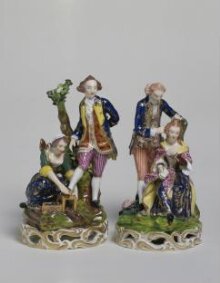
This group and the companion ones of a stocking-mender and a hairdresser, were copied from biscuit figure groups made around 1756 at Sèvres, the Royal French porcelain factory. By this time porcelain figures were also being used in interior decoration. It is most likely that the glazed porcelain versions that Derby made in the 1770s, and which they reissued in the early 19th century, were intended for use in interiors.
People
The Sèvres porcelain originals on which this group and its companions were based were modelled by Etienne-Maurice Falconet (1716-1791), a leading French sculptor. Falconet was the director of modelling at the factory between 1757 and 1766.
Materials & Making
Like most Derby figure groups, this one is formed by slip-casting. In this process a mixture of clay and water is poured into a set of hollow plaster moulds. The water evaporates, leaving a thin layer of clay. The moulds are then taken apart and the figure parts removed and assembled before firing.
From about 1740 sets of porcelain figures were first made as table decorations for the dessert course of grand dinners. They were used in place of, or alongside, decorations modelled in sugar paste or wax. Unglazed ('biscuit') porcelain figures were considered especially suitable for the dessert course.
This group and the companion ones of a stocking-mender and a hairdresser, were copied from biscuit figure groups made around 1756 at Sèvres, the Royal French porcelain factory. By this time porcelain figures were also being used in interior decoration. It is most likely that the glazed porcelain versions that Derby made in the 1770s, and which they reissued in the early 19th century, were intended for use in interiors.
People
The Sèvres porcelain originals on which this group and its companions were based were modelled by Etienne-Maurice Falconet (1716-1791), a leading French sculptor. Falconet was the director of modelling at the factory between 1757 and 1766.
Materials & Making
Like most Derby figure groups, this one is formed by slip-casting. In this process a mixture of clay and water is poured into a set of hollow plaster moulds. The water evaporates, leaving a thin layer of clay. The moulds are then taken apart and the figure parts removed and assembled before firing.
Object details
| Categories | |
| Object type | |
| Materials and techniques | Porcelain painted with enamels and gilded |
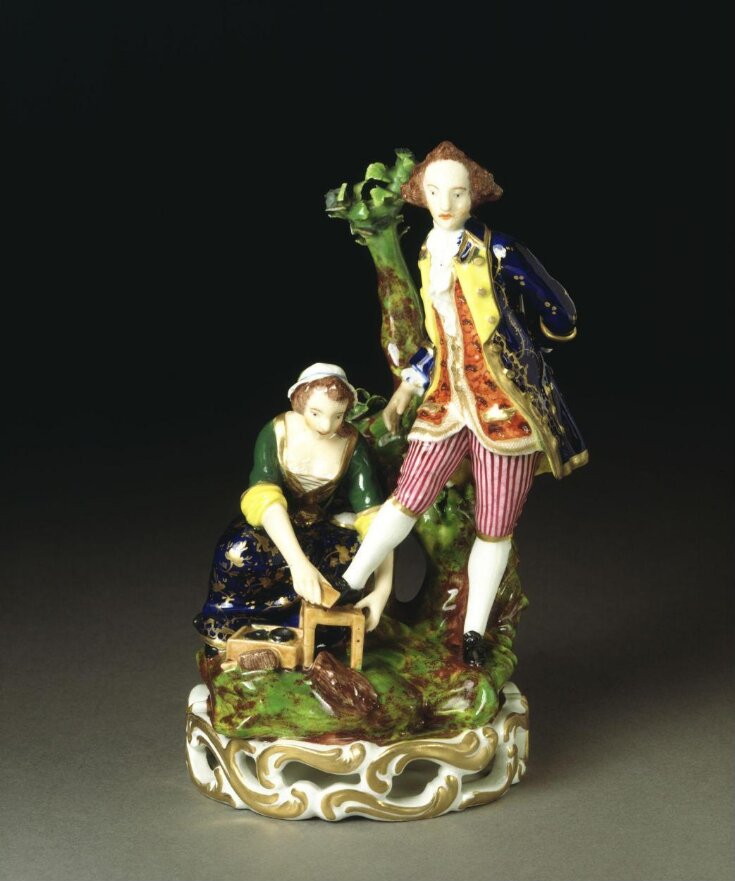
| Brief description | Figure group in porcelain painted with enamels and gilded of a woman cleaning a man's shoes, Derby Porcelain factory, Derby, 1830-1835. |
| Physical description | Figure group in porcelain painted with enamels and gilded of a woman cleaning a man's shoes. The man stands on his left leg and supports his right on a stool. He has his hair tied behind his neck and wears a blue gilt coat lined with yellow, a red flowered waistcoat, mauve and white striped breeches, white stockings and black shoes. The woman is kneeling on one knee and wears a green bodice and a blue gilt skirt. She is brushing the man's right shoe. A green tree stump is behind them and the ground is also green. Circular base with openwork gilt scrolls round the sides. |
| Dimensions |
|
| Gallery label | British Galleries:
Porcelain manufacturers followed the lead of the publishers who reprinted 18th-century engravings, by reissuing porcelain figures that had first been produced nearly 80 years earlier. The naturalism of the modelling, the bright colours and the soft scrolls of the Rococo bases would all have had renewed appeal for consumers in the 1830s.(27/03/2003) |
| Credit line | Bequeathed by Mr John George Joicey |
| Subjects depicted | |
| Summary | Object Type From about 1740 sets of porcelain figures were first made as table decorations for the dessert course of grand dinners. They were used in place of, or alongside, decorations modelled in sugar paste or wax. Unglazed ('biscuit') porcelain figures were considered especially suitable for the dessert course. This group and the companion ones of a stocking-mender and a hairdresser, were copied from biscuit figure groups made around 1756 at Sèvres, the Royal French porcelain factory. By this time porcelain figures were also being used in interior decoration. It is most likely that the glazed porcelain versions that Derby made in the 1770s, and which they reissued in the early 19th century, were intended for use in interiors. People The Sèvres porcelain originals on which this group and its companions were based were modelled by Etienne-Maurice Falconet (1716-1791), a leading French sculptor. Falconet was the director of modelling at the factory between 1757 and 1766. Materials & Making Like most Derby figure groups, this one is formed by slip-casting. In this process a mixture of clay and water is poured into a set of hollow plaster moulds. The water evaporates, leaving a thin layer of clay. The moulds are then taken apart and the figure parts removed and assembled before firing. |
| Bibliographic reference | Twitchett, John. Derby Porcelain. London : Barrie & Jenkins, 1980. 292 p.
|
| Collection | |
| Accession number | C.1303-1919 |
About this object record
Explore the Collections contains over a million catalogue records, and over half a million images. It is a working database that includes information compiled over the life of the museum. Some of our records may contain offensive and discriminatory language, or reflect outdated ideas, practice and analysis. We are committed to addressing these issues, and to review and update our records accordingly.
You can write to us to suggest improvements to the record.
Suggest feedback
You can write to us to suggest improvements to the record.
Suggest feedback
| Record created | March 27, 2003 |
| Record URL |
Download as: JSONIIIF Manifest
