
BBB
Tile
1898 (made)
1898 (made)
| Artist/Maker | |
| Place of origin |
Object Type
Hand-painted tiles became a regular feature of Arts and Crafts interiors from the 1860s onwards. Such schemes were often associated with the revival among architects of the English vernacular, and notably the 'Old English' and 'Queen Anne' styles pioneered by Richard Norman Shaw. The tiles themselves were produced by firms such as those of William Morris and William De Morgan, or were imported from The Netherlands. Larger industrial manufacturers also produced some lines that catered to Arts and Crafts tastes. Fireplaces were the most common setting for such tiles.
Design & Designing
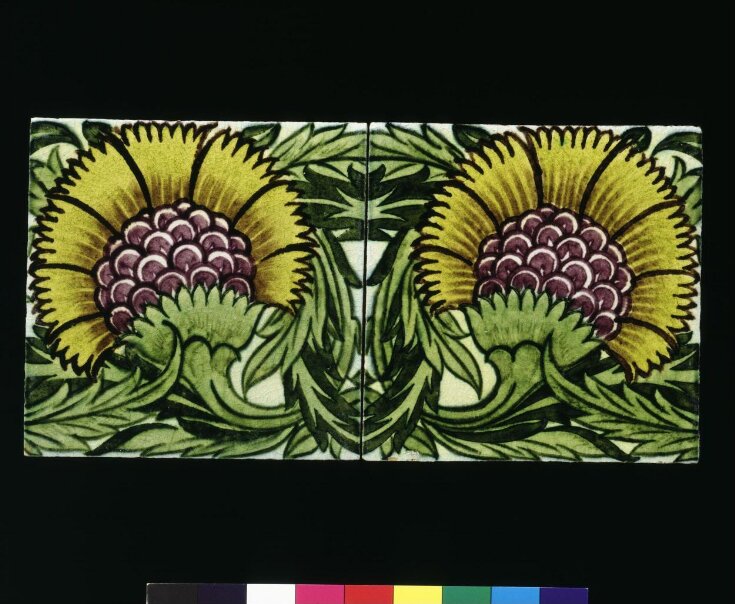
This pattern, with flower heads facing in alternating directions, was probably the most popular of all of De Morgan's tile designs. It was known as 'BBB', after the Norwich firm of Barnard, Bishop and Barnard who made cast-iron fireplaces and supplied tiles for use in conjunction with them.
Materials & Making
De Morgan's technique for transferring patterns to tiles such as these was unusual. The decoration was painted onto a sheet of fine tissue placed on a sheet of glass, behind which an outline of the pattern acted as a guide. The tissue was then fixed face-down onto the surface of the tile, which had been coated with a layer of fine white clay. The surface was then dusted with powdered glaze. During the firing the tissue would burn away and the ash would be incorporated into the glaze.
Hand-painted tiles became a regular feature of Arts and Crafts interiors from the 1860s onwards. Such schemes were often associated with the revival among architects of the English vernacular, and notably the 'Old English' and 'Queen Anne' styles pioneered by Richard Norman Shaw. The tiles themselves were produced by firms such as those of William Morris and William De Morgan, or were imported from The Netherlands. Larger industrial manufacturers also produced some lines that catered to Arts and Crafts tastes. Fireplaces were the most common setting for such tiles.
Design & Designing
This pattern, with flower heads facing in alternating directions, was probably the most popular of all of De Morgan's tile designs. It was known as 'BBB', after the Norwich firm of Barnard, Bishop and Barnard who made cast-iron fireplaces and supplied tiles for use in conjunction with them.
Materials & Making
De Morgan's technique for transferring patterns to tiles such as these was unusual. The decoration was painted onto a sheet of fine tissue placed on a sheet of glass, behind which an outline of the pattern acted as a guide. The tissue was then fixed face-down onto the surface of the tile, which had been coated with a layer of fine white clay. The surface was then dusted with powdered glaze. During the firing the tissue would burn away and the ash would be incorporated into the glaze.
Delve deeper
Discover more about this object

Object details
| Categories | |
| Object type | |
| Title | BBB (manufacturer's title) |
| Materials and techniques | Earthenware, with hand-painted decoration over a white slip |
| Brief description | Tile, 'BBB' design, by William de Morgan, London, England, late 19th century |
| Physical description | Pair of tiles: 'BBB' |
| Dimensions |
|
| Marks and inscriptions | Impressed mark: 'DM98' |
| Gallery label | British Galleries:
ORIGINAL DESIGN FOR TILES and two examples The potter William De Morgan made both grand, individual works of art, such as the vase and cover in the case above, and more commercial items such as tiles. Here is the original design and two samples of a pattern called BBB. This was one of his most popular tiles and was named after the iron founding firm of Barnard, Bishop and Barnard of Norwich, who made the fireplaces in which De Morgan's tiles were frequently used.(27/03/2003) |
| Credit line | Bequeathed by Mrs G. M. Spear |
| Object history | Designed by William De Morgan (born in London, 1839, died there in 1917) and made by his firm in Fulham, London |
| Summary | Object Type Hand-painted tiles became a regular feature of Arts and Crafts interiors from the 1860s onwards. Such schemes were often associated with the revival among architects of the English vernacular, and notably the 'Old English' and 'Queen Anne' styles pioneered by Richard Norman Shaw. The tiles themselves were produced by firms such as those of William Morris and William De Morgan, or were imported from The Netherlands. Larger industrial manufacturers also produced some lines that catered to Arts and Crafts tastes. Fireplaces were the most common setting for such tiles. Design & Designing This pattern, with flower heads facing in alternating directions, was probably the most popular of all of De Morgan's tile designs. It was known as 'BBB', after the Norwich firm of Barnard, Bishop and Barnard who made cast-iron fireplaces and supplied tiles for use in conjunction with them. Materials & Making De Morgan's technique for transferring patterns to tiles such as these was unusual. The decoration was painted onto a sheet of fine tissue placed on a sheet of glass, behind which an outline of the pattern acted as a guide. The tissue was then fixed face-down onto the surface of the tile, which had been coated with a layer of fine white clay. The surface was then dusted with powdered glaze. During the firing the tissue would burn away and the ash would be incorporated into the glaze. |
| Associated objects | |
| Collection | |
| Accession number | C.12A-1971 |
About this object record
Explore the Collections contains over a million catalogue records, and over half a million images. It is a working database that includes information compiled over the life of the museum. Some of our records may contain offensive and discriminatory language, or reflect outdated ideas, practice and analysis. We are committed to addressing these issues, and to review and update our records accordingly.
You can write to us to suggest improvements to the record.
Suggest feedback
You can write to us to suggest improvements to the record.
Suggest feedback
| Record created | March 27, 2003 |
| Record URL |
Download as: JSONIIIF Manifest
