Hogarth's Dog, Trump
Figure
1747-1750 (made)
1747-1750 (made)
| Artist/Maker | |
| Place of origin |
Object Type
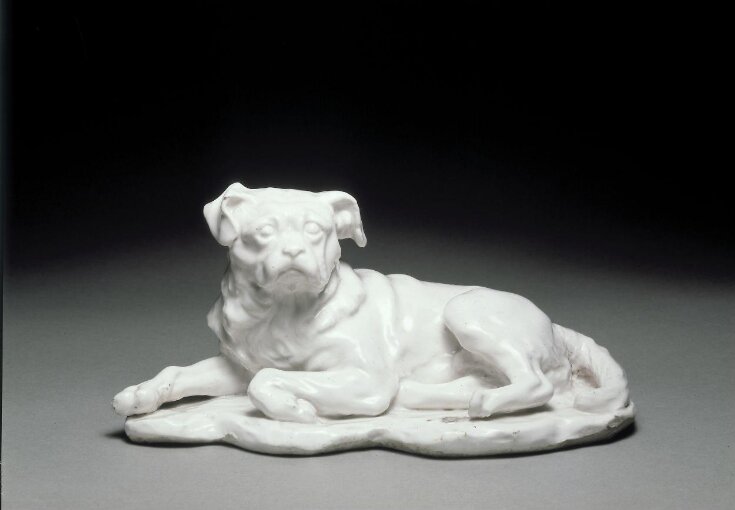
Trump was the pet dog of the artist William Hogarth (1697-1762), and porcelain figures of the pug were probably intended for sale to admirers of Hogarth's paintings and prints. They would probably have been displayed in libraries or other domestic interiors. Trump has a much longer muzzle than the pugs of today.
People
Hogarth depicted Trump prominently in the foreground of his self-portrait of 1745 (now in Tate Britain). A combative personality, Hogarth identified strongly with his pet, and as a result was himself depicted as Trump in Pug's Graces, a caricature of 1753 by the watercolour painter Paul Sandby (1730-1809). The sculptor Louis-François Roubiliac (1705-1762) modelled the original terracotta on which this small sculpture is indirectly based. The manager of the Chelsea porcelain factory, Nicholas Sprimont (1716-1771), was a friend of both Hogarth and Roubiliac.
Design & Designing
Roubiliac's original terracotta of Trump remained with Hogarth's widow until her death in 1790, while plaster casts of the pug were sold among the sculptor's effects in 1762. The Staffordshire potter Josiah Wedgwood (1730-1795) made versions in Black Basalt. He based these on a cast bought in 1774 from the London plaster shop of Richard Parker. The Chelsea factory probably also based its version on a commercially available plaster.
Trump was the pet dog of the artist William Hogarth (1697-1762), and porcelain figures of the pug were probably intended for sale to admirers of Hogarth's paintings and prints. They would probably have been displayed in libraries or other domestic interiors. Trump has a much longer muzzle than the pugs of today.
People
Hogarth depicted Trump prominently in the foreground of his self-portrait of 1745 (now in Tate Britain). A combative personality, Hogarth identified strongly with his pet, and as a result was himself depicted as Trump in Pug's Graces, a caricature of 1753 by the watercolour painter Paul Sandby (1730-1809). The sculptor Louis-François Roubiliac (1705-1762) modelled the original terracotta on which this small sculpture is indirectly based. The manager of the Chelsea porcelain factory, Nicholas Sprimont (1716-1771), was a friend of both Hogarth and Roubiliac.
Design & Designing
Roubiliac's original terracotta of Trump remained with Hogarth's widow until her death in 1790, while plaster casts of the pug were sold among the sculptor's effects in 1762. The Staffordshire potter Josiah Wedgwood (1730-1795) made versions in Black Basalt. He based these on a cast bought in 1774 from the London plaster shop of Richard Parker. The Chelsea factory probably also based its version on a commercially available plaster.
Delve deeper
Discover more about this object

Object details
| Categories | |
| Object type | |
| Title | Hogarth's Dog, Trump (generic title) |
| Materials and techniques | Soft-paste porcelain |
| Brief description | Porcelain figure of Hogarth's dog 'Trump', Chelsea Porcelain factory, 1747-1750 |
| Physical description | Figure of Hogarth's dog 'Trump', soft-paste porcelain. |
| Dimensions |
|
| Gallery label | British Galleries:
The dog was made after a model by the sculptor Louis-François Roubiliac. It is likely that this model was bought from one of the London plaster shops, which sold plaster chimneypiece and library ornaments. Such plasters were often copied by the English ceramic factories.(27/03/2003) |
| Object history | After an original by Louis-François Roubiliac (born in Lyon, France, 1705, died in London, 1762) Made at the Chelsea porcelain factory, London |
| Subject depicted | |
| Association | |
| Summary | Object Type Trump was the pet dog of the artist William Hogarth (1697-1762), and porcelain figures of the pug were probably intended for sale to admirers of Hogarth's paintings and prints. They would probably have been displayed in libraries or other domestic interiors. Trump has a much longer muzzle than the pugs of today. People Hogarth depicted Trump prominently in the foreground of his self-portrait of 1745 (now in Tate Britain). A combative personality, Hogarth identified strongly with his pet, and as a result was himself depicted as Trump in Pug's Graces, a caricature of 1753 by the watercolour painter Paul Sandby (1730-1809). The sculptor Louis-François Roubiliac (1705-1762) modelled the original terracotta on which this small sculpture is indirectly based. The manager of the Chelsea porcelain factory, Nicholas Sprimont (1716-1771), was a friend of both Hogarth and Roubiliac. Design & Designing Roubiliac's original terracotta of Trump remained with Hogarth's widow until her death in 1790, while plaster casts of the pug were sold among the sculptor's effects in 1762. The Staffordshire potter Josiah Wedgwood (1730-1795) made versions in Black Basalt. He based these on a cast bought in 1774 from the London plaster shop of Richard Parker. The Chelsea factory probably also based its version on a commercially available plaster. |
| Bibliographic reference | Baker, Malcolm, and Brenda Richardson (eds.), A Grand Design: The Art of the Victoria and Albert Museum, London: V&A Publications, 1999.
|
| Collection | |
| Accession number | C.101-1966 |
About this object record
Explore the Collections contains over a million catalogue records, and over half a million images. It is a working database that includes information compiled over the life of the museum. Some of our records may contain offensive and discriminatory language, or reflect outdated ideas, practice and analysis. We are committed to addressing these issues, and to review and update our records accordingly.
You can write to us to suggest improvements to the record.
Suggest feedback
You can write to us to suggest improvements to the record.
Suggest feedback
| Record created | March 27, 2003 |
| Record URL |
Download as: JSONIIIF Manifest
