
Tile Set
1847-1850 (made)
| Artist/Maker | |
| Place of origin |
Object Type
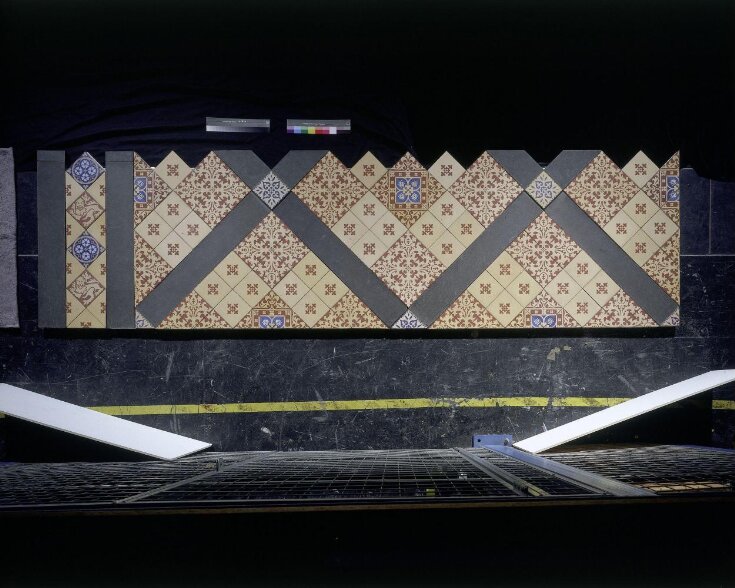
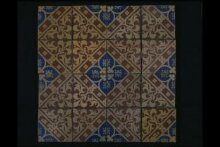
Encaustic tiles (tiles with decoration inlaid into their surface with contrastingly coloured clay) were produced in large quantities from the mid-19th century. The firm of Minton & Co. was one of the major producers.
Places
The old Palace of Westminster, London, was largely destroyed by fire in 1834, so a competition was held to design a new building for the seat of Parliament. After much debate, a stipulation was made that the new design had to be in the Gothic or Elizabethan Revival style. Charles Barry (1795-1860), who was assisted in his Gothic Revival design by A.W.N. Pugin (1812-1852), won the competition. Construction of the new building started in 1840. The House of Lords was opened to great acclaim in 1847, and the House of Commons was completed in 1852. Encaustic tiles, a common feature of Gothic Revival buildings, were used extensively throughout the Palace of Westminster.
Design & Designing
In 1844 Charles Barry again enlisted Pugin's help, this time to design the interior fittings for the Palace of Westminster. Barry prevented the government from putting the production of the designs out to tender. This allowed Pugin to work with his established contacts in the manufacturing industries. The encaustic tiles were produced by the firm of his friend Herbert Minton (1793-1858) in Stoke-on-Trent, Staffordshire. Pugin is reputed to have sketched the designs for a number of encaustic tiles while on the train to Stoke.
Encaustic tiles (tiles with decoration inlaid into their surface with contrastingly coloured clay) were produced in large quantities from the mid-19th century. The firm of Minton & Co. was one of the major producers.
Places
The old Palace of Westminster, London, was largely destroyed by fire in 1834, so a competition was held to design a new building for the seat of Parliament. After much debate, a stipulation was made that the new design had to be in the Gothic or Elizabethan Revival style. Charles Barry (1795-1860), who was assisted in his Gothic Revival design by A.W.N. Pugin (1812-1852), won the competition. Construction of the new building started in 1840. The House of Lords was opened to great acclaim in 1847, and the House of Commons was completed in 1852. Encaustic tiles, a common feature of Gothic Revival buildings, were used extensively throughout the Palace of Westminster.
Design & Designing
In 1844 Charles Barry again enlisted Pugin's help, this time to design the interior fittings for the Palace of Westminster. Barry prevented the government from putting the production of the designs out to tender. This allowed Pugin to work with his established contacts in the manufacturing industries. The encaustic tiles were produced by the firm of his friend Herbert Minton (1793-1858) in Stoke-on-Trent, Staffordshire. Pugin is reputed to have sketched the designs for a number of encaustic tiles while on the train to Stoke.
Object details
| Categories | |
| Object type | |
| Materials and techniques | Earthenware tiles with inlaid decoration, and slate edging slabs |
| Brief description | Encaustic tiles from the House of Commons |
| Dimensions |
|
| Marks and inscriptions | Marked 'MINTON & CO' and impressed 'STOKE UPON TRENT' |
| Gallery label | British Galleries:
The tile floors that Pugin designed for the new Palace of Westminster were the earliest extensive series of tile floors made in the 19th century.(27/03/2003) |
| Credit line | Given by the Department of the Environment |
| Object history | Historical significance: The tile floors that Pugin designed for the new Palace of Westminster were the earliest extensive series of tile floors made in the 19th century. |
| Summary | Object Type Encaustic tiles (tiles with decoration inlaid into their surface with contrastingly coloured clay) were produced in large quantities from the mid-19th century. The firm of Minton & Co. was one of the major producers. Places The old Palace of Westminster, London, was largely destroyed by fire in 1834, so a competition was held to design a new building for the seat of Parliament. After much debate, a stipulation was made that the new design had to be in the Gothic or Elizabethan Revival style. Charles Barry (1795-1860), who was assisted in his Gothic Revival design by A.W.N. Pugin (1812-1852), won the competition. Construction of the new building started in 1840. The House of Lords was opened to great acclaim in 1847, and the House of Commons was completed in 1852. Encaustic tiles, a common feature of Gothic Revival buildings, were used extensively throughout the Palace of Westminster. Design & Designing In 1844 Charles Barry again enlisted Pugin's help, this time to design the interior fittings for the Palace of Westminster. Barry prevented the government from putting the production of the designs out to tender. This allowed Pugin to work with his established contacts in the manufacturing industries. The encaustic tiles were produced by the firm of his friend Herbert Minton (1793-1858) in Stoke-on-Trent, Staffordshire. Pugin is reputed to have sketched the designs for a number of encaustic tiles while on the train to Stoke. |
| Associated objects |
|
| Collection | |
| Accession number | C.1:5-1985 |
About this object record
Explore the Collections contains over a million catalogue records, and over half a million images. It is a working database that includes information compiled over the life of the museum. Some of our records may contain offensive and discriminatory language, or reflect outdated ideas, practice and analysis. We are committed to addressing these issues, and to review and update our records accordingly.
You can write to us to suggest improvements to the record.
Suggest feedback
You can write to us to suggest improvements to the record.
Suggest feedback
| Record created | March 27, 2003 |
| Record URL |
Download as: JSONIIIF Manifest
