
Homer
Bust
1764 (dated)
1764 (dated)
| Artist/Maker | |
| Place of origin |
Object Type
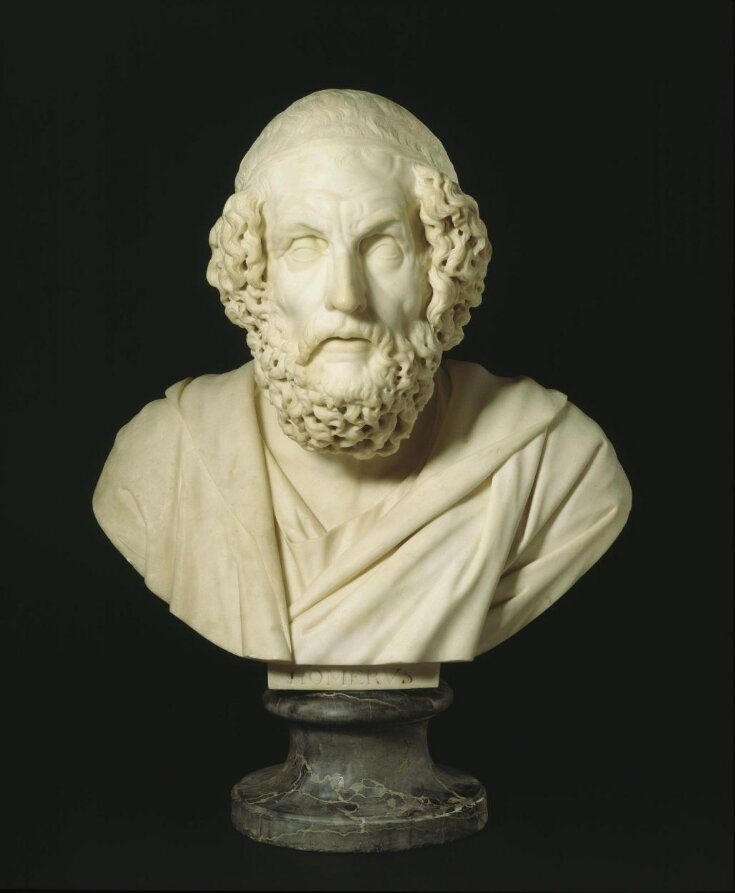
This bust of the ancient Greek poet Homer may have been one of a set carved for a library. It was made in Florence, where the sculptor Francis Harwood spent some of his working life, mostly undertaking commissions for British visitors on the Grand Tour. Library busts, usually set on top of bookcases, were extremely popular in the homes of the well-to-do and in universities (for example, the library at Trinity College, Cambridge) in the18th century.
People
Francis Harwood (born about 1727; died 1783) spent 30 years working first in Rome and then in Florence. He specialised in carving busts and figures after the antique, including the Venus de' Medici and the Apollo Belvedere. The sculptor Joseph Nollekens (1737-1823) wrote in a letter from Rome in 1769 in his idiosyncratic style: 'there is F.H. at Florence who is knocking the marbil about like feway, & belive he as got more work to do than any One Sculptor in England'.
Materials & Making
Marble busts were among the most prestigious types of portrait commissioned in Britain during the 18th century. Harwood was able to obtain the material relatively easily in Italy, probably from the quarries at Carrara. He may also have learned the skills needed to carve marble in Florence, or more probably Rome, which was the most important artistic centre for an aspiring artist at this date, partly because of the rich collections of antique sculpture, and partly because of the concentration of both artists and patrons.
This bust of the ancient Greek poet Homer may have been one of a set carved for a library. It was made in Florence, where the sculptor Francis Harwood spent some of his working life, mostly undertaking commissions for British visitors on the Grand Tour. Library busts, usually set on top of bookcases, were extremely popular in the homes of the well-to-do and in universities (for example, the library at Trinity College, Cambridge) in the18th century.
People
Francis Harwood (born about 1727; died 1783) spent 30 years working first in Rome and then in Florence. He specialised in carving busts and figures after the antique, including the Venus de' Medici and the Apollo Belvedere. The sculptor Joseph Nollekens (1737-1823) wrote in a letter from Rome in 1769 in his idiosyncratic style: 'there is F.H. at Florence who is knocking the marbil about like feway, & belive he as got more work to do than any One Sculptor in England'.
Materials & Making
Marble busts were among the most prestigious types of portrait commissioned in Britain during the 18th century. Harwood was able to obtain the material relatively easily in Italy, probably from the quarries at Carrara. He may also have learned the skills needed to carve marble in Florence, or more probably Rome, which was the most important artistic centre for an aspiring artist at this date, partly because of the rich collections of antique sculpture, and partly because of the concentration of both artists and patrons.
Object details
| Categories | |
| Object type | |
| Title | Homer (generic title) |
| Materials and techniques | Marble |
| Brief description | Bust, marble, Homer, by Francis Harwood, after the Antique, England or Florence, signed and dated 1764 |
| Physical description | Bearded portrait of Homer facing straight. Signed and dated. |
| Dimensions |
|
| Marks and inscriptions | 'F.Harwood fecit 1764' (Inscribed on base beneath the left shoulder:) |
| Gallery label | British Galleries:
Copies of antique busts, especially of ancient Greek and Roman writers, were purchased by British patrons who were unable to obtain originals. This demand was met by sculptors such as Francis Harwood who spent his career in Florence, 'knocking out the marble like fury'.(27/03/2003) |
| Credit line | Given by Bert Crowther |
| Object history | Carved by Francis Harwood (born about 1727, died in Florence, Italy, 1783). Given by Mr. Bert Crowther. Formerly at Gordon Castle, Banffshire, Scotland. Given by Bert Crowther, Isleworth in 1958, though actually received into the Museum in 1948 together with its pendant bust of Seneca (V&A. mus. no. A.26-1948). On long-term loan to Chiswick House from 1958, returned to the Museum in December 1990. |
| Production | Signed and dated 1764. Probably carved in Florence. |
| Subject depicted | |
| Summary | Object Type This bust of the ancient Greek poet Homer may have been one of a set carved for a library. It was made in Florence, where the sculptor Francis Harwood spent some of his working life, mostly undertaking commissions for British visitors on the Grand Tour. Library busts, usually set on top of bookcases, were extremely popular in the homes of the well-to-do and in universities (for example, the library at Trinity College, Cambridge) in the18th century. People Francis Harwood (born about 1727; died 1783) spent 30 years working first in Rome and then in Florence. He specialised in carving busts and figures after the antique, including the Venus de' Medici and the Apollo Belvedere. The sculptor Joseph Nollekens (1737-1823) wrote in a letter from Rome in 1769 in his idiosyncratic style: 'there is F.H. at Florence who is knocking the marbil about like feway, & belive he as got more work to do than any One Sculptor in England'. Materials & Making Marble busts were among the most prestigious types of portrait commissioned in Britain during the 18th century. Harwood was able to obtain the material relatively easily in Italy, probably from the quarries at Carrara. He may also have learned the skills needed to carve marble in Florence, or more probably Rome, which was the most important artistic centre for an aspiring artist at this date, partly because of the rich collections of antique sculpture, and partly because of the concentration of both artists and patrons. |
| Bibliographic references |
|
| Collection | |
| Accession number | A.8-1958 |
About this object record
Explore the Collections contains over a million catalogue records, and over half a million images. It is a working database that includes information compiled over the life of the museum. Some of our records may contain offensive and discriminatory language, or reflect outdated ideas, practice and analysis. We are committed to addressing these issues, and to review and update our records accordingly.
You can write to us to suggest improvements to the record.
Suggest feedback
You can write to us to suggest improvements to the record.
Suggest feedback
| Record created | March 27, 2003 |
| Record URL |
Download as: JSONIIIF Manifest
