
William Shakespeare
Bust
after 1726 (made)
after 1726 (made)
| Artist/Maker | |
| Place of origin |
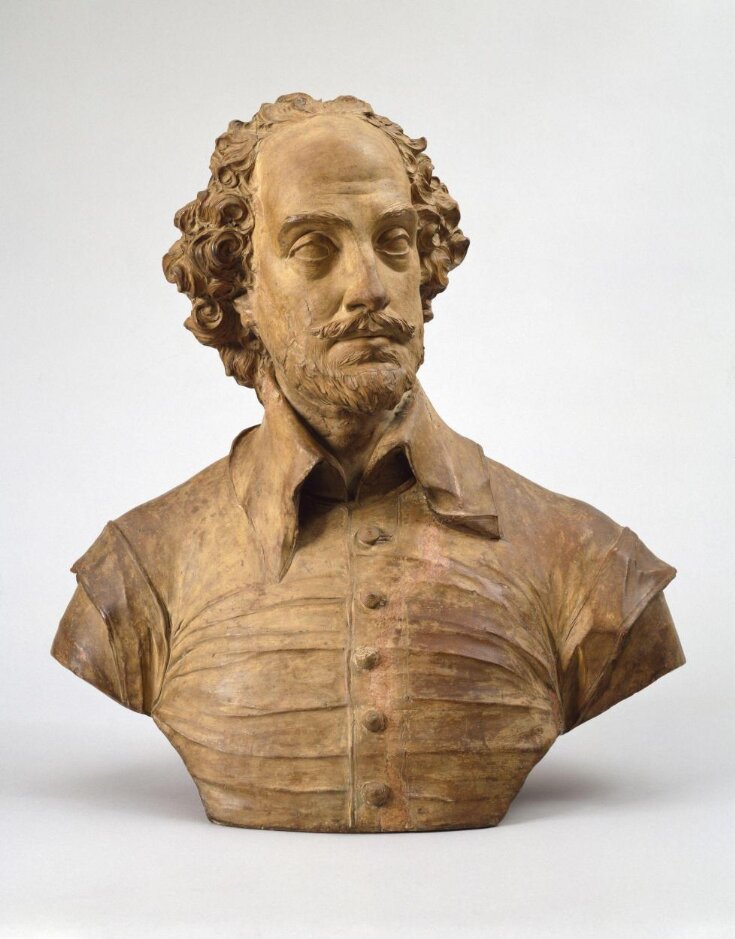
This historicising bust of Shakespeare may well have been one of a group of British Worthies. Shakespeare, along with John Milton, Isaac Newton and other figures became important symbols in the 18th century for what were perceived as the great British traditions of independent and creative thought and action.
This particular bust is a version of one in the Temple of British Worthies at Stowe, Buckinghamshire; the bust at Stowe was carved by Rysbrack for Lord Cobham in about 1730. This version may also have been one of a set, although its original context is unknown. This terracotta bust may have been a model for the stone bust at Stowe.
John Michael Rysbrack (1694-1770) was one of the most successful sculptors working in Britain in the 18th century. Born in Antwerp, he arrived in England in about 1720, and soon established himself as a leading sculptor of funerary monuments and portrait busts in particular. Many of his monuments are in Westminster Abbey. His bust of the architect James Gibbs (1682-1754) commemorates his friendship with him (the bust was commissioned and owned by Gibbs himself); he and Gibbs worked together on a number of projects, at Stowe and elsewhere.
This particular bust is a version of one in the Temple of British Worthies at Stowe, Buckinghamshire; the bust at Stowe was carved by Rysbrack for Lord Cobham in about 1730. This version may also have been one of a set, although its original context is unknown. This terracotta bust may have been a model for the stone bust at Stowe.
John Michael Rysbrack (1694-1770) was one of the most successful sculptors working in Britain in the 18th century. Born in Antwerp, he arrived in England in about 1720, and soon established himself as a leading sculptor of funerary monuments and portrait busts in particular. Many of his monuments are in Westminster Abbey. His bust of the architect James Gibbs (1682-1754) commemorates his friendship with him (the bust was commissioned and owned by Gibbs himself); he and Gibbs worked together on a number of projects, at Stowe and elsewhere.
Object details
| Categories | |
| Object type | |
| Title | William Shakespeare (generic title) |
| Materials and techniques | Terracotta |
| Brief description | Bust, terracotta, of Shakespeare, by John Michael Rysbrack, England, ca. 1730 |
| Physical description | The playwright William Shakerspeare is shown in contemporary dress with a buttoned jerkin. |
| Dimensions |
|
| Gallery label | British Galleries:
Shakespeare (1564-1616) was revered in the 18th century as a British genius. Along with Sir Isaac Newton (1642-1727), he was celebrated through busts and statues demonstrating pride in the nation's history. This example is based on a stone bust by Michael Rysbrack, made for the Temple of British Worthies at Stowe, Buckinghamshire.(27/03/2003) |
| Credit line | Presented by Mrs M. A. Miller, in memory of her father, Augustus William Roxon |
| Object history | Modelled in England after a model by Michael Rysbrack (born in Antwerp, Belgium, 1694, died in London, 1770). Given by Mrs M.A. Miller, Anglesey House, Isle of Wight in 1924 in memory of her father Augustus William Rixon, to whom the bust had previously belonged. A business card for E.W. Field, Dealer in Antiques and Works of Art, 28 Union Street, Ryde, Isle of Wight, was found amongst the papers relating to the objects offered as gifts to the Museum by Mrs Miller, and may indicate he acted as an agent for the donor. |
| Subject depicted | |
| Summary | This historicising bust of Shakespeare may well have been one of a group of British Worthies. Shakespeare, along with John Milton, Isaac Newton and other figures became important symbols in the 18th century for what were perceived as the great British traditions of independent and creative thought and action. This particular bust is a version of one in the Temple of British Worthies at Stowe, Buckinghamshire; the bust at Stowe was carved by Rysbrack for Lord Cobham in about 1730. This version may also have been one of a set, although its original context is unknown. This terracotta bust may have been a model for the stone bust at Stowe. John Michael Rysbrack (1694-1770) was one of the most successful sculptors working in Britain in the 18th century. Born in Antwerp, he arrived in England in about 1720, and soon established himself as a leading sculptor of funerary monuments and portrait busts in particular. Many of his monuments are in Westminster Abbey. His bust of the architect James Gibbs (1682-1754) commemorates his friendship with him (the bust was commissioned and owned by Gibbs himself); he and Gibbs worked together on a number of projects, at Stowe and elsewhere. |
| Bibliographic references |
|
| Collection | |
| Accession number | A.6-1924 |
About this object record
Explore the Collections contains over a million catalogue records, and over half a million images. It is a working database that includes information compiled over the life of the museum. Some of our records may contain offensive and discriminatory language, or reflect outdated ideas, practice and analysis. We are committed to addressing these issues, and to review and update our records accordingly.
You can write to us to suggest improvements to the record.
Suggest feedback
You can write to us to suggest improvements to the record.
Suggest feedback
| Record created | March 27, 2003 |
| Record URL |
Download as: JSONIIIF Manifest
