Relief
Relief
1822 (made)
1822 (made)
| Artist/Maker | |
| Place of origin |
Object Type
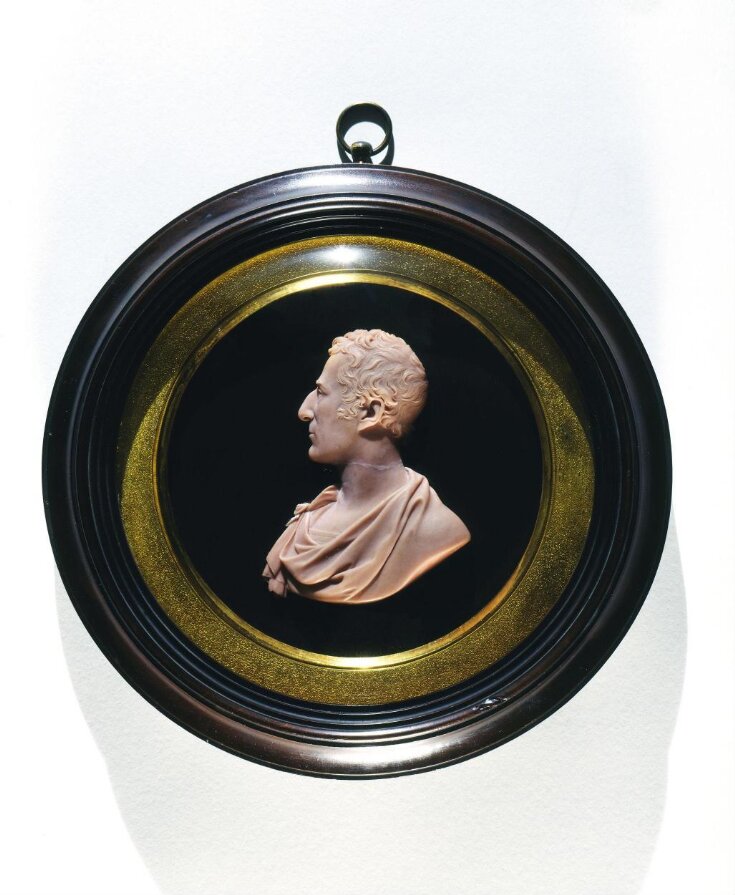
This small wax portrait of Arthur Wellesley, 1st Duke of Wellington (1769-1852), was one of many likenesses produced in different media during the 19th century, following the victory at Waterloo in 1815. The wax was probably produced in some numbers and sold to retail customers, rather than being commissioned. Such waxes would be hung on walls, predominantly in middle-class homes.
People
Peter Rouw (1770-1852) was a highly successful wax modeller, who was appointed 'Sculptor & Modeller of Gems and Cameos to His Majesty' (George III) in 1807. He attended the Royal Academy Schools in 1788, and exhibited 22 portraits in wax at the Royal Academy between 1787 and 1833. He specialised in pink wax portraits, such as this one of Wellington.
Materials & Making
Wax portraits and figure groups were popular in Britain during the 18th and early19th centuries. The malleability of the material meant that it could be modelled extremely naturalistically, and, as casts could easily be taken and wax was relatively cheap, reproductions could be made and sold at low prices. Sometimes colour was added: the pink colour of this portrait was favoured by Rouw and other portrait modellers. Some wax pieces were naturalistically coloured and adorned with textiles or other additions, such as glass jewels, increasing the realism of the pieces.
This small wax portrait of Arthur Wellesley, 1st Duke of Wellington (1769-1852), was one of many likenesses produced in different media during the 19th century, following the victory at Waterloo in 1815. The wax was probably produced in some numbers and sold to retail customers, rather than being commissioned. Such waxes would be hung on walls, predominantly in middle-class homes.
People
Peter Rouw (1770-1852) was a highly successful wax modeller, who was appointed 'Sculptor & Modeller of Gems and Cameos to His Majesty' (George III) in 1807. He attended the Royal Academy Schools in 1788, and exhibited 22 portraits in wax at the Royal Academy between 1787 and 1833. He specialised in pink wax portraits, such as this one of Wellington.
Materials & Making
Wax portraits and figure groups were popular in Britain during the 18th and early19th centuries. The malleability of the material meant that it could be modelled extremely naturalistically, and, as casts could easily be taken and wax was relatively cheap, reproductions could be made and sold at low prices. Sometimes colour was added: the pink colour of this portrait was favoured by Rouw and other portrait modellers. Some wax pieces were naturalistically coloured and adorned with textiles or other additions, such as glass jewels, increasing the realism of the pieces.
Object details
| Categories | |
| Object type | |
| Title | Relief |
| Materials and techniques | Modelled wax |
| Brief description | Portrait of the Duke of Wellington (1769-1852) |
| Physical description | Relief, portrait in pink wax. Shown in profile facing to the left with a loose drapery round the shoulders. On a plain ground backed with brown. Signed underneath 'Peter Rouw Sculptor & Modeller to his Majesty, 1822.' On the back is written in ink 'Portrait of the Duke of Wellington, No. 39 Peter Rouw, Sculptor & Modeller of Gems and Cameos to His Majesty, 80 Norton Street, Portland Road, London. 1822.' |
| Dimensions |
|
| Marks and inscriptions | Portrait of the Duke of Wellington- Peter Rouw- Sculptor- Modeller of Gem & Cameos to His majesty. New Road- Opposite Cleveland London 1822. |
| Gallery label | British Galleries:
The Duke of Wellington's victory over Napoleon at Waterloo in 1815 made him a national hero. Wax portraits provided the perfect medium for multiple images of such a revered figure. After the image was modelled a mould could be taken from it and the waxes produced in large numbers.(27/03/2003) |
| Object history | Made in London by Peter Rouw (1771-1852). Given by Miss E.D.R. Formilli. Gift of Miss E.D.R. Formilli |
| Subject depicted | |
| Summary | Object Type This small wax portrait of Arthur Wellesley, 1st Duke of Wellington (1769-1852), was one of many likenesses produced in different media during the 19th century, following the victory at Waterloo in 1815. The wax was probably produced in some numbers and sold to retail customers, rather than being commissioned. Such waxes would be hung on walls, predominantly in middle-class homes. People Peter Rouw (1770-1852) was a highly successful wax modeller, who was appointed 'Sculptor & Modeller of Gems and Cameos to His Majesty' (George III) in 1807. He attended the Royal Academy Schools in 1788, and exhibited 22 portraits in wax at the Royal Academy between 1787 and 1833. He specialised in pink wax portraits, such as this one of Wellington. Materials & Making Wax portraits and figure groups were popular in Britain during the 18th and early19th centuries. The malleability of the material meant that it could be modelled extremely naturalistically, and, as casts could easily be taken and wax was relatively cheap, reproductions could be made and sold at low prices. Sometimes colour was added: the pink colour of this portrait was favoured by Rouw and other portrait modellers. Some wax pieces were naturalistically coloured and adorned with textiles or other additions, such as glass jewels, increasing the realism of the pieces. |
| Collection | |
| Accession number | A.58-1940 |
About this object record
Explore the Collections contains over a million catalogue records, and over half a million images. It is a working database that includes information compiled over the life of the museum. Some of our records may contain offensive and discriminatory language, or reflect outdated ideas, practice and analysis. We are committed to addressing these issues, and to review and update our records accordingly.
You can write to us to suggest improvements to the record.
Suggest feedback
You can write to us to suggest improvements to the record.
Suggest feedback
| Record created | March 27, 2003 |
| Record URL |
Download as: JSONIIIF Manifest
