
Mary Salmon
Bust
ca. 1750 (made)
ca. 1750 (made)
| Artist/Maker | |
| Place of origin |
Object Type
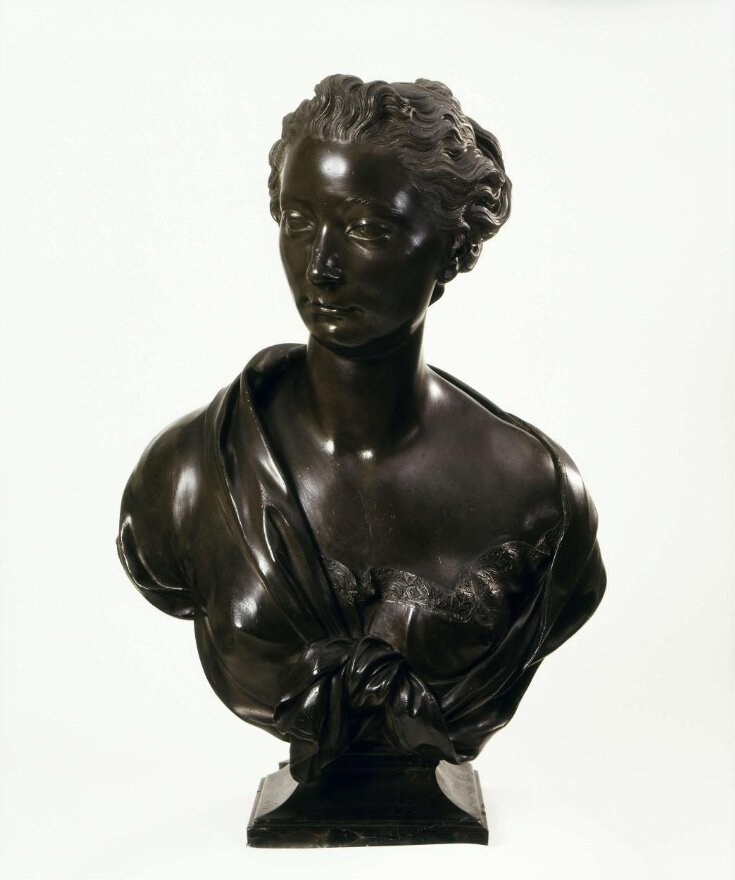
This portrait bust was one of a pair, made along with the companion lead bust of Mary's husband, Dr W. H. Salmon. The sitters were not aristocrats, and the fact that they (or possibly members of their family) commissioned portraits of them of this sort indicates the sculpture's popularity among the professional classes at mid-century. The busts of Dr and Mrs Salmon were probably made to be displayed in their own home, perhaps on a chimneypiece. No other copies of this bust are known, although lead was a reproductive material, and this piece would have been cast from a mould.
Materials & Making
Lead sculptures were cast from models probably of clay or terracotta (literally 'baked clay'). A mould would have been made from the sculptor's original clay or terracotta model, and lead versions were then cast from it. Lead is a soft and malleable metal, and the subtlety of the original modelling in the clay is seen clearly in the surface here, especially in the lace bodice. Since lead was a relatively cheap material, such a bust was less costly than a carved marble one would have been. Henry Cheere (1703-1781) is likely to have been the sculptor, both because the socle (the small integral base on which the bust stands) replicates one at Belton House, Lincolnshire, known to be by him, and because his brother, John Cheere (1709-1787), produced many sculptures in lead, and could well have been involved in the production of this piece.
This portrait bust was one of a pair, made along with the companion lead bust of Mary's husband, Dr W. H. Salmon. The sitters were not aristocrats, and the fact that they (or possibly members of their family) commissioned portraits of them of this sort indicates the sculpture's popularity among the professional classes at mid-century. The busts of Dr and Mrs Salmon were probably made to be displayed in their own home, perhaps on a chimneypiece. No other copies of this bust are known, although lead was a reproductive material, and this piece would have been cast from a mould.
Materials & Making
Lead sculptures were cast from models probably of clay or terracotta (literally 'baked clay'). A mould would have been made from the sculptor's original clay or terracotta model, and lead versions were then cast from it. Lead is a soft and malleable metal, and the subtlety of the original modelling in the clay is seen clearly in the surface here, especially in the lace bodice. Since lead was a relatively cheap material, such a bust was less costly than a carved marble one would have been. Henry Cheere (1703-1781) is likely to have been the sculptor, both because the socle (the small integral base on which the bust stands) replicates one at Belton House, Lincolnshire, known to be by him, and because his brother, John Cheere (1709-1787), produced many sculptures in lead, and could well have been involved in the production of this piece.
Object details
| Categories | |
| Object type | |
| Parts | This object consists of 2 parts.
|
| Title | Mary Salmon (generic title) |
| Materials and techniques | Cast lead on wooden plinth |
| Brief description | Bust, lead, of Mrs Mary Salmon, probably after a model by Sir Henry Cheere, cast perhaps by John Cheere, English ca. 1750 |
| Physical description | Purchased together with A.19-1921 from the Rev. J.D.C. Wickham, 8 Landsdown Place East, Bath in 1921 for £170. |
| Dimensions |
|
| Gallery label | British Galleries:
Mary Salmon was the wife of a doctor in Holcombe, Somerset. Her bust was made as a pair to one of her husband. During the 18th century busts were increasingly made for members of the professional classes as well as members of the nobility. A lead bust cast from a terracotta model was considerably cheaper than one in marble.(27/03/2003) |
| Object history | Probably modelled by Sir Henry Cheere (born in London, 1703, died there in 1781); possibly cast in London by John Cheere (born in London, 1709, died there in 1787) |
| Subject depicted | |
| Summary | Object Type This portrait bust was one of a pair, made along with the companion lead bust of Mary's husband, Dr W. H. Salmon. The sitters were not aristocrats, and the fact that they (or possibly members of their family) commissioned portraits of them of this sort indicates the sculpture's popularity among the professional classes at mid-century. The busts of Dr and Mrs Salmon were probably made to be displayed in their own home, perhaps on a chimneypiece. No other copies of this bust are known, although lead was a reproductive material, and this piece would have been cast from a mould. Materials & Making Lead sculptures were cast from models probably of clay or terracotta (literally 'baked clay'). A mould would have been made from the sculptor's original clay or terracotta model, and lead versions were then cast from it. Lead is a soft and malleable metal, and the subtlety of the original modelling in the clay is seen clearly in the surface here, especially in the lace bodice. Since lead was a relatively cheap material, such a bust was less costly than a carved marble one would have been. Henry Cheere (1703-1781) is likely to have been the sculptor, both because the socle (the small integral base on which the bust stands) replicates one at Belton House, Lincolnshire, known to be by him, and because his brother, John Cheere (1709-1787), produced many sculptures in lead, and could well have been involved in the production of this piece. |
| Associated object | A.19-1921 (Pair) |
| Bibliographic references |
|
| Collection | |
| Accession number | A.20&A-1921 |
About this object record
Explore the Collections contains over a million catalogue records, and over half a million images. It is a working database that includes information compiled over the life of the museum. Some of our records may contain offensive and discriminatory language, or reflect outdated ideas, practice and analysis. We are committed to addressing these issues, and to review and update our records accordingly.
You can write to us to suggest improvements to the record.
Suggest feedback
You can write to us to suggest improvements to the record.
Suggest feedback
| Record created | March 27, 2003 |
| Record URL |
Download as: JSONIIIF Manifest
