
King James II crowned by Peace and Justice
Relief
ca. 1685 (made)
ca. 1685 (made)
| Artist/Maker | |
| Place of origin |
Object Type
The exact purpose of this allegorical ivory carving is unknown, although it may have been designed to commemorate the suppression by James II of the Monmouth Rebellion in 1685. It is signed by Jacobus Constantin, an artist who is otherwise unrecorded. He is likely to have been a Continental artist, perhaps from Dieppe, working for the Stuart court. A Jacques Constantin was admitted to the French Huguenot Hospital 25 February 1733, aged 78, when he was describe as a painter.
Subjects Depicted
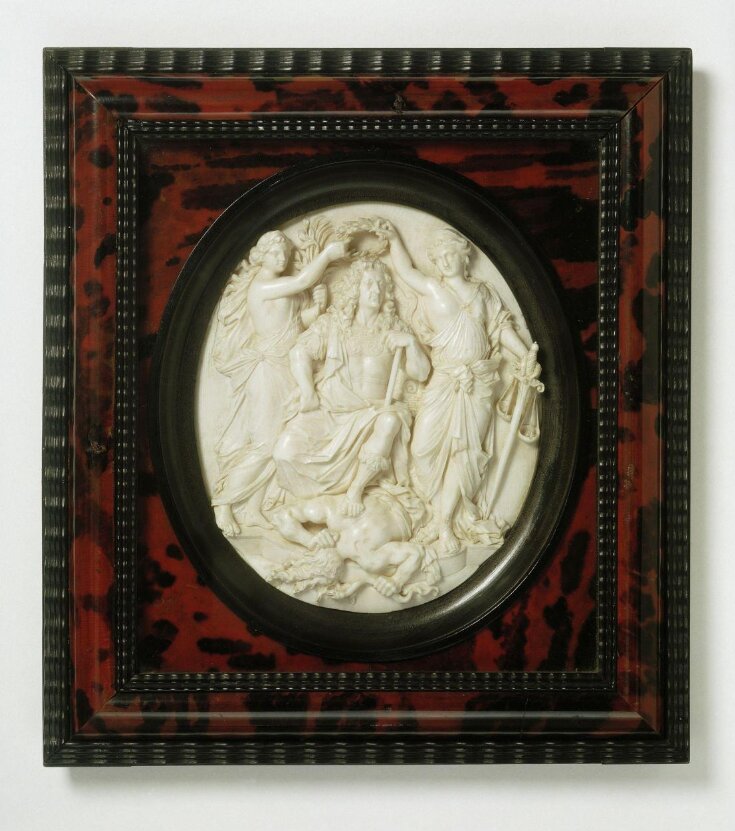
The King is seated on his throne, holding his sceptre and crushing with his left foot a representation of Discord, shown as a half-naked man with a serpent. Two classically dressed female figures, Peace and Justice, flank the King and jointly crown him with a laurel wreath of victory. Justice holds a sword and scales, while Peace holds an olive branch.
Materials & Making
Ivory was a precious and relatively expensive commodity, used at this date for portraits, and for allegorical images. It was particularly favoured by Netherlandish and German sculptors, who also used it to carve religious scenes. Ivory tusks were probably imported from Africa, where they were often bought at the same time as slaves, who were shipped to the sugar plantations in the West Indies. Ivory could be carved relatively easily, although occasionally faults led to breaks during the carving process. Because of the size and shape of the tusks large ivories are rare, many being even smaller than this piece.
The exact purpose of this allegorical ivory carving is unknown, although it may have been designed to commemorate the suppression by James II of the Monmouth Rebellion in 1685. It is signed by Jacobus Constantin, an artist who is otherwise unrecorded. He is likely to have been a Continental artist, perhaps from Dieppe, working for the Stuart court. A Jacques Constantin was admitted to the French Huguenot Hospital 25 February 1733, aged 78, when he was describe as a painter.
Subjects Depicted
The King is seated on his throne, holding his sceptre and crushing with his left foot a representation of Discord, shown as a half-naked man with a serpent. Two classically dressed female figures, Peace and Justice, flank the King and jointly crown him with a laurel wreath of victory. Justice holds a sword and scales, while Peace holds an olive branch.
Materials & Making
Ivory was a precious and relatively expensive commodity, used at this date for portraits, and for allegorical images. It was particularly favoured by Netherlandish and German sculptors, who also used it to carve religious scenes. Ivory tusks were probably imported from Africa, where they were often bought at the same time as slaves, who were shipped to the sugar plantations in the West Indies. Ivory could be carved relatively easily, although occasionally faults led to breaks during the carving process. Because of the size and shape of the tusks large ivories are rare, many being even smaller than this piece.
Object details
| Categories | |
| Object type | |
| Title | King James II crowned by Peace and Justice (generic title) |
| Materials and techniques | Ivory in glazed tortoiseshell and wood frame. |
| Brief description | Medallion relief, ivory, King James II Crowned by Peace and Justice, by Jacobus Constantin (perhaps Jacques Constantin of Dieppe), perhaps French, produced in Britain, c.1685. |
| Physical description | Oval relief in ivory. Signed on the back. The King is shown in full length, seated on a throne with his left foot on the back of Discord, a naked man lying prone on his face grasping a serpent. The King rests his left hand on a baton, and looks towards his left. A female figure symbolic of Justice, to his left, holding a sword and scales in her left hand, and crowning the King with a laurel wreath. To his right is Peace, standing and holding an olive branch, and also holding the laurel wreath together with Justice about to crown the King. |
| Dimensions |
|
| Content description | King James II is shown seated, resting his left foot on the shoulder of a prostrate defeated figure of Discord.On his left is an allegorical figure of Justice crowning him with a laurel wreath. On his right is another allegorical figure, of Peace, also crowning him and holding an olive branch. The relief may symbolize the defeat of the 1685 rebellion led by James, Duke of Monmouth (1649-1685). The relief is signed on the bcak 'Jacobus Constantin fecit'. This may be Jacques Constantin (c.1654-after 1732), from Dieppe, who was admitted to the French Huguenot hospital on 25 February 1733, aged 78, and described as a painter. |
| Marks and inscriptions | 'Jacobus Constantin fecit' (On the reverse )
|
| Gallery label | British Galleries:
King James II is shown enthroned, and dressed in classical armour. He is being crowned by two figures representing Peace (with an olive branch) and Justice (with a sword and scales), while Discord (with a snake) lies defeated underfoot. The design may symbolise the monarch crushing the rebellion in 1685 led by James, Duke of Monmouth (1649-1685).(27/03/2003) |
| Object history | Bought for £13 2s. 6d. through Durlacher Brothers, New Bond Street, London, at Christies's, London, 15 April 1937 (Bernard Currie Collection), lot 43. Formerly Currie Collection, Minley Manor, Hampshire, 1908 |
| Subjects depicted | |
| Summary | Object Type The exact purpose of this allegorical ivory carving is unknown, although it may have been designed to commemorate the suppression by James II of the Monmouth Rebellion in 1685. It is signed by Jacobus Constantin, an artist who is otherwise unrecorded. He is likely to have been a Continental artist, perhaps from Dieppe, working for the Stuart court. A Jacques Constantin was admitted to the French Huguenot Hospital 25 February 1733, aged 78, when he was describe as a painter. Subjects Depicted The King is seated on his throne, holding his sceptre and crushing with his left foot a representation of Discord, shown as a half-naked man with a serpent. Two classically dressed female figures, Peace and Justice, flank the King and jointly crown him with a laurel wreath of victory. Justice holds a sword and scales, while Peace holds an olive branch. Materials & Making Ivory was a precious and relatively expensive commodity, used at this date for portraits, and for allegorical images. It was particularly favoured by Netherlandish and German sculptors, who also used it to carve religious scenes. Ivory tusks were probably imported from Africa, where they were often bought at the same time as slaves, who were shipped to the sugar plantations in the West Indies. Ivory could be carved relatively easily, although occasionally faults led to breaks during the carving process. Because of the size and shape of the tusks large ivories are rare, many being even smaller than this piece. |
| Bibliographic references |
|
| Collection | |
| Accession number | A.13-1937 |
About this object record
Explore the Collections contains over a million catalogue records, and over half a million images. It is a working database that includes information compiled over the life of the museum. Some of our records may contain offensive and discriminatory language, or reflect outdated ideas, practice and analysis. We are committed to addressing these issues, and to review and update our records accordingly.
You can write to us to suggest improvements to the record.
Suggest feedback
You can write to us to suggest improvements to the record.
Suggest feedback
| Record created | March 27, 2003 |
| Record URL |
Download as: JSONIIIF Manifest
