
Apollo and the Nine Muses
Panel
ca. 1580 (made)
ca. 1580 (made)
| Artist/Maker | |
| Place of origin |
Object Type
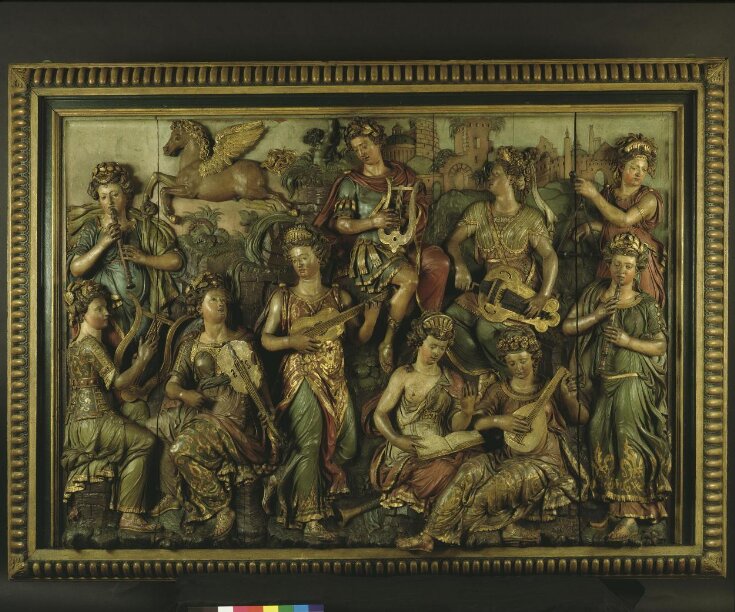
The subject, Apollo and the Nine Muses, represents the Arts in general. It would have been thought suitable for an important chamber of a grand house. Panels such as these served as overmantels and, together with the chimney-piece, were the most prominent part of the room.
Time
Apollo and the Nine Muses was a popular theme in European art from the 1530s onwards. This carving is characteristic of English work of the 1580s and similar to the alabaster overmantel of Apollo in the Nine Muses in the library of Hardwick Hall, Derbyshire. The rocky landscape and ruins in the background are similar to prints based on engravings such as Hieronymus Cock's Praecipua aliquot romanae Antiquitatis ruinarum monumenta ('Some outstanding monuments of Ancient Roman ruins'). Cock's work was published in Antwerp, Flanders (now Belgium), in 1551and soon became widely available in England.
Subjects Depicted
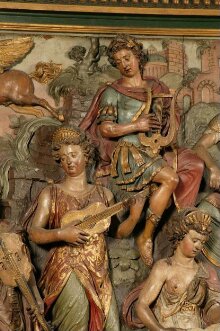
Music played an important part of life in the grand house. Musicians were often of the payroll of the owner and they provided music for banquets, dances and chapel services. Proficiency on the lute or spinet was considered the mark of a lady or gentleman. Here, Apollo plays the lyre while the nine muses play the following instruments (from left to right): lyre, recorder, viola da braccio, viola da mano, hurdy-gurdy, lute, triangle and oboe (added later, as oboes were not invented until 1650).
Place
The panel formed part of the Temple of the Muses at the Grange, Hockliffe, Bedfordshire. It is said to have come from the Manor House, Toddington, Bedfordshire, which was built in the 1570s and demolished in 1745.
The subject, Apollo and the Nine Muses, represents the Arts in general. It would have been thought suitable for an important chamber of a grand house. Panels such as these served as overmantels and, together with the chimney-piece, were the most prominent part of the room.
Time
Apollo and the Nine Muses was a popular theme in European art from the 1530s onwards. This carving is characteristic of English work of the 1580s and similar to the alabaster overmantel of Apollo in the Nine Muses in the library of Hardwick Hall, Derbyshire. The rocky landscape and ruins in the background are similar to prints based on engravings such as Hieronymus Cock's Praecipua aliquot romanae Antiquitatis ruinarum monumenta ('Some outstanding monuments of Ancient Roman ruins'). Cock's work was published in Antwerp, Flanders (now Belgium), in 1551and soon became widely available in England.
Subjects Depicted
Music played an important part of life in the grand house. Musicians were often of the payroll of the owner and they provided music for banquets, dances and chapel services. Proficiency on the lute or spinet was considered the mark of a lady or gentleman. Here, Apollo plays the lyre while the nine muses play the following instruments (from left to right): lyre, recorder, viola da braccio, viola da mano, hurdy-gurdy, lute, triangle and oboe (added later, as oboes were not invented until 1650).
Place
The panel formed part of the Temple of the Muses at the Grange, Hockliffe, Bedfordshire. It is said to have come from the Manor House, Toddington, Bedfordshire, which was built in the 1570s and demolished in 1745.
Object details
| Categories | |
| Object type | |
| Title | Apollo and the Nine Muses (popular title) |
| Materials and techniques | Carved, painted and gilt oak |
| Brief description | Apollo and the Nine Muses |
| Physical description | Panel carved in high relief, depicting Apollo seated with his lyre, surrounded by the Nine Muses playing on musical instruments (viol, gittern, triangle, lyre-guitar, flageolet (2), theorbo and hurdy-gurdy); in the background is Pegaus flying and a ruined townscape; painted chiefly in blue, green, red with gilded scrolls on the garments. In a deep frame with gadrooning and corner leaf ornaments, with inner slip frame on three sides. Construction The panel is made up of 7 vertical boards of varying widths 17-28 which are glued together. The panel is also laminated for depth: two obvious layers can be detected. The back is reinforced with metal struts which are screwed into the back of the panel and of the frame. Additional oak boards are also screwed into the back of the frame. The two wind instruments are turned from hardwood other than oak, possibly box or pear. The peg box of the violin and the pegs are also made from a different type of hardwood. Several of the arms, hands and fingers are a later restorations and are carved from softwood. Polychromy The existing polychrome layer is clearly not original as an earlier layer can be seen in damaged areas. It is likely that several feet have not been overpainted. In 2000 one dispersed sample of the first polychrome layer (taken from the sky above the head of the standing Muse on the extreme left) was examined under polarised light. It shows lead white, azurite, gypsum and a very small amount of vermilion. Modifications Replaced in 2000: two missing fingers (visible in an earlier photograph) of the proper left hand of the standing Muse on the extreme left. |
| Dimensions |
|
| Gallery label |
|
| Object history | Bought from Messrs. Robersons for £350 (RF. 1924/2211). Previously offered at auction by Knight, Frank & Rutley (20 Hanover Square, London) 29-30th June, and 13-14th July, 1922, lot 327 'A French Renaissance Carved, Painted and gilt overmantel with 10 female classical figures in high relief (illustrated), from 14 Stratton Street, Piccadilly'. Said to have come from the Manor House, Toddington, Bedfordshire. Anthony Wells-Cole (1997, see References) suggests that Adrian Gaunt, a joiner who worked at Longleat from 1563 to the late 1570s could have been the author of this panel, as well as the Chatsworth Apollo overmantel in alabaster. In this representation Apollo plays the lyre while the nine muses play the following instruments (from left to right): lyre, recorder (modelled after a baroque instrument and must therefore replace a lost original), viola da braccio, guitar (an opulent representation of an instrument that became fashionable in England in the 1540s and 1550s, although very few depictions survive in English sources), hurdy-gurdy, lute, triangle and oboe (added later, as oboes were not invented until 1650). The two lyres are fake 'antique' lyres that correspond to no instrument actually in use at the time. In musical terms the carving depicts an assembly of instruments rather than those used authentically by a Tudor musical consort. The level of accuracy in the depictions of contemporary musical instruments is fairly high. For example, the guitar is shown with one gut string represented in the bass with the rope-like texture it would have possessed (see Christopher Page, below) |
| Historical context | Discussion of the subjects depicted Pegasus: The 6th century mythographer Fulgentius made Pegasus a symbol of Fame since both are winged, and hence he is seen among the Muses, sometimes on Mount Parnassus. (Hall's Dictionary of Subjects and Symbols in Art, rev. ed. 1979) The Nine Muses (information taken from James Hall, Dictionary of Subjects and Symbols in Art (London 1974) The goddesses of creative inspiration in poetry, song and other arts; the companions of Apollo. They were the daughters of Jupiter and the Titaness Mnemosyne (Memory) who had lain together for nine consecutive nights. The Muses were originally nymphs who presided over springs that had the power to give inspiration, especially Aganippe and Hippocrene on Mount Helicon and the Castalian spring on Mount Parnassus. The latter eventually became their accepted abode. Thus fountains and streams often feature in pictures of the Muses. In time their number was established as nine and each acquired her sphere of influence over learning and the arts. Their attributes, particularly their musical instruments, are liable to change at different periods, making identification difficult; in the 17th and 18th cents. some may be without attributes. The most constant are the globe and compasses of Urania and Euterpe's flute. From the 17th cent. the attributes given in Ripa's Iconologia were generally followed. Clio (Muse of history), book, scroll or tablet and stylus; occasionally a swan; from 17th cent., the book may be `Herodotus' or `Thucydides'; laurel crown; trumpet. Euterpe (music, lyric, poetry), flute, often double, or occasionally trumpet or other instrument; from 17th cent. her hair garlanded with flowers. Thalia (comedy, pastoral poetry), scroll; small viol, more rarely other instruments; from 17th cent., masks. Melpomene (tragedy), horn; tragic masks; from 17th cent., sword or dagger; crown held in hand; sceptres lying at feet. (Stage properties.) Terpsichore (dancing and song), viol, lyre, or other stringed instrument; from 17th cent., often a harp; crowned with flowers. Erato (lyric and love poetry), tambourine, lyre, more rarely a triangle, or viol; occasionally a swan; from 17th cent., a putto at her feet. Urania (astronomy), glove and compasses; from 17th cent., crowned with a circle of stars. Calliope (epic poetry), trumpet; tablet and stylus; from 17th cent., Books (Iliad, Odyssey, Aeneid); holds laurel crown. Polyhymnia (or Polymnia) (heroic hymns), portative organ, more rarely a lute or other instrument. |
| Subject depicted | |
| Summary | Object Type The subject, Apollo and the Nine Muses, represents the Arts in general. It would have been thought suitable for an important chamber of a grand house. Panels such as these served as overmantels and, together with the chimney-piece, were the most prominent part of the room. Time Apollo and the Nine Muses was a popular theme in European art from the 1530s onwards. This carving is characteristic of English work of the 1580s and similar to the alabaster overmantel of Apollo in the Nine Muses in the library of Hardwick Hall, Derbyshire. The rocky landscape and ruins in the background are similar to prints based on engravings such as Hieronymus Cock's Praecipua aliquot romanae Antiquitatis ruinarum monumenta ('Some outstanding monuments of Ancient Roman ruins'). Cock's work was published in Antwerp, Flanders (now Belgium), in 1551and soon became widely available in England. Subjects Depicted Music played an important part of life in the grand house. Musicians were often of the payroll of the owner and they provided music for banquets, dances and chapel services. Proficiency on the lute or spinet was considered the mark of a lady or gentleman. Here, Apollo plays the lyre while the nine muses play the following instruments (from left to right): lyre, recorder, viola da braccio, viola da mano, hurdy-gurdy, lute, triangle and oboe (added later, as oboes were not invented until 1650). Place The panel formed part of the Temple of the Muses at the Grange, Hockliffe, Bedfordshire. It is said to have come from the Manor House, Toddington, Bedfordshire, which was built in the 1570s and demolished in 1745. |
| Bibliographic references |
|
| Collection | |
| Accession number | A.12-1924 |
About this object record
Explore the Collections contains over a million catalogue records, and over half a million images. It is a working database that includes information compiled over the life of the museum. Some of our records may contain offensive and discriminatory language, or reflect outdated ideas, practice and analysis. We are committed to addressing these issues, and to review and update our records accordingly.
You can write to us to suggest improvements to the record.
Suggest feedback
You can write to us to suggest improvements to the record.
Suggest feedback
| Record created | March 27, 2003 |
| Record URL |
Download as: JSONIIIF Manifest
