
Comb
1800-1880 (made)
| Artist/Maker | |
| Place of origin |
Object Type
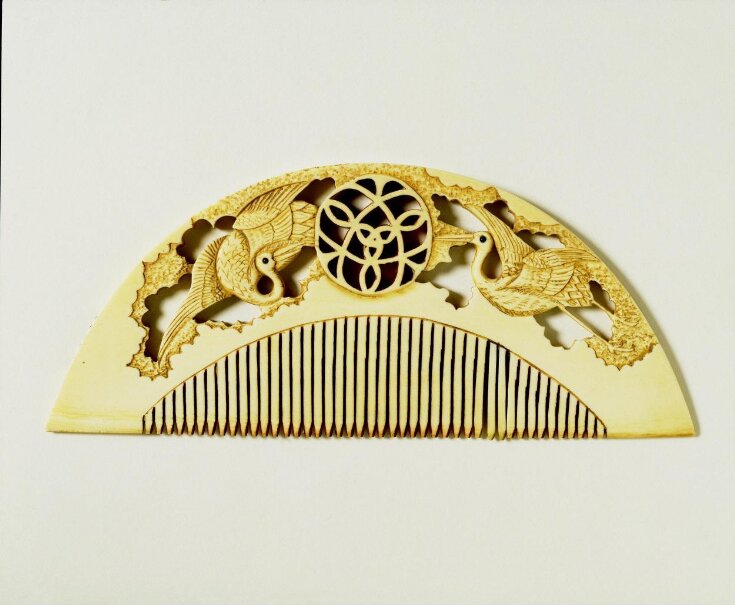
This is a typical 19th-century Japanese ornamental comb. Combs were often made of luxurious and eye-catching materials such as lacquer or ivory, as in this case. The decoration of cranes symbolises long life.
Ownership & Use
This type of comb was meant to be used as a decorative hair ornament rather than as something with which to actually comb the hair. Combs became popular with the emergence of elaborate hairdos during the 17th century. They complemented the elegant kimono of their wearers and were usually used in combination with ornate hairpins and bodkins.
Time
In the mid-1850s Japan was opened up after more than two centuries of seclusion from the rest of the world. The passion for all things Japanese that this triggered in the West was termed Japonisme. Japanese art objects were avidly bought by western collectors, artists and designers from specialist dealers or shops such as Liberty's. Kimono and dress accessories were regarded as the embodiment of Japanese femininity. Combs were pretty items that could be bought relatively cheaply.
This is a typical 19th-century Japanese ornamental comb. Combs were often made of luxurious and eye-catching materials such as lacquer or ivory, as in this case. The decoration of cranes symbolises long life.
Ownership & Use
This type of comb was meant to be used as a decorative hair ornament rather than as something with which to actually comb the hair. Combs became popular with the emergence of elaborate hairdos during the 17th century. They complemented the elegant kimono of their wearers and were usually used in combination with ornate hairpins and bodkins.
Time
In the mid-1850s Japan was opened up after more than two centuries of seclusion from the rest of the world. The passion for all things Japanese that this triggered in the West was termed Japonisme. Japanese art objects were avidly bought by western collectors, artists and designers from specialist dealers or shops such as Liberty's. Kimono and dress accessories were regarded as the embodiment of Japanese femininity. Combs were pretty items that could be bought relatively cheaply.
Object details
| Categories | |
| Object type | |
| Materials and techniques | Carved and incised ivory, with openwork |
| Brief description | Ivory comb with cranes |
| Dimensions |
|
| Gallery label | British Galleries:
COMBS To a Victorian audience the image of a woman dressed in a kimono embodied Japan. Items of Japanese women's dress and accessories were popular purchases. Combs such as these were very attractive and not very expensive. They could be bought from specialist dealers and from shops such as Liberty's in London.(27/03/2003) |
| Object history | Purchased from a source not recorded in the Asia Department registers, accessioned in 1888. This acquisition information reflects that found in the Asia Department registers, as part of a 2022 provenance research project. |
| Subject depicted | |
| Summary | Object Type This is a typical 19th-century Japanese ornamental comb. Combs were often made of luxurious and eye-catching materials such as lacquer or ivory, as in this case. The decoration of cranes symbolises long life. Ownership & Use This type of comb was meant to be used as a decorative hair ornament rather than as something with which to actually comb the hair. Combs became popular with the emergence of elaborate hairdos during the 17th century. They complemented the elegant kimono of their wearers and were usually used in combination with ornate hairpins and bodkins. Time In the mid-1850s Japan was opened up after more than two centuries of seclusion from the rest of the world. The passion for all things Japanese that this triggered in the West was termed Japonisme. Japanese art objects were avidly bought by western collectors, artists and designers from specialist dealers or shops such as Liberty's. Kimono and dress accessories were regarded as the embodiment of Japanese femininity. Combs were pretty items that could be bought relatively cheaply. |
| Collection | |
| Accession number | 91-1888 |
About this object record
Explore the Collections contains over a million catalogue records, and over half a million images. It is a working database that includes information compiled over the life of the museum. Some of our records may contain offensive and discriminatory language, or reflect outdated ideas, practice and analysis. We are committed to addressing these issues, and to review and update our records accordingly.
You can write to us to suggest improvements to the record.
Suggest feedback
You can write to us to suggest improvements to the record.
Suggest feedback
| Record created | March 27, 2003 |
| Record URL |
Download as: JSONIIIF Manifest
