
Vase
1780-1800 (made)
| Artist/Maker | |
| Place of origin |
Object Type
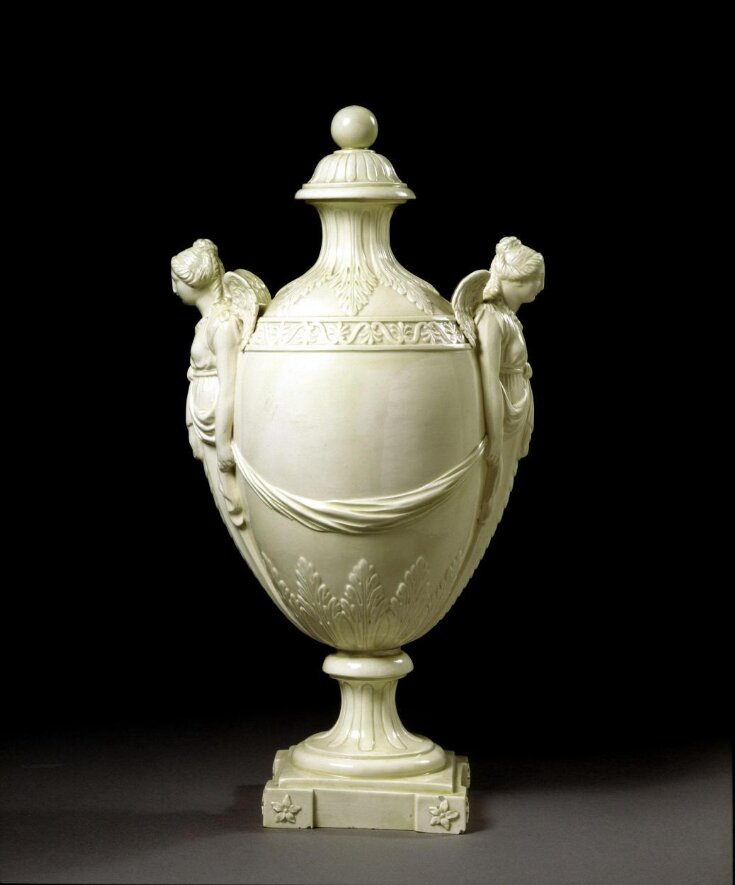
An ornamental creamware vase with a secondary function as a two-branch candlestick. Not only is it marked 'LP' for Leeds Pottery, but its function is made clear by the title 'Vase Candlestick' in the Leeds Pottery catalogue of 1783.
Time
'Vase madness' extended from smart and expensive ormolu-mounted blue-john vases and the Black Basalt products Josiah Wedgwood (1730-1795) made in the 1770s, to the later and more humble creamwares produced by many factories in Staffordshire and Yorkshire. Athough a similar, but more elaborately decorated, version of this Leeds Pottery vase-candlestick is shown in the Castleford Pottery catalogue of 1796, the rarity of these objects suggests a strictly limited production. Indeed, the insertion of gilt brass candle arms into soft lead-glazed creamware sockets seems unlikely to have been wholly successful, either structurally or visually.
Design & Designing
Winged harpies copied from Greek sarcophagi have been added to a typical Roman vase shape of the type used for tea urns made of Sheffield plate. Though cheap to produce, once the mould was made, the cream-coloured material is incapable of reproducing the sharpness of detail necessary for Neo-classical design - detail for which the coloured stonewares of Wedgwood and others were ideally suitable. The ormolu candle arms (none of which survive) were traditionally made by specialist 'Branch Makers', who are frequently listed in the 1750s as making candle arms and sconces (wall lights with a bracket and reflective back-plate) for English porcelain figures.
An ornamental creamware vase with a secondary function as a two-branch candlestick. Not only is it marked 'LP' for Leeds Pottery, but its function is made clear by the title 'Vase Candlestick' in the Leeds Pottery catalogue of 1783.
Time
'Vase madness' extended from smart and expensive ormolu-mounted blue-john vases and the Black Basalt products Josiah Wedgwood (1730-1795) made in the 1770s, to the later and more humble creamwares produced by many factories in Staffordshire and Yorkshire. Athough a similar, but more elaborately decorated, version of this Leeds Pottery vase-candlestick is shown in the Castleford Pottery catalogue of 1796, the rarity of these objects suggests a strictly limited production. Indeed, the insertion of gilt brass candle arms into soft lead-glazed creamware sockets seems unlikely to have been wholly successful, either structurally or visually.
Design & Designing
Winged harpies copied from Greek sarcophagi have been added to a typical Roman vase shape of the type used for tea urns made of Sheffield plate. Though cheap to produce, once the mould was made, the cream-coloured material is incapable of reproducing the sharpness of detail necessary for Neo-classical design - detail for which the coloured stonewares of Wedgwood and others were ideally suitable. The ormolu candle arms (none of which survive) were traditionally made by specialist 'Branch Makers', who are frequently listed in the 1750s as making candle arms and sconces (wall lights with a bracket and reflective back-plate) for English porcelain figures.
Object details
| Categories | |
| Object type | |
| Parts | This object consists of 2 parts.
|
| Materials and techniques | Creamware |
| Brief description | Vase, creamware, Leeds Pottery, Leeds, 1780-1800 |
| Dimensions |
|
| Marks and inscriptions | Incised with the monogram 'LP' (for Leeds Pottery) |
| Gallery label | British Galleries:
This 'vase candlestick' originally had candle arms and sconces projecting from the sockets.(27/03/2003) |
| Summary | Object Type An ornamental creamware vase with a secondary function as a two-branch candlestick. Not only is it marked 'LP' for Leeds Pottery, but its function is made clear by the title 'Vase Candlestick' in the Leeds Pottery catalogue of 1783. Time 'Vase madness' extended from smart and expensive ormolu-mounted blue-john vases and the Black Basalt products Josiah Wedgwood (1730-1795) made in the 1770s, to the later and more humble creamwares produced by many factories in Staffordshire and Yorkshire. Athough a similar, but more elaborately decorated, version of this Leeds Pottery vase-candlestick is shown in the Castleford Pottery catalogue of 1796, the rarity of these objects suggests a strictly limited production. Indeed, the insertion of gilt brass candle arms into soft lead-glazed creamware sockets seems unlikely to have been wholly successful, either structurally or visually. Design & Designing Winged harpies copied from Greek sarcophagi have been added to a typical Roman vase shape of the type used for tea urns made of Sheffield plate. Though cheap to produce, once the mould was made, the cream-coloured material is incapable of reproducing the sharpness of detail necessary for Neo-classical design - detail for which the coloured stonewares of Wedgwood and others were ideally suitable. The ormolu candle arms (none of which survive) were traditionally made by specialist 'Branch Makers', who are frequently listed in the 1750s as making candle arms and sconces (wall lights with a bracket and reflective back-plate) for English porcelain figures. |
| Bibliographic reference | Clifford, Sir Timothy, ‘Some English Ceramic Vases and their Sources, Part 2’ in Walford, Tom and Hilary Young British Ceramic Design, 1600-2002: Papers presented at the colloquium celebrating the 75th anniversary of the English Ceramic Circle, 1927-2002. 2003, p. 77, fig. 4 |
| Collection | |
| Accession number | 838&A-1870 |
About this object record
Explore the Collections contains over a million catalogue records, and over half a million images. It is a working database that includes information compiled over the life of the museum. Some of our records may contain offensive and discriminatory language, or reflect outdated ideas, practice and analysis. We are committed to addressing these issues, and to review and update our records accordingly.
You can write to us to suggest improvements to the record.
Suggest feedback
You can write to us to suggest improvements to the record.
Suggest feedback
| Record created | March 27, 2003 |
| Record URL |
Download as: JSONIIIF Manifest
