Wine Cooler
1810-1811 (made)
| Artist/Maker | |
| Place of origin |
Object Type
A wine cooler or ice pail for a single bottle was a French refinement for more informal dining in smaller numbers. Introduced into England in the early 18th century, it was filled with ice to chill the wine before serving. By the early 19th century, these individual wine coolers were beginning to be left on the table as part of the dressing of very grand dinners.
Design
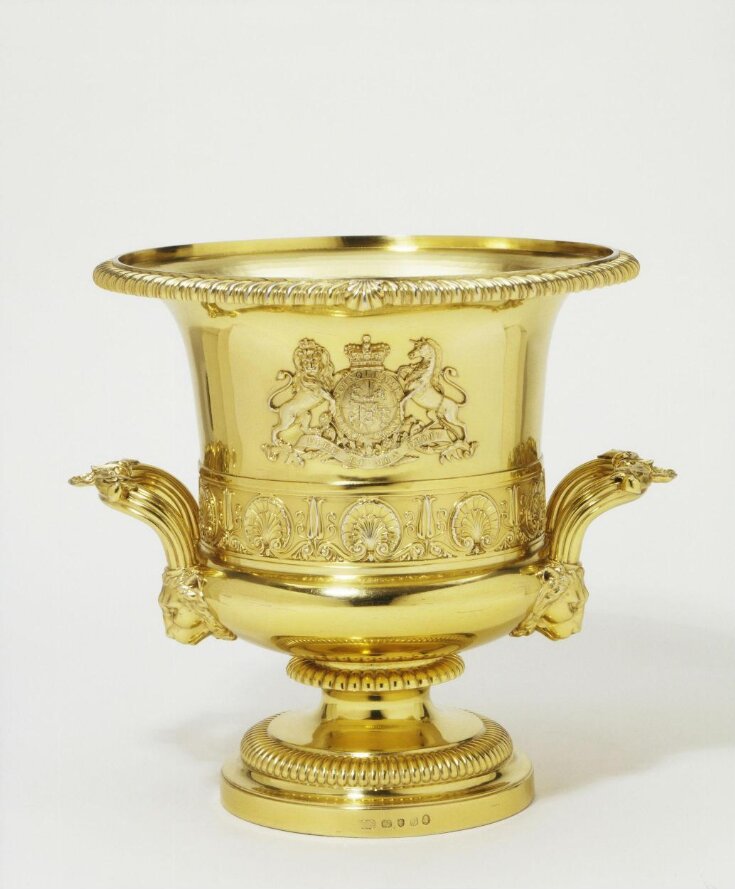
The form of the wine cooler is based upon that of the ancient Greek calyx-krater, which was a pottery vase used for holding and mixing wine and water. This has been adapted with the addition of lion's-head handles that turn outwards rather than inwards as on the original Greek design. The broad band of ornament uses alternating palmette (a fan-shaped motif resembling a palm leaf) and lotus, which are typical Neo-classical motifs.
Trading
The Royal Goldsmiths, Rundell, Bridge & Rundell, made this wine cooler in 1810. It would have been one of the most expensive silver items purchased for the dining room. (In 1804, for example, Viscount Lowther, later 2nd Earl Lonsdale, had paid Rundells £125 1s 9d for two wine coolers.) The royal arms and the coronation medals of William IV (ruled 1830-1837) and Queen Adelaide (1792-1849) were added to the wine cooler around 1830 to celebrate their coronation. These additions show that Rundells were updating a second-hand piece of silver, perhaps as a royal gift.
A wine cooler or ice pail for a single bottle was a French refinement for more informal dining in smaller numbers. Introduced into England in the early 18th century, it was filled with ice to chill the wine before serving. By the early 19th century, these individual wine coolers were beginning to be left on the table as part of the dressing of very grand dinners.
Design
The form of the wine cooler is based upon that of the ancient Greek calyx-krater, which was a pottery vase used for holding and mixing wine and water. This has been adapted with the addition of lion's-head handles that turn outwards rather than inwards as on the original Greek design. The broad band of ornament uses alternating palmette (a fan-shaped motif resembling a palm leaf) and lotus, which are typical Neo-classical motifs.
Trading
The Royal Goldsmiths, Rundell, Bridge & Rundell, made this wine cooler in 1810. It would have been one of the most expensive silver items purchased for the dining room. (In 1804, for example, Viscount Lowther, later 2nd Earl Lonsdale, had paid Rundells £125 1s 9d for two wine coolers.) The royal arms and the coronation medals of William IV (ruled 1830-1837) and Queen Adelaide (1792-1849) were added to the wine cooler around 1830 to celebrate their coronation. These additions show that Rundells were updating a second-hand piece of silver, perhaps as a royal gift.
Object details
| Categories | |
| Object type | |
| Materials and techniques | Silver gilt, cast and chased, with applied decoration |
| Brief description | Silver-gilt, London hallmarks for 1810-11, mark of Paul Storr, designed by John Flaxman RA. |
| Physical description | Wine cooler, (one of a pair) of jardinière form with two curved handles, decorated with leaves and shells and united to the body by lion's masks. Round the body runs a repousssé band of classical ornament. The top of the vase, the short baluster stem and the circular foot are decorated with gadrooned bands. On one side are the Royal arms and on the other the Coronation medals of William IV and Queen Adelaide surrounded by wreaths of oak leaves and acorns and surmounted by a crown. The Royal arms and the medals appear to have been applied afterwards. |
| Dimensions |
|
| Marks and inscriptions |
|
| Gallery label | British Galleries:
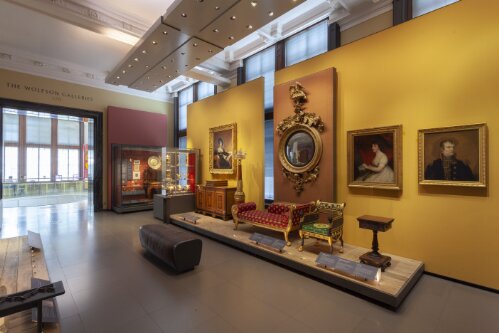
These wine coolers were made by Paul Storr, one of the most famous early 19th-century goldsmiths. He became a workshop manager and partner in Rundell, Bridge & Rundell. Much of Rundells' output between 1807 and 1819 was struck with his mark. He worked in an assured Neo-classical style that proved highly popular with Rundells' royal and aristocratic clients.(27/03/2003) |
| Credit line | Given by Joseph Bond |
| Object history | Given by Joseph Bond |
| Historical context | Presented by William IV to Sir George Naylor, Garter King-at-Arms. |
| Subjects depicted | |
| Associations | |
| Summary | Object Type A wine cooler or ice pail for a single bottle was a French refinement for more informal dining in smaller numbers. Introduced into England in the early 18th century, it was filled with ice to chill the wine before serving. By the early 19th century, these individual wine coolers were beginning to be left on the table as part of the dressing of very grand dinners. Design The form of the wine cooler is based upon that of the ancient Greek calyx-krater, which was a pottery vase used for holding and mixing wine and water. This has been adapted with the addition of lion's-head handles that turn outwards rather than inwards as on the original Greek design. The broad band of ornament uses alternating palmette (a fan-shaped motif resembling a palm leaf) and lotus, which are typical Neo-classical motifs. Trading The Royal Goldsmiths, Rundell, Bridge & Rundell, made this wine cooler in 1810. It would have been one of the most expensive silver items purchased for the dining room. (In 1804, for example, Viscount Lowther, later 2nd Earl Lonsdale, had paid Rundells £125 1s 9d for two wine coolers.) The royal arms and the coronation medals of William IV (ruled 1830-1837) and Queen Adelaide (1792-1849) were added to the wine cooler around 1830 to celebrate their coronation. These additions show that Rundells were updating a second-hand piece of silver, perhaps as a royal gift. |
| Associated object | 833A-1890 (Set) |
| Collection | |
| Accession number | 833-1890 |
About this object record
Explore the Collections contains over a million catalogue records, and over half a million images. It is a working database that includes information compiled over the life of the museum. Some of our records may contain offensive and discriminatory language, or reflect outdated ideas, practice and analysis. We are committed to addressing these issues, and to review and update our records accordingly.
You can write to us to suggest improvements to the record.
Suggest feedback
You can write to us to suggest improvements to the record.
Suggest feedback
| Record created | March 27, 2003 |
| Record URL |
Download as: JSONIIIF Manifest
