
Candelabrum
ca. 1846 (made)
| Artist/Maker | |
| Place of origin |
Object Type
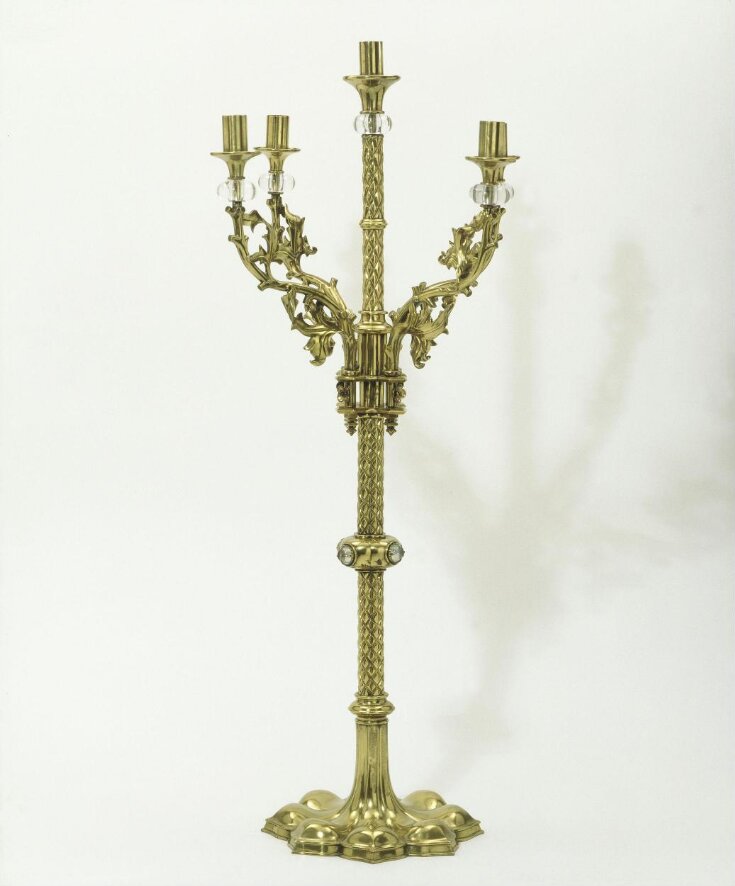
This brass candelabrum was designed for the House of Lords by A.W.N. Pugin and made by Hardman & Co. of Birmingham. The design is based on late Gothic brass wares produced in such centres as Nuremberg, Germany and Dinant, Belgium, which Pugin had seen on his frequent trips to the Continent.
Materials & Making
Pugin chose John Hardman & Co. as a suitable manufacturer of his designs because their craftsmanship and finish were of a very high standard. They used the most modern methods of manufacture then available including die-stamping and electro-forming and their gilding and cast work was of the highest quality.
Design & Designing
Design features of this candelabrum such as the lobed foot and strongly worked foliage are very typical of Pugin's attempt to interpret Medieval form. Pugin had been fascinated by candlesticks and sconces from his youth and some of his earliest drawings are for different forms of lights. In his own words he thought a candlestick should 'take the light well and sparkle'. This candelabrum formed part of Hardman's base-metalwork display at the Great Exhibition of 1851. It was intended to be used in one of the Gothic architectural interiors for which Pugin was so famous. It was bought by the Museum from the Great Exhibition.
This brass candelabrum was designed for the House of Lords by A.W.N. Pugin and made by Hardman & Co. of Birmingham. The design is based on late Gothic brass wares produced in such centres as Nuremberg, Germany and Dinant, Belgium, which Pugin had seen on his frequent trips to the Continent.
Materials & Making
Pugin chose John Hardman & Co. as a suitable manufacturer of his designs because their craftsmanship and finish were of a very high standard. They used the most modern methods of manufacture then available including die-stamping and electro-forming and their gilding and cast work was of the highest quality.
Design & Designing
Design features of this candelabrum such as the lobed foot and strongly worked foliage are very typical of Pugin's attempt to interpret Medieval form. Pugin had been fascinated by candlesticks and sconces from his youth and some of his earliest drawings are for different forms of lights. In his own words he thought a candlestick should 'take the light well and sparkle'. This candelabrum formed part of Hardman's base-metalwork display at the Great Exhibition of 1851. It was intended to be used in one of the Gothic architectural interiors for which Pugin was so famous. It was bought by the Museum from the Great Exhibition.
Object details
| Categories | |
| Object type | |
| Materials and techniques | Wrought brasswork |
| Brief description | Candelabrum, brass, English, mid-19th century |
| Physical description | A branched altar candlestick to hold five lights, with Gothic scroll foliage |
| Dimensions |
|
| Gallery label | British Galleries:
The spikiness, lobed foot and bold foliage of this candelabrum are interpretations of Medieval form, probably inspired by early German metalwork. The manufacturers, Hardman & Co., worked closely with the architect and designer A.W.N. Pugin. Hardman's specialised in high quality metalwork in the Gothic style, for both domestic and ecclesiastical use.(27/03/2003) |
| Object history | Originally designed for the House of Lords, Palace of Westminster. Designed by A. W.N. Pugin (born in London 1812, died in Ramsgate, Kent, 1852) and made by John Hardman & Co., Birmingham. Purchased from the Great Exhibition of 1851. |
| Summary | Object Type This brass candelabrum was designed for the House of Lords by A.W.N. Pugin and made by Hardman & Co. of Birmingham. The design is based on late Gothic brass wares produced in such centres as Nuremberg, Germany and Dinant, Belgium, which Pugin had seen on his frequent trips to the Continent. Materials & Making Pugin chose John Hardman & Co. as a suitable manufacturer of his designs because their craftsmanship and finish were of a very high standard. They used the most modern methods of manufacture then available including die-stamping and electro-forming and their gilding and cast work was of the highest quality. Design & Designing Design features of this candelabrum such as the lobed foot and strongly worked foliage are very typical of Pugin's attempt to interpret Medieval form. Pugin had been fascinated by candlesticks and sconces from his youth and some of his earliest drawings are for different forms of lights. In his own words he thought a candlestick should 'take the light well and sparkle'. This candelabrum formed part of Hardman's base-metalwork display at the Great Exhibition of 1851. It was intended to be used in one of the Gothic architectural interiors for which Pugin was so famous. It was bought by the Museum from the Great Exhibition. |
| Bibliographic reference | North, Anthony, R.E., "Contrasts: English Gothic Revival Wares in Brass", Journal of the Antique Metalware Society, Volume 14, June 2006, p. 35, Fig. 10 |
| Collection | |
| Accession number | 2742-1851 |
About this object record
Explore the Collections contains over a million catalogue records, and over half a million images. It is a working database that includes information compiled over the life of the museum. Some of our records may contain offensive and discriminatory language, or reflect outdated ideas, practice and analysis. We are committed to addressing these issues, and to review and update our records accordingly.
You can write to us to suggest improvements to the record.
Suggest feedback
You can write to us to suggest improvements to the record.
Suggest feedback
| Record created | June 2, 1998 |
| Record URL |
Download as: JSONIIIF Manifest
