
Shawl
ca. 1850 (made)
| Artist/Maker | |
| Place of origin |
Object Type
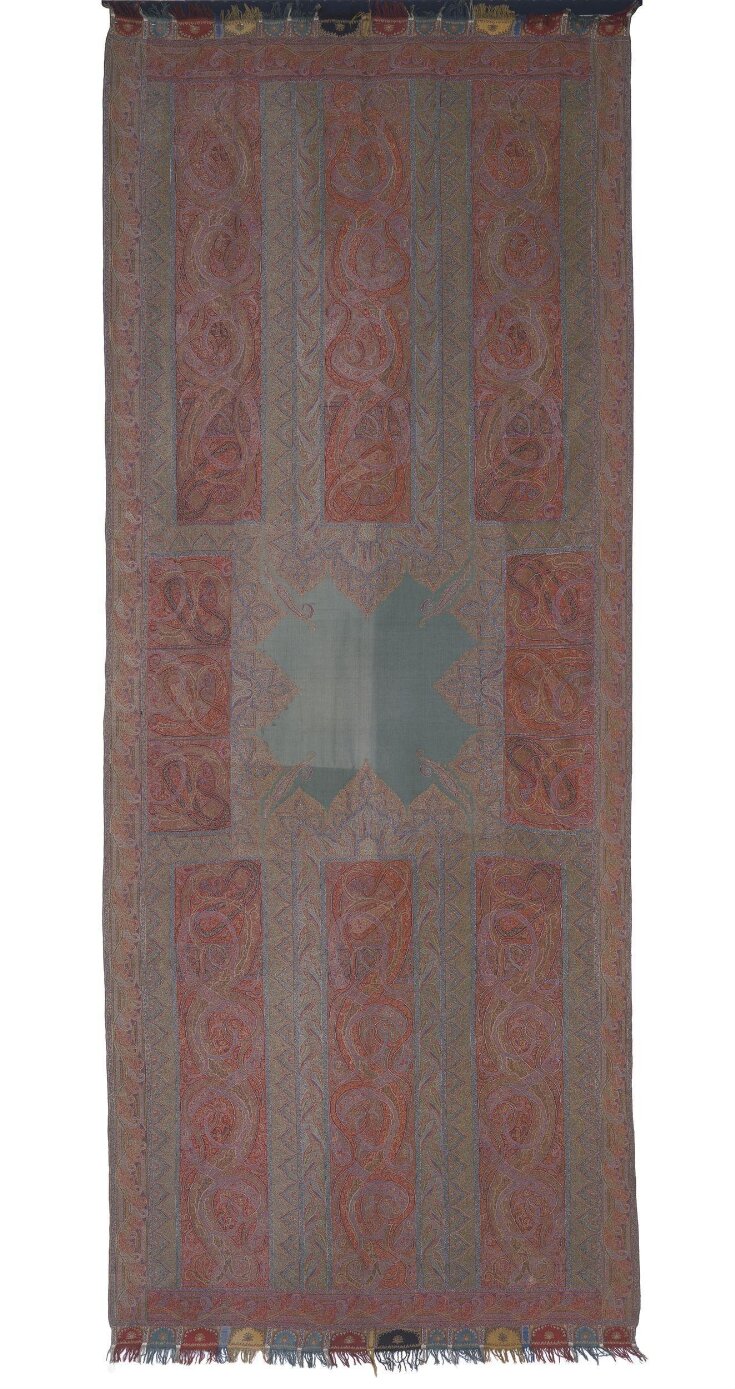
Kashmir shawls had been items of fashionable dress in Europe since the late 18th century, and had reached the peak of their popularity there during the first half of the 19th century. By the time this shawl was exhibited at the Great Exhibition in 1851, the designs had become overblown and elaborate, and the shawls themselves very long. They had first become noted as fashionable items of male dress at the court of the Emperor Akbar (ruled 1555-1605).
Materials & Making
Kashmir shawls are made of the soft under-hair of the Himalayan goat, Capra hircus laniger, known as pashmina, from the Persian pashm, meaning 'wool'. An even finer variety of shawl is traditionally woven from the extremely fine and soft hair of the Tibetan antelope, Pantholops hodgsoni, or chiru, called shahtoosh. Poaching of chiru in recent years has led to shahtoosh shawls being made illegal. The finest pashmina shawls have designs woven on the loom, although many examples from the 1830s onwards duplicated these woven designs in embroidery, as this was easier and quicker to manufacture.
Trading
The trade in Kashmir shawls to Europe started around the 1770s, and was well established by about 1800. Leaders of fashion such as the Empress Josephine in France and Emma Hamilton in Britain owned large collections of shawls, which went very well with the loose-fitting 'Empire' fashions of the time. European merchants soon established themselves in the main centres, especially Srinagar in Kashmir, and set about persuading the weavers to make shawls that would conform to the tastes of their respective countries.
Kashmir shawls had been items of fashionable dress in Europe since the late 18th century, and had reached the peak of their popularity there during the first half of the 19th century. By the time this shawl was exhibited at the Great Exhibition in 1851, the designs had become overblown and elaborate, and the shawls themselves very long. They had first become noted as fashionable items of male dress at the court of the Emperor Akbar (ruled 1555-1605).
Materials & Making
Kashmir shawls are made of the soft under-hair of the Himalayan goat, Capra hircus laniger, known as pashmina, from the Persian pashm, meaning 'wool'. An even finer variety of shawl is traditionally woven from the extremely fine and soft hair of the Tibetan antelope, Pantholops hodgsoni, or chiru, called shahtoosh. Poaching of chiru in recent years has led to shahtoosh shawls being made illegal. The finest pashmina shawls have designs woven on the loom, although many examples from the 1830s onwards duplicated these woven designs in embroidery, as this was easier and quicker to manufacture.
Trading
The trade in Kashmir shawls to Europe started around the 1770s, and was well established by about 1800. Leaders of fashion such as the Empress Josephine in France and Emma Hamilton in Britain owned large collections of shawls, which went very well with the loose-fitting 'Empire' fashions of the time. European merchants soon established themselves in the main centres, especially Srinagar in Kashmir, and set about persuading the weavers to make shawls that would conform to the tastes of their respective countries.
Object details
| Categories | |
| Object type | |
| Materials and techniques | Woven goat-hair (pashmina) |
| Brief description | Costume, goat hair, Kashmir India, c1850; Textile |
| Dimensions |
|
| Gallery label | British Galleries:
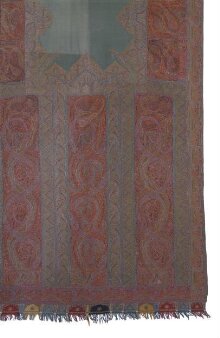
The elaborate design of this shawl is typical of the kind woven in India for the British market. The traditional pine cone pattern became highly stylised to accommodate British tastes. By the 1850s the Kashmir shawl industry in India was dominated by French and English agents who brought more patterns from Europe for the local shawl weavers to copy.(27/03/2003) |
| Object history | Purchased from the Great Exhibition of 1851 |
| Summary | Object Type Kashmir shawls had been items of fashionable dress in Europe since the late 18th century, and had reached the peak of their popularity there during the first half of the 19th century. By the time this shawl was exhibited at the Great Exhibition in 1851, the designs had become overblown and elaborate, and the shawls themselves very long. They had first become noted as fashionable items of male dress at the court of the Emperor Akbar (ruled 1555-1605). Materials & Making Kashmir shawls are made of the soft under-hair of the Himalayan goat, Capra hircus laniger, known as pashmina, from the Persian pashm, meaning 'wool'. An even finer variety of shawl is traditionally woven from the extremely fine and soft hair of the Tibetan antelope, Pantholops hodgsoni, or chiru, called shahtoosh. Poaching of chiru in recent years has led to shahtoosh shawls being made illegal. The finest pashmina shawls have designs woven on the loom, although many examples from the 1830s onwards duplicated these woven designs in embroidery, as this was easier and quicker to manufacture. Trading The trade in Kashmir shawls to Europe started around the 1770s, and was well established by about 1800. Leaders of fashion such as the Empress Josephine in France and Emma Hamilton in Britain owned large collections of shawls, which went very well with the loose-fitting 'Empire' fashions of the time. European merchants soon established themselves in the main centres, especially Srinagar in Kashmir, and set about persuading the weavers to make shawls that would conform to the tastes of their respective countries. |
| Bibliographic reference | Bryant, Julius and Weber, Susan; John Lockwood Kipling: Arts and Crafts in the Punjab and London Newhaven: Yale University Press, 2017
p. 6, fig. 1.7, cat. 14 |
| Collection | |
| Accession number | 772-1852 |
About this object record
Explore the Collections contains over a million catalogue records, and over half a million images. It is a working database that includes information compiled over the life of the museum. Some of our records may contain offensive and discriminatory language, or reflect outdated ideas, practice and analysis. We are committed to addressing these issues, and to review and update our records accordingly.
You can write to us to suggest improvements to the record.
Suggest feedback
You can write to us to suggest improvements to the record.
Suggest feedback
| Record created | March 27, 2003 |
| Record URL |
Download as: JSONIIIF Manifest
