
Vase
ca. 450-440 BC (made)
| Artist/Maker | |
| Place of origin |
Object Type
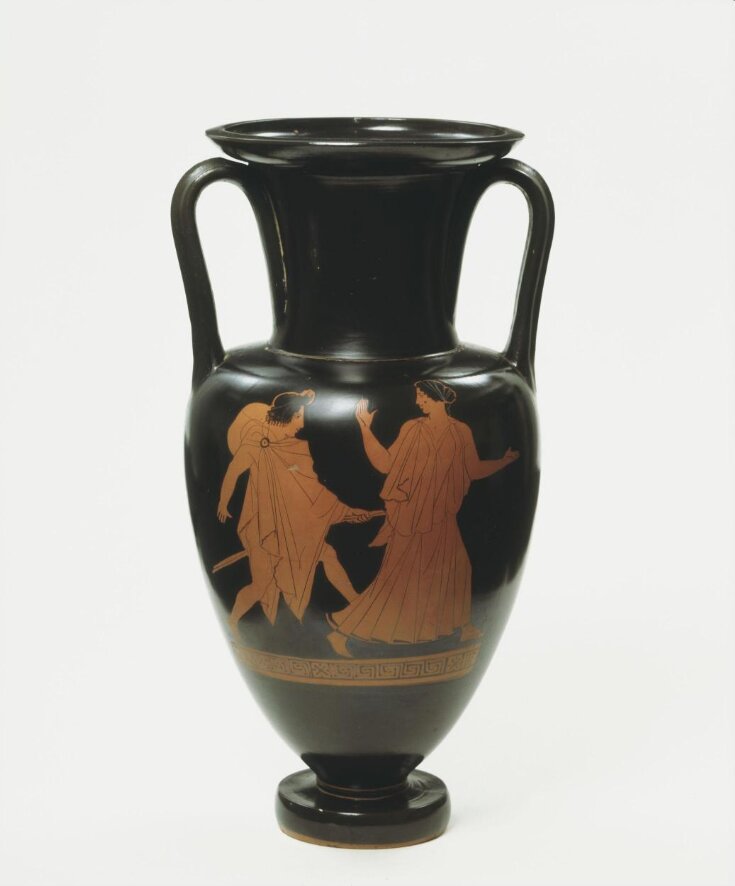
The vase is an amphora, a type of two-handled storage vessel. It was originally intended for storing wine or oil. Greek vases like this were greatly admired in late-18th-century Britain, where they were often displayed in private libraries and in galleries specially designed to house antiquities. The Staffordshire potter Josiah Wedgwood (1730-1795) made imitations of Greek vases like this one in 'encaustic'-painted Black Basalt stoneware.
Materials & Technique
The vase is decorated in the 'red figure' technique, in which the areas surrounding the figures are painted in a slip (mixture of clay and water), leaving the red pottery showing through. Careful control of the firing process allowed Greek potters to oxidise the body of the pot, turning it red, by keeping the kiln well ventilated. The kiln was then starved of oxygen and filled with carbon monoxide (by using wet fuel), causing the slip to turn black. The kiln was then again well ventilated. The fresh oxygen supply turned the pottery back to red. The firing was stopped before the slip turned red once again.
The vase is an amphora, a type of two-handled storage vessel. It was originally intended for storing wine or oil. Greek vases like this were greatly admired in late-18th-century Britain, where they were often displayed in private libraries and in galleries specially designed to house antiquities. The Staffordshire potter Josiah Wedgwood (1730-1795) made imitations of Greek vases like this one in 'encaustic'-painted Black Basalt stoneware.
Materials & Technique
The vase is decorated in the 'red figure' technique, in which the areas surrounding the figures are painted in a slip (mixture of clay and water), leaving the red pottery showing through. Careful control of the firing process allowed Greek potters to oxidise the body of the pot, turning it red, by keeping the kiln well ventilated. The kiln was then starved of oxygen and filled with carbon monoxide (by using wet fuel), causing the slip to turn black. The kiln was then again well ventilated. The fresh oxygen supply turned the pottery back to red. The firing was stopped before the slip turned red once again.
Object details
| Categories | |
| Object type | |
| Materials and techniques | Earthenware, painted in black slip |
| Brief description | Vase, amphora shape, earthenware, black ground with painted decoration with male and female figures, Ancient Greek, 4th Century BC |
| Physical description | Amphora shape, double-handled, black ground with painted decoration of male and female figures in orange |
| Dimensions |
|
| Summary | Object Type The vase is an amphora, a type of two-handled storage vessel. It was originally intended for storing wine or oil. Greek vases like this were greatly admired in late-18th-century Britain, where they were often displayed in private libraries and in galleries specially designed to house antiquities. The Staffordshire potter Josiah Wedgwood (1730-1795) made imitations of Greek vases like this one in 'encaustic'-painted Black Basalt stoneware. Materials & Technique The vase is decorated in the 'red figure' technique, in which the areas surrounding the figures are painted in a slip (mixture of clay and water), leaving the red pottery showing through. Careful control of the firing process allowed Greek potters to oxidise the body of the pot, turning it red, by keeping the kiln well ventilated. The kiln was then starved of oxygen and filled with carbon monoxide (by using wet fuel), causing the slip to turn black. The kiln was then again well ventilated. The fresh oxygen supply turned the pottery back to red. The firing was stopped before the slip turned red once again. |
| Collection | |
| Accession number | 738-1864 |
About this object record
Explore the Collections contains over a million catalogue records, and over half a million images. It is a working database that includes information compiled over the life of the museum. Some of our records may contain offensive and discriminatory language, or reflect outdated ideas, practice and analysis. We are committed to addressing these issues, and to review and update our records accordingly.
You can write to us to suggest improvements to the record.
Suggest feedback
You can write to us to suggest improvements to the record.
Suggest feedback
| Record created | March 27, 2003 |
| Record URL |
Download as: JSONIIIF Manifest
