Bed Curtain
1690-1710 (made)
| Artist/Maker | |
| Place of origin |
Object Type
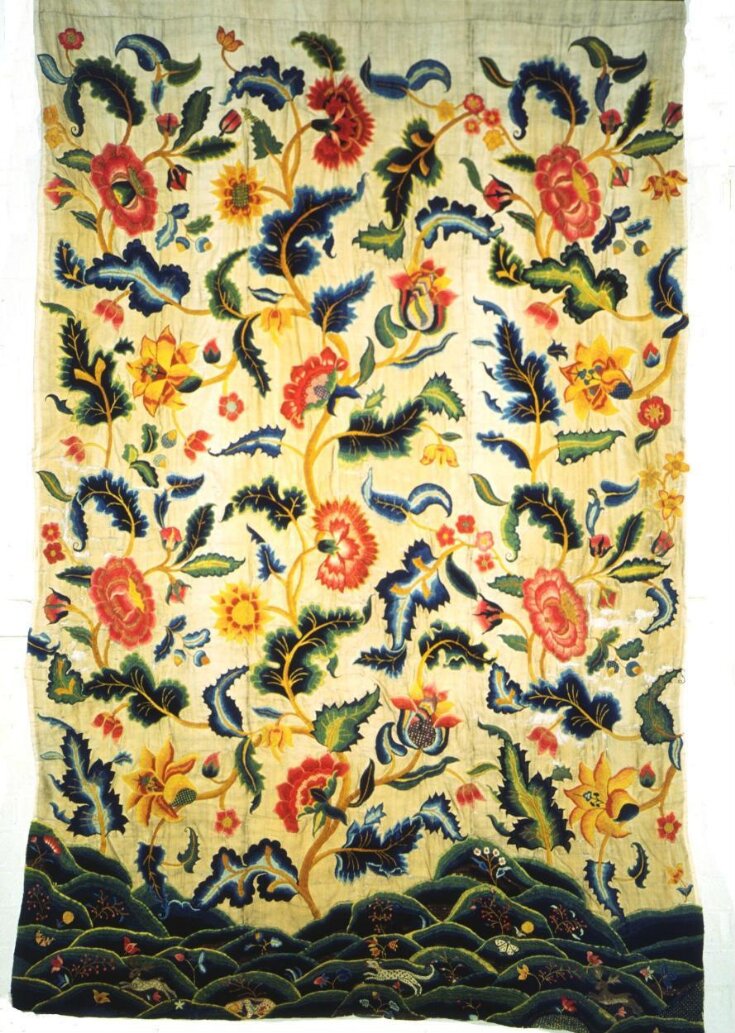
This curtain is from a set of bed hangings. When the set was acquired it comprised four curtains and three valances, but there may originally have been more pieces to make the complete bed. One of the curtains has the embroidered date 1755, suggesting it was thought valuable enough to complete or refurbish some 50 years after it was originally started.
Design & Designing
The design here derives from the Indian flowering tree motif, but has been turned into a repeating pattern of vertical branches suitable for a set of hangings. The effect of the repetition is softened by variations in the stitches and colours, and its regularity suggests it was drawn by a professional onto the ground fabric or copied directly from a pattern. The repeating motif of hound chasing stag is particularly suited to a design seen in the round when the curtains are drawn.
Materials & Making
Needlework was a skill taught from early girlhood in 17th-century Britain. Adult women might earn their living from it, or use it in the upkeep and decoration of their households. In the case of curtains like this it enabled the impact of such imported and professionally manufactured goods as chintz to be imitated in a domestic setting.
This curtain is from a set of bed hangings. When the set was acquired it comprised four curtains and three valances, but there may originally have been more pieces to make the complete bed. One of the curtains has the embroidered date 1755, suggesting it was thought valuable enough to complete or refurbish some 50 years after it was originally started.
Design & Designing
The design here derives from the Indian flowering tree motif, but has been turned into a repeating pattern of vertical branches suitable for a set of hangings. The effect of the repetition is softened by variations in the stitches and colours, and its regularity suggests it was drawn by a professional onto the ground fabric or copied directly from a pattern. The repeating motif of hound chasing stag is particularly suited to a design seen in the round when the curtains are drawn.
Materials & Making
Needlework was a skill taught from early girlhood in 17th-century Britain. Adult women might earn their living from it, or use it in the upkeep and decoration of their households. In the case of curtains like this it enabled the impact of such imported and professionally manufactured goods as chintz to be imitated in a domestic setting.
Object details
| Categories | |
| Object type | |
| Materials and techniques | Linen and cotton twill, embroidered with wool |
| Brief description | embroidered, 1700s, English; Crewelwork |
| Physical description | Embroidered Curtain; linen and cotton twill, embroidered with wool; with large mainly red or blue flowers, blue or blue-green leaves and yellow stems, above a ground area of dark green mossy like lumps, on which are a variety of creatures including, butterflies, deer, a spotted dog with collar, and a variety of flowers. |
| Dimensions |
|
| Gallery label | British Galleries:
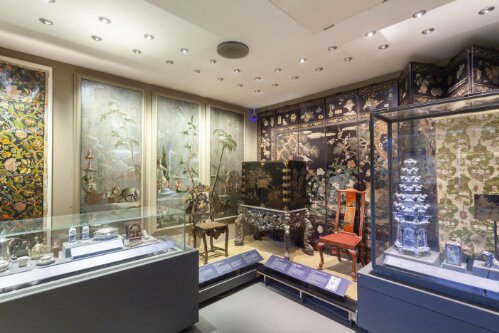
BED CURTAINS These two curtains illustrate how design ideas were passed backwards and forwards between India and England. Both are based on the Indian flowering tree pattern. The Indian makers of the painted chintz used textile designs from Britain to adapt their traditional designs for a British market. The British makers of the embroidered curtain were, in turn, imitating fashionable Indian chintzes and re-created them with embroidery.(27/03/2003) |
| Summary | Object Type This curtain is from a set of bed hangings. When the set was acquired it comprised four curtains and three valances, but there may originally have been more pieces to make the complete bed. One of the curtains has the embroidered date 1755, suggesting it was thought valuable enough to complete or refurbish some 50 years after it was originally started. Design & Designing The design here derives from the Indian flowering tree motif, but has been turned into a repeating pattern of vertical branches suitable for a set of hangings. The effect of the repetition is softened by variations in the stitches and colours, and its regularity suggests it was drawn by a professional onto the ground fabric or copied directly from a pattern. The repeating motif of hound chasing stag is particularly suited to a design seen in the round when the curtains are drawn. Materials & Making Needlework was a skill taught from early girlhood in 17th-century Britain. Adult women might earn their living from it, or use it in the upkeep and decoration of their households. In the case of curtains like this it enabled the impact of such imported and professionally manufactured goods as chintz to be imitated in a domestic setting. |
| Collection | |
| Accession number | 72C-1897 |
About this object record
Explore the Collections contains over a million catalogue records, and over half a million images. It is a working database that includes information compiled over the life of the museum. Some of our records may contain offensive and discriminatory language, or reflect outdated ideas, practice and analysis. We are committed to addressing these issues, and to review and update our records accordingly.
You can write to us to suggest improvements to the record.
Suggest feedback
You can write to us to suggest improvements to the record.
Suggest feedback
| Record created | March 27, 2003 |
| Record URL |
Download as: JSONIIIF Manifest
