
Richard Sackville, 3rd Earl of Dorset
Portrait Miniature
1616 (painted)
1616 (painted)
| Artist/Maker | |
| Place of origin |
Object Type
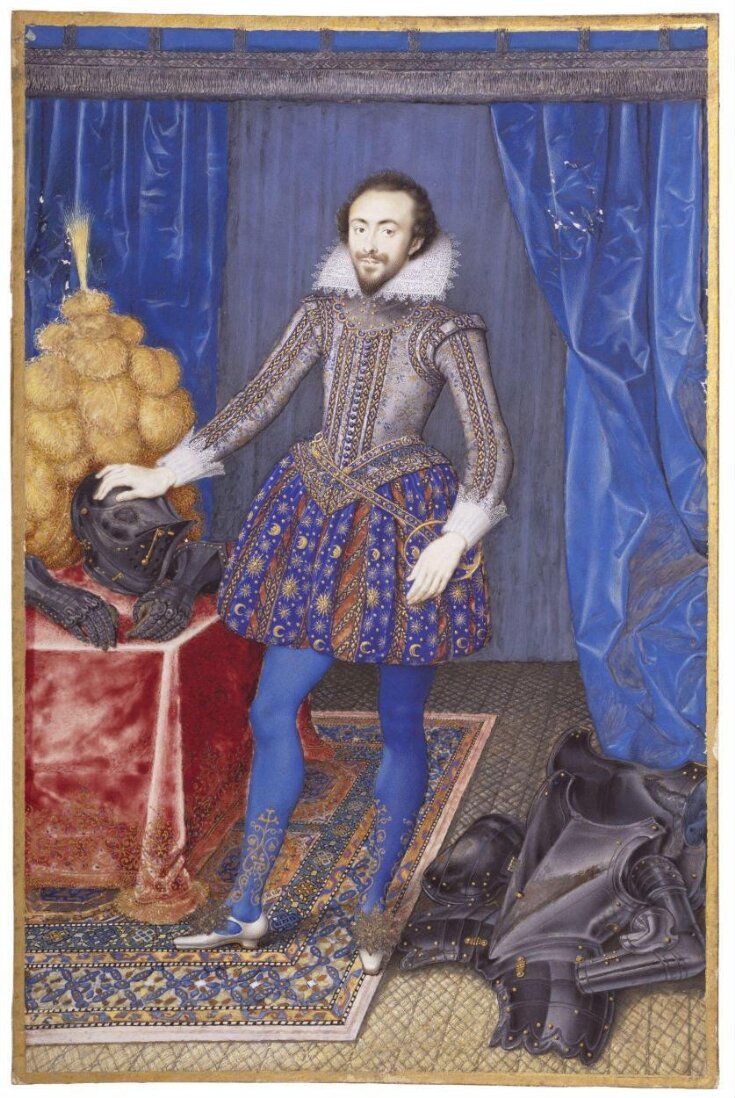
The term 'miniature' is a description of a watercolour technique rather than the size of a painting. So although this painting may seem quite large, it is a miniature because it is painted in watercolour on vellum (fine animal skin). Such large miniatures are today called 'cabinet miniatures'. This is a recent term for miniatures that would have been kept in a cupboard or a room hung with other small paintings. Both spaces were then called 'cabinets'.
People
Richard Sackville (1590-1624) succeeded as 3rd Earl of Dorset in 1609. He married Anne Clifford, daughter of George Clifford, 3rd Earl of Cumberland. Her diary records the many extravagances that led the mortgaging of his house, Knole in Kent. Sackville was a prominent figure in the tiltyard (where a horseman with a spear would charge at a mark or person). His interest in such chivalrous pastimes is reflected in the pieces of armour on the table and floor.
Materials & Making
This is one of the biggest and most important of Isaac Oliver's large-scale miniatures. For Dorset no expense was too great. Here the painter used the three most important blue pigments: costly ultramarine (lapis lazuli) for his breeches spangled with moons and suns; blue bice (azurite) for the side curtain, pelmet and stockings; and smalt (a pigment made from cobalt-coloured glass) for the greyish curtain behind the sitter.
The term 'miniature' is a description of a watercolour technique rather than the size of a painting. So although this painting may seem quite large, it is a miniature because it is painted in watercolour on vellum (fine animal skin). Such large miniatures are today called 'cabinet miniatures'. This is a recent term for miniatures that would have been kept in a cupboard or a room hung with other small paintings. Both spaces were then called 'cabinets'.
People
Richard Sackville (1590-1624) succeeded as 3rd Earl of Dorset in 1609. He married Anne Clifford, daughter of George Clifford, 3rd Earl of Cumberland. Her diary records the many extravagances that led the mortgaging of his house, Knole in Kent. Sackville was a prominent figure in the tiltyard (where a horseman with a spear would charge at a mark or person). His interest in such chivalrous pastimes is reflected in the pieces of armour on the table and floor.
Materials & Making
This is one of the biggest and most important of Isaac Oliver's large-scale miniatures. For Dorset no expense was too great. Here the painter used the three most important blue pigments: costly ultramarine (lapis lazuli) for his breeches spangled with moons and suns; blue bice (azurite) for the side curtain, pelmet and stockings; and smalt (a pigment made from cobalt-coloured glass) for the greyish curtain behind the sitter.
Delve deeper
Discover more about this object

Object details
| Categories | |
| Object type | |
| Title | Richard Sackville, 3rd Earl of Dorset (generic title) |
| Materials and techniques | Watercolour on vellum, stuck to plain card |
| Brief description | Portrait miniature of Richard Sackville, third Earl of Dorset, watercolour on vellum, painted by Isaac Oliver, 1616. |
| Physical description | Portrait miniature of a man, full-length, standing in an interior. |
| Dimensions |
|
| Styles | |
| Marks and inscriptions | 'Isaac. Olliuierus. fecit.; and: 1616.' (Signed, bottom right) |
| Gallery label | British Galleries:
Richard Sackville was described as 'a man of spirit and talent, but a licentious spendthrift'. The sumptuous clothes worn here are recorded in an inventory of 1617, down to the 'paire of Roeses edged with gold and silver lace' on his shoes. The blue pigments used for this miniature would have been expensive, echoing the fabrics depicted.(27/03/2003) |
| Credit line | Bequeathed by John Jones |
| Object history | COLLECTIONS: Presumably commissioned by the sitter; first recorded in the collection of Jeremiah Harman; C. Sackville Bale collection; sold 24th May 1881 (lot 1424); acquired by John Jones; bequeathed by him, 1882. |
| Production | Signed and dated 1616 |
| Subjects depicted | |
| Summary | Object Type The term 'miniature' is a description of a watercolour technique rather than the size of a painting. So although this painting may seem quite large, it is a miniature because it is painted in watercolour on vellum (fine animal skin). Such large miniatures are today called 'cabinet miniatures'. This is a recent term for miniatures that would have been kept in a cupboard or a room hung with other small paintings. Both spaces were then called 'cabinets'. People Richard Sackville (1590-1624) succeeded as 3rd Earl of Dorset in 1609. He married Anne Clifford, daughter of George Clifford, 3rd Earl of Cumberland. Her diary records the many extravagances that led the mortgaging of his house, Knole in Kent. Sackville was a prominent figure in the tiltyard (where a horseman with a spear would charge at a mark or person). His interest in such chivalrous pastimes is reflected in the pieces of armour on the table and floor. Materials & Making This is one of the biggest and most important of Isaac Oliver's large-scale miniatures. For Dorset no expense was too great. Here the painter used the three most important blue pigments: costly ultramarine (lapis lazuli) for his breeches spangled with moons and suns; blue bice (azurite) for the side curtain, pelmet and stockings; and smalt (a pigment made from cobalt-coloured glass) for the greyish curtain behind the sitter. |
| Bibliographic reference | Strong, Roy. Artists of the Tudor Court: the Portrait Miniature Rediscovered 1520-1620. London: The Victoria and Albert Museum, 1983.Cat. 276, p. 166. Part Citation: "Richard Sackville, (1590-1624), who succeeded as third Earl in 1609 was categorized as “a man of spirit and talent, but a licentious spendthrift”. He married Anne Clifford, daughter of George Clifford, 3rd Earl of Cumberland and her diary records his extravagances, so that by his death he had mortgaged Knole.
One of the biggest and most important of Oliver’s large-scale miniatures. Dorset’s prodigality was famous and is here reflected, as V&A conservator V. J. Murrell has observed, in the use of the three most important blue pigments: the costly ultramarine (lapis lazuli) for the trunk hose; blue bice (azurite) for the side curtain, pelmet and stockings; and smalt (a pigment made from cobalt-coloured glass) for the greyish curtain behind the sitter. This miniature is a rare instance where the clothes worn can actually be identified in a contemporary inventory. In 1617 “An Inventorie of the rich wearing Apparrell of the right honourable Richard Earle of Dorset” was compiled, in which Sacville’s attire is identifiable:
“Item one paire of Bullen hose of Scarlett and blew velvet the panes of Scarlett laced all over with watchett silk silver and gold lace and the puffs of blew velvett embroidered all over with sonnes Moones and stares of gold
Item one paire of longe watchet silke stockings embroidered.The suit in the inventory consists of only five items, whereas normally it would have been made up of eleven. By 1617 parts of it must have already been given away or dismantled for upholstery at Knole, as was the case of most of the clothes and caparisons in the inventory.
Dorset was a prominent figure in the tiltyard and his interest in chivalrous pastimes is reflected in the pieces of armour on the table and floor. No other miniature corresponds so closely with the formalized portraits ascribed to William Larkin. The miniature, however startling a feat of virtuosity, is so uncharacteristic of Oliver in its composition and multicoloured tonality that it must reflect the dictates of the sitter." |
| Collection | |
| Accession number | 721-1882 |
About this object record
Explore the Collections contains over a million catalogue records, and over half a million images. It is a working database that includes information compiled over the life of the museum. Some of our records may contain offensive and discriminatory language, or reflect outdated ideas, practice and analysis. We are committed to addressing these issues, and to review and update our records accordingly.
You can write to us to suggest improvements to the record.
Suggest feedback
You can write to us to suggest improvements to the record.
Suggest feedback
| Record created | March 27, 2003 |
| Record URL |
Download as: JSONIIIF Manifest
