
Fireback
1590-1600 (made)
| Artist/Maker | |
| Place of origin |
Object Type
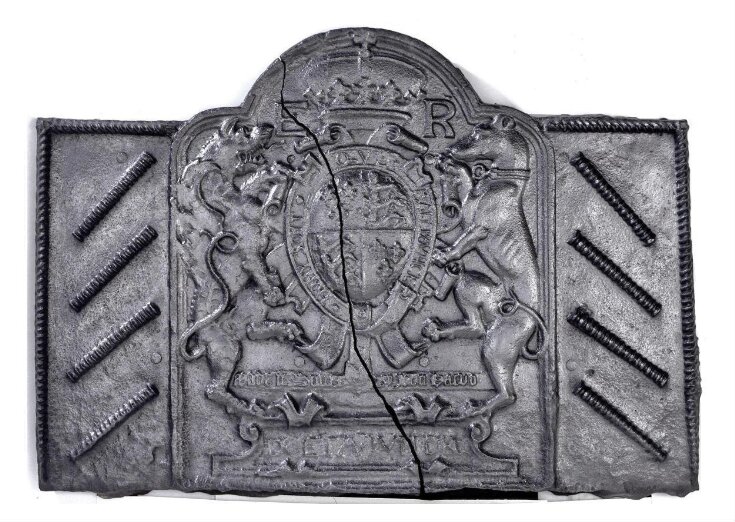
Decorated slabs of cast iron were placed at the back of fireplaces in order to protect the brickwork and radiate heat. In this one the central panel is decorated with complicated heraldic designs, while the borders have simple patterns. The royal arms are those used by the Tudor sovereigns, with a dragon and a greyhound as supporters.
Materials & Making
The fireback was made by a process known as sand casting, in which molten iron was poured into a sand mould. The mould was made by placing a carved model - usually made of wood, of rectangular shape - face down onto flat, damp sand set into the foundry floor. The model was gently hammered down until it was embedded in the sand. It was then removed, leaving its impression in the sand. The iron, heated until it was liquid, was poured into this mould and left to cool. The end product was an iron slab, patterned on one side.
Places
The inscription on this fireback states that it was made in Sussex by John Harvo. However, wear on the central panel is greater than on the side panels suggesting the fireback was made by using a casting fireback as a pattern and adding the side panels to make a larger fireback. John Harvo was active as an iron founder at Pounsley Furnace in Framfield, Sussex, between 1547 and 1565, but the fireback is likely to date from the end of the 16th century. Sussex, because of its closeness to London and its good supplies of fuel and iron ore, was a great centre for foundry work in the 16th century and many firebacks were produced there.
Time
Cast ironwork can be difficult to date accurately as patterns were often used over and over again, sometimes for generations. The inscription on this fireback is in late Gothic script, known as 'black-letter', still found occasionally in the 16th century.
Decorated slabs of cast iron were placed at the back of fireplaces in order to protect the brickwork and radiate heat. In this one the central panel is decorated with complicated heraldic designs, while the borders have simple patterns. The royal arms are those used by the Tudor sovereigns, with a dragon and a greyhound as supporters.
Materials & Making
The fireback was made by a process known as sand casting, in which molten iron was poured into a sand mould. The mould was made by placing a carved model - usually made of wood, of rectangular shape - face down onto flat, damp sand set into the foundry floor. The model was gently hammered down until it was embedded in the sand. It was then removed, leaving its impression in the sand. The iron, heated until it was liquid, was poured into this mould and left to cool. The end product was an iron slab, patterned on one side.
Places
The inscription on this fireback states that it was made in Sussex by John Harvo. However, wear on the central panel is greater than on the side panels suggesting the fireback was made by using a casting fireback as a pattern and adding the side panels to make a larger fireback. John Harvo was active as an iron founder at Pounsley Furnace in Framfield, Sussex, between 1547 and 1565, but the fireback is likely to date from the end of the 16th century. Sussex, because of its closeness to London and its good supplies of fuel and iron ore, was a great centre for foundry work in the 16th century and many firebacks were produced there.
Time
Cast ironwork can be difficult to date accurately as patterns were often used over and over again, sometimes for generations. The inscription on this fireback is in late Gothic script, known as 'black-letter', still found occasionally in the 16th century.
Object details
| Categories | |
| Object type | |
| Materials and techniques | Cast iron |
| Brief description | Fireback showing the Tudor royal arms, caat-iron, the central section cast from a mid-16th-century fireback by John Harvo, Sussex, cast and extended with side panels ca. 1590-1600 |
| Physical description | Rectangular 'portrait' orientation fireback with a domed top to the central section fitted with side panels each with four 'roped' lines, the central section cast with the Tudor royal arms, the initials 'E.R.' and the motto 'DU ET MOUN DROI (T)' and 'HONY SOIT QUE MAL Y PAYNCE'; cast in Gothic letters 'Made in Sussex by John Harvo' |
| Dimensions |
|
| Marks and inscriptions | Cast with the Tudor royal arms, the initials 'E.R.' and the motto 'DU ET MOUN DROI (T)' and 'HONY SOIT QUE MAL Y PAYNCE'; cast in Gothic letters 'Made in Sussex by John Harvo' (Cadt form a fireback made by John Harvo, maker unknown) |
| Gallery label | British Galleries:
A fireback was used to protect the brick lining of a hearth from the intense heat of the fire. All sorts of decoration could be cast. Some show biblical or classical scenes. The original owner of this fireback probably chose the Tudor royal arms to express his loyalty.(27/03/2003) |
| Object history | While the central section is signed by John Harvo of Framfield, Sussex, wear on the central armorial panel is greater than on the side panels. This indicates that this fireback was made by using a casting of the armorial fireback as a pattern and adding the side panels to make a larger fireback. John Harvo was active as an iron founder at Pounsley Furnace in Framfield, Sussex, between 1547 and 1565, but the fireback is likely to date from the end of the 16th century. |
| Historical context | The museum is grateful for images and information supplied by the researcher and author, Jeremy Hodgkinson FSA, 30 March 2022 |
| Production | Made in Sussex. |
| Subjects depicted | |
| Summary | Object Type Decorated slabs of cast iron were placed at the back of fireplaces in order to protect the brickwork and radiate heat. In this one the central panel is decorated with complicated heraldic designs, while the borders have simple patterns. The royal arms are those used by the Tudor sovereigns, with a dragon and a greyhound as supporters. Materials & Making The fireback was made by a process known as sand casting, in which molten iron was poured into a sand mould. The mould was made by placing a carved model - usually made of wood, of rectangular shape - face down onto flat, damp sand set into the foundry floor. The model was gently hammered down until it was embedded in the sand. It was then removed, leaving its impression in the sand. The iron, heated until it was liquid, was poured into this mould and left to cool. The end product was an iron slab, patterned on one side. Places The inscription on this fireback states that it was made in Sussex by John Harvo. However, wear on the central panel is greater than on the side panels suggesting the fireback was made by using a casting fireback as a pattern and adding the side panels to make a larger fireback. John Harvo was active as an iron founder at Pounsley Furnace in Framfield, Sussex, between 1547 and 1565, but the fireback is likely to date from the end of the 16th century. Sussex, because of its closeness to London and its good supplies of fuel and iron ore, was a great centre for foundry work in the 16th century and many firebacks were produced there. Time Cast ironwork can be difficult to date accurately as patterns were often used over and over again, sometimes for generations. The inscription on this fireback is in late Gothic script, known as 'black-letter', still found occasionally in the 16th century. |
| Bibliographic reference | Hodgkinson, Jeremy. British Cast-Iron Firebacks of the 16th to Mid-18th Centuries. Crawley: HodgersBooks. 2010
fig. 115, pp. 106, 236 |
| Collection | |
| Accession number | 685-1899 |
About this object record
Explore the Collections contains over a million catalogue records, and over half a million images. It is a working database that includes information compiled over the life of the museum. Some of our records may contain offensive and discriminatory language, or reflect outdated ideas, practice and analysis. We are committed to addressing these issues, and to review and update our records accordingly.
You can write to us to suggest improvements to the record.
Suggest feedback
You can write to us to suggest improvements to the record.
Suggest feedback
| Record created | March 27, 2003 |
| Record URL |
Download as: JSONIIIF Manifest
