The Walpole Salver
Salver
1728-1729 (made)
1728-1729 (made)
| Artist/Maker | |
| Place of origin |
Object Type
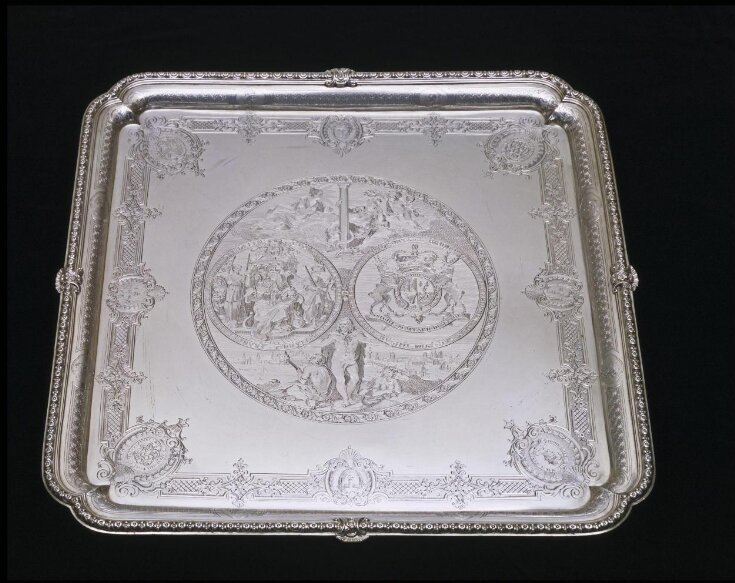
This square tray, or 'salver' is one of two commissioned by Sir Robert Walpole to commemorate his terms as Chancellor of the Exchequer.
Ownership & Use
It was a long-established custom for the holders of certain Crown offices to receive as a perquisite ('perk') the official silver seal of their office when it became redundant, as, for example, following the death of the sovereign. The recipient commissioned a piece of silver engraved with the designs of the official seals. Sir Robert Walpole was Chancellor of the Exchequer when George I died in 1727 and this salver is engraved with the design of the Second Exchequer Seal of George I. The salver was eventually inherited by Sir Robert's youngest son, Horace.
Engraved Decoration
The centre is engraved with the obverse, or front, and reverse of the Second Exchequer Seal of George I in use from 1724-1727. The seal roundels are supported by a figure of Hercules, representing Heroic Virtue. He is flanked by allegorical figures representing Calumny and Envy, with a view of the City of London in the background. The figures above represent Prudence and Fortitude. The elaborate strapwork border encloses masks representing the Four Seasons and has a cartouche in each corner. Each shows, within the Garter collar, the double cipher 'RW' appearing twice, the arms of Walpole quartering those of his first wife Catherine Shorter, and the Walpole crest of a Saracen's head.
People
This salver was made by Paul de Lamerie (1688-1751), one of the leading goldsmiths of the time. The superb engraving is of the highest quality and is attributed to the renowned artist William Hogarth (1697-1764).
This square tray, or 'salver' is one of two commissioned by Sir Robert Walpole to commemorate his terms as Chancellor of the Exchequer.
Ownership & Use
It was a long-established custom for the holders of certain Crown offices to receive as a perquisite ('perk') the official silver seal of their office when it became redundant, as, for example, following the death of the sovereign. The recipient commissioned a piece of silver engraved with the designs of the official seals. Sir Robert Walpole was Chancellor of the Exchequer when George I died in 1727 and this salver is engraved with the design of the Second Exchequer Seal of George I. The salver was eventually inherited by Sir Robert's youngest son, Horace.
Engraved Decoration
The centre is engraved with the obverse, or front, and reverse of the Second Exchequer Seal of George I in use from 1724-1727. The seal roundels are supported by a figure of Hercules, representing Heroic Virtue. He is flanked by allegorical figures representing Calumny and Envy, with a view of the City of London in the background. The figures above represent Prudence and Fortitude. The elaborate strapwork border encloses masks representing the Four Seasons and has a cartouche in each corner. Each shows, within the Garter collar, the double cipher 'RW' appearing twice, the arms of Walpole quartering those of his first wife Catherine Shorter, and the Walpole crest of a Saracen's head.
People
This salver was made by Paul de Lamerie (1688-1751), one of the leading goldsmiths of the time. The superb engraving is of the highest quality and is attributed to the renowned artist William Hogarth (1697-1764).
Object details
| Categories | |
| Object type | |
| Title | The Walpole Salver (popular title) |
| Materials and techniques | Silver, engraved, with cast and applied decoration |
| Brief description | Silver, London hallmarks for 1728-9, mark of Paul de Lamerie, possibly designed by William Hogarth. |
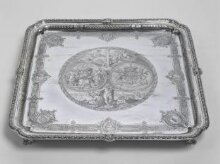
| Physical description | A square salver on four cast feet, with a cast and applied rim. Engraved with the obverse and reverse of the Second Exchequer Seal of George I (in use 1724-1727). The roundels are supported by Hercules, representing Heroic Virtue. He stands against a view of the City of London, and is flanked by allegorical figures of Calumny and Envy, with Wisdom and Virtue above. The salver's border is composed of elaborate strapwork enclosing masks of the Four Seasons. In the elaborate corner cartouches, the double cypher RW appears twice, alternating with arms and a crest, each within the Garter collar. The arms are those of Robert Walpole quartering those of his first wife Catherine Shorter. |
| Dimensions |
|
| Marks and inscriptions |
|
| Gallery label | British Galleries:
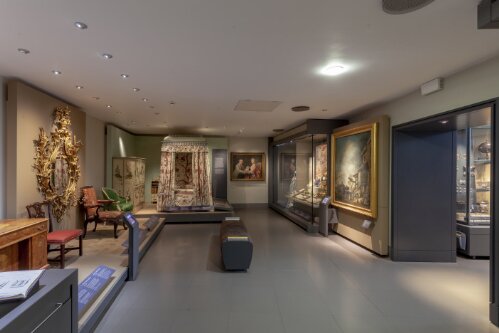
Horace Walpole was keenly interested in his own family history. This salver was made for his father, the British statesman Sir Robert Walpole, Ist Earl of Orford (1676-1745). Sir Robert was Chancellor of the Exchequer when George I died in 1727. He followed the contemporary custom in converting the official silver seal of his office, made obsolete by the king's death, into a piece of silver engraved with the design of the Exchequer seal. The salver is one of Paul de Lamerie's best known works, and the engraving is probably by the painter William Hogarth.(27/03/2003) |
| Credit line | Acquired with the assistance of the Pilgrim Trust and The Art Fund |
| Object history | Made in London by Paul de Lamerie (born in Bois-le-Duc, The Netherlands, 1688, died in London 1751), probably engraved by William Hogarth (born in London, 1697, died there in 1764) Norwich Castle Exhibition RF.95/1378B V&A Exhibition RF.2008/527 Historical significance: The Walpole Salver is the later, and the better, known of the two salvers commemorating Sir Robert Walpole's two terms of service to George I as Chancellor of the Exchequer. It is among the best-known examples of Lamerie's work. |
| Historical context | By the early 18th century it was a long-established custom for holders of crown office to commemorate their term of office with a piece of silver (a cup or a a salver), engraved with the design of their official seals. Its weight often corresponded approximately to the metal of the original silver matrices, which were a perquisite of office. |
| Production | When John Nichols published Biographical Anecdotes of William Hogarth (1781) he listed a pull from this salver, although the salver itsef was not known to him, nor was it referred to by Horace Walpole in his Anecdotes of Painting in England. The attribution to Hogarth was challenged by Phillips (1935), on no very good grounds, and again by Collins (Apollo, 1957), but more recently both Oman (1978) and Paulson (1970 and 1971) have argued forcibly for accepting Nichols' evidence. In January 1714, William Hogarth was apprenticed through the Merchant Taylor's Company to the goldsmith, Ellis Gamble, as an engraver, for whom he later engraved a tradecard (ca. 1724). From 1720 when Hogarth set up shop, he spent a decade supporting himself as a jobbing engraver, engraving both silver and copper plates .... Apart from shopcards, he presumably worked for whichever goldsmith sent him orders; a single impression of Lamerie's own arms in the Royal Library is attributed to Hogarth and he engraved arms on silver for various clients, including the Duchess of Kendal, mistress of George I. A letterhead from Blundell's School (1726) and a benefit ticket for the actor Henry Milward (1728) ... It has been suggested that Walpole might have specified Hogarth as the engraver of the salver, and it is true that the two men knew one another; one of the artist's early portraits (1728) was of Horace Walpole as a boy. But Lamerie's leading position in the trade and the business partnership between him and Hogarth's old master Ellis Gamble, as evidenced by their joint fire insurance policies for 1723-1728 is far more likely to be the explanation. The strongest evidence for the attribution to Hogarth is the close resemblance between the poses of the allegorical figures and those of the engravings known to have been Hogarth's work, such as the Gamble card and 'The Lottery' (1724). They derive from Sir James Thornhill's paintings of the Protestant Succession in the Great Hall at Greenwich. These 'were running in my head' during Hogarth's apprenticeship, an enthusiasm revived by his attendance at Thornhill's Academy from 1724. Source: exh. cat., Paul de Lamerie, Goldsmiths' Hall, London, 1990, No. 50 (P. Glanville) |
| Subjects depicted | |
| Place depicted | |
| Association | |
| Summary | Object Type This square tray, or 'salver' is one of two commissioned by Sir Robert Walpole to commemorate his terms as Chancellor of the Exchequer. Ownership & Use It was a long-established custom for the holders of certain Crown offices to receive as a perquisite ('perk') the official silver seal of their office when it became redundant, as, for example, following the death of the sovereign. The recipient commissioned a piece of silver engraved with the designs of the official seals. Sir Robert Walpole was Chancellor of the Exchequer when George I died in 1727 and this salver is engraved with the design of the Second Exchequer Seal of George I. The salver was eventually inherited by Sir Robert's youngest son, Horace. Engraved Decoration The centre is engraved with the obverse, or front, and reverse of the Second Exchequer Seal of George I in use from 1724-1727. The seal roundels are supported by a figure of Hercules, representing Heroic Virtue. He is flanked by allegorical figures representing Calumny and Envy, with a view of the City of London in the background. The figures above represent Prudence and Fortitude. The elaborate strapwork border encloses masks representing the Four Seasons and has a cartouche in each corner. Each shows, within the Garter collar, the double cipher 'RW' appearing twice, the arms of Walpole quartering those of his first wife Catherine Shorter, and the Walpole crest of a Saracen's head. People This salver was made by Paul de Lamerie (1688-1751), one of the leading goldsmiths of the time. The superb engraving is of the highest quality and is attributed to the renowned artist William Hogarth (1697-1764). |
| Bibliographic references |
|
| Collection | |
| Accession number | M.9-1956 |
About this object record
Explore the Collections contains over a million catalogue records, and over half a million images. It is a working database that includes information compiled over the life of the museum. Some of our records may contain offensive and discriminatory language, or reflect outdated ideas, practice and analysis. We are committed to addressing these issues, and to review and update our records accordingly.
You can write to us to suggest improvements to the record.
Suggest feedback
You can write to us to suggest improvements to the record.
Suggest feedback
| Record created | June 1, 1998 |
| Record URL |
Download as: JSONIIIF Manifest
