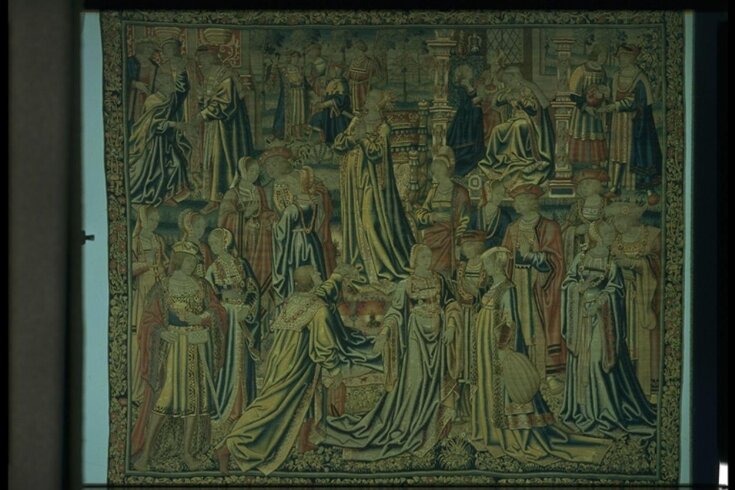

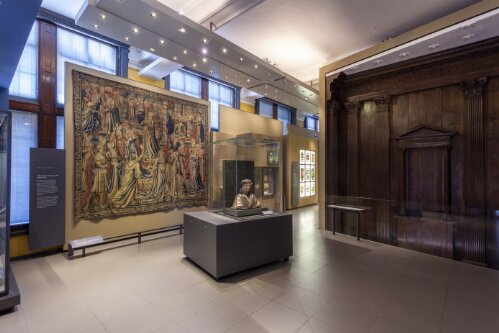
Esther hearing of Haman's plot
Tapestry
1500-1525 (made)
1500-1525 (made)
| Artist/Maker | |
| Place of origin |
Object Type
Rich and noble families often owned large numbers of tapestries, which could be transported as required from house to house. They were hung on the walls, where they helped to insulate draughty rooms as well as adding colour and interest to an interior. Some tapestries told a story, while others had a decorative design using popular motifs.
Design & Designing
There were two main stages to the design of a tapestry. First, a preliminary sketch was made. This was then converted into a full-size drawing, or cartoon, in which the design was shown in greater detail. The weavers followed this cartoon. Generally, the workshops employed a skilled craftsman to produce cartoons from the existing stock of designs, or by 'borrowing' from outside sources. Renowned artists were used only for important commissions.
Subjects Depicted
The story comes from the Old Testament. Esther was the wife of Xerxes, King of Persia. Unaware that she was Jewish, the King allowed his chief minister to order the massacre of all Jews in the Persian empire. Esther risked her own death to intercede with the King to save her people.
The subject was a favourite theme, particularly on tapestries of the15th and 16th century. A number of these survive, including two unrelated examples in the V&A, the piece described here and another with a different scene. Both Henry VIII and his Lord Chancellor, Cardinal Wolsey, owned Esther tapestries and several sets are listed in the numerous entries for tapestries in the inventory of Henry VIII's possessions.
Rich and noble families often owned large numbers of tapestries, which could be transported as required from house to house. They were hung on the walls, where they helped to insulate draughty rooms as well as adding colour and interest to an interior. Some tapestries told a story, while others had a decorative design using popular motifs.
Design & Designing
There were two main stages to the design of a tapestry. First, a preliminary sketch was made. This was then converted into a full-size drawing, or cartoon, in which the design was shown in greater detail. The weavers followed this cartoon. Generally, the workshops employed a skilled craftsman to produce cartoons from the existing stock of designs, or by 'borrowing' from outside sources. Renowned artists were used only for important commissions.
Subjects Depicted
The story comes from the Old Testament. Esther was the wife of Xerxes, King of Persia. Unaware that she was Jewish, the King allowed his chief minister to order the massacre of all Jews in the Persian empire. Esther risked her own death to intercede with the King to save her people.
The subject was a favourite theme, particularly on tapestries of the15th and 16th century. A number of these survive, including two unrelated examples in the V&A, the piece described here and another with a different scene. Both Henry VIII and his Lord Chancellor, Cardinal Wolsey, owned Esther tapestries and several sets are listed in the numerous entries for tapestries in the inventory of Henry VIII's possessions.
Object details
| Categories | |
| Object type | |
| Title | Esther hearing of Haman's plot (generic title) |
| Materials and techniques | Tapestry-woven in wool and silk |
| Brief description | Esther hearing of Haman's plot |
| Physical description | Tapestry showing a scene from the story of Esther |
| Dimensions |
|
| Gallery label | British Galleries:
Sets of imported tapestries were used in palaces and great houses as luxurious wall hangings that also served to insulate against draughts. The contemporary dress of the figures underlined the relevance for the Tudor court of this Old Testament story where virtue overcomes evil. Queen Esther saved the Jewish people from destruction, against the advice of Haman, the King's evil minister. In the centre the Queen stands by her throne in anguish. In the foreground a messenger makes his way between groups of courtiers.(27/03/2003) |
| Subjects depicted | |
| Summary | Object Type Rich and noble families often owned large numbers of tapestries, which could be transported as required from house to house. They were hung on the walls, where they helped to insulate draughty rooms as well as adding colour and interest to an interior. Some tapestries told a story, while others had a decorative design using popular motifs. Design & Designing There were two main stages to the design of a tapestry. First, a preliminary sketch was made. This was then converted into a full-size drawing, or cartoon, in which the design was shown in greater detail. The weavers followed this cartoon. Generally, the workshops employed a skilled craftsman to produce cartoons from the existing stock of designs, or by 'borrowing' from outside sources. Renowned artists were used only for important commissions. Subjects Depicted The story comes from the Old Testament. Esther was the wife of Xerxes, King of Persia. Unaware that she was Jewish, the King allowed his chief minister to order the massacre of all Jews in the Persian empire. Esther risked her own death to intercede with the King to save her people. The subject was a favourite theme, particularly on tapestries of the15th and 16th century. A number of these survive, including two unrelated examples in the V&A, the piece described here and another with a different scene. Both Henry VIII and his Lord Chancellor, Cardinal Wolsey, owned Esther tapestries and several sets are listed in the numerous entries for tapestries in the inventory of Henry VIII's possessions. |
| Bibliographic reference | Baker, Malcolm, and Brenda Richardson (eds.), A Grand Design: The Art of the Victoria and Albert Museum, London: V&A Publications, 1999.
|
| Collection | |
| Accession number | 5669-1859 |
About this object record
Explore the Collections contains over a million catalogue records, and over half a million images. It is a working database that includes information compiled over the life of the museum. Some of our records may contain offensive and discriminatory language, or reflect outdated ideas, practice and analysis. We are committed to addressing these issues, and to review and update our records accordingly.
You can write to us to suggest improvements to the record.
Suggest feedback
You can write to us to suggest improvements to the record.
Suggest feedback
| Record created | March 27, 2003 |
| Record URL |
Download as: JSONIIIF Manifest
