Peg Tankard
1655-1657 (hallmarked)
| Artist/Maker | |
| Place of origin |
Object Type
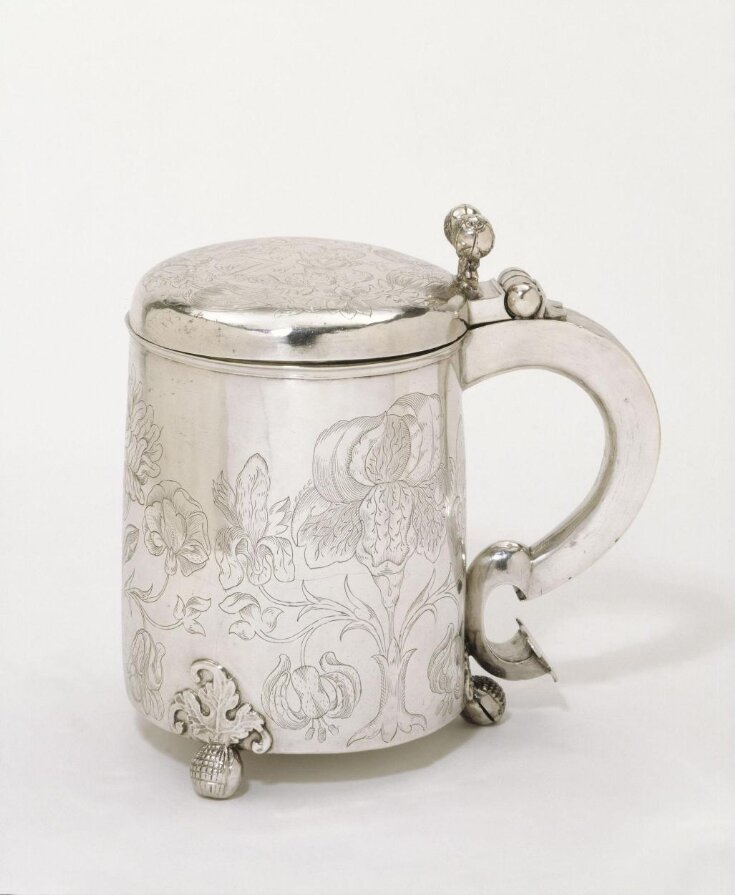
This tankard, known as a peg tankard, would have been used for beer, ale or cider.
History & Use
Peg tankards are so called as they contain a series of cylindrical pegs which are soldered in a vertical row to the internal sides of the tankard. The pegs denote a measure of liquid; after one drinker had drunk their allocated peg measure, the tankard was passed to another. The term 'peg' probably derives from the Danish measure 'paegl', roughly equivalent to a pint. This example contains six pegs. Peg tankards have a long history in the Scandinavian and Baltic countries. British examples are known from Edinburgh, Newcastle upon Tyne, York and Hull, reflecting the established trading links across the North Sea.
Design & Decoration
British peg tankards usually follow the Scandinavian form, incorporating pomegranate feet and a thumbpiece. The floral engraving also has parallel examples in Scandinavian silver of the 1650s and later, and is probably based on a volume of botanical illustrations.
Maker
This form of peg tankard was a speciality of York goldsmiths. John Plummer, the maker of this example, produced a large number of peg tankards.
This tankard, known as a peg tankard, would have been used for beer, ale or cider.
History & Use
Peg tankards are so called as they contain a series of cylindrical pegs which are soldered in a vertical row to the internal sides of the tankard. The pegs denote a measure of liquid; after one drinker had drunk their allocated peg measure, the tankard was passed to another. The term 'peg' probably derives from the Danish measure 'paegl', roughly equivalent to a pint. This example contains six pegs. Peg tankards have a long history in the Scandinavian and Baltic countries. British examples are known from Edinburgh, Newcastle upon Tyne, York and Hull, reflecting the established trading links across the North Sea.
Design & Decoration
British peg tankards usually follow the Scandinavian form, incorporating pomegranate feet and a thumbpiece. The floral engraving also has parallel examples in Scandinavian silver of the 1650s and later, and is probably based on a volume of botanical illustrations.
Maker
This form of peg tankard was a speciality of York goldsmiths. John Plummer, the maker of this example, produced a large number of peg tankards.
Object details
| Categories | |
| Object type | |
| Materials and techniques | Silver, with chased and engraved decoration |
| Brief description | Tankard, silver, English, mid-16th century |
| Physical description | A three-footed tankard with a series of six pegs inside; engraved on body and cover. On the body above each domed foot is a cast and chased three-part leaf. The base is slightly convex. Three of the domed silver pegs are visibly flush with the external surafce. The handle is D-shaped with a central chased rib; at its lower end a separate C-section meets the body and is finished with a shield-shaped plate. Under this is a casting or soldering hole. the thumb-piece is a pair of seeded pomegranates cast and chased rising from entwined cast stems. The raised, slightly domed lid is set onto a right-angled strip fitting inside the rim. The body is engraved with three different flowering plants with roots and pairs of secondary blossoms and buds. The lid is engraved with a stylized cluster of fruit. From this two stems, each with three different flower heads, encircle the central field which is engraved with mantling around a crested helm and coat of arms of Sayer, Kent. (P.Glanville, Silver in Tudor and Early Stuart England, No. 56.) |
| Dimensions |
|
| Marks and inscriptions |
|
| Gallery label |
|
| Credit line | Presented by Art Fund |
| Object history | With the mark of John Plummer, York (active 1648-1688) Historical significance: The engraving has parallels with Scandinavian silver of the 1650s and later, compare for example a tankard in Aarbord Museum, Denmark. The source is a book of horticultural illustrations, as yet unidentified; a possible source is Hortus Eystetteusis by Basilius Bester (Nuremberg, 1613). Plummer's work was different in many ways from that of his London contemporaries but comparable in quality. |
| Historical context | Peg tankards of this type have a long history in the Baltic countries and their presence is a reminder of the close cultural links across the North Sea. |
| Production | Hallmarked for 1655 or 1657. The York date letter sequence is not absolutely established and may not be as published by Jackson. It may have been marked two years earlier than previously thought (1657). |
| Subject depicted | |
| Summary | Object Type This tankard, known as a peg tankard, would have been used for beer, ale or cider. History & Use Peg tankards are so called as they contain a series of cylindrical pegs which are soldered in a vertical row to the internal sides of the tankard. The pegs denote a measure of liquid; after one drinker had drunk their allocated peg measure, the tankard was passed to another. The term 'peg' probably derives from the Danish measure 'paegl', roughly equivalent to a pint. This example contains six pegs. Peg tankards have a long history in the Scandinavian and Baltic countries. British examples are known from Edinburgh, Newcastle upon Tyne, York and Hull, reflecting the established trading links across the North Sea. Design & Decoration British peg tankards usually follow the Scandinavian form, incorporating pomegranate feet and a thumbpiece. The floral engraving also has parallel examples in Scandinavian silver of the 1650s and later, and is probably based on a volume of botanical illustrations. Maker This form of peg tankard was a speciality of York goldsmiths. John Plummer, the maker of this example, produced a large number of peg tankards. |
| Bibliographic reference | Englesko Srebro [English silver from the Victoria and Albert Museum], Belgrade : Muzej Primenjene Umetnosti, 1980 |
| Collection | |
| Accession number | M.217-1938 |
About this object record
Explore the Collections contains over a million catalogue records, and over half a million images. It is a working database that includes information compiled over the life of the museum. Some of our records may contain offensive and discriminatory language, or reflect outdated ideas, practice and analysis. We are committed to addressing these issues, and to review and update our records accordingly.
You can write to us to suggest improvements to the record.
Suggest feedback
You can write to us to suggest improvements to the record.
Suggest feedback
| Record created | June 1, 1998 |
| Record URL |
Download as: JSONIIIF Manifest
