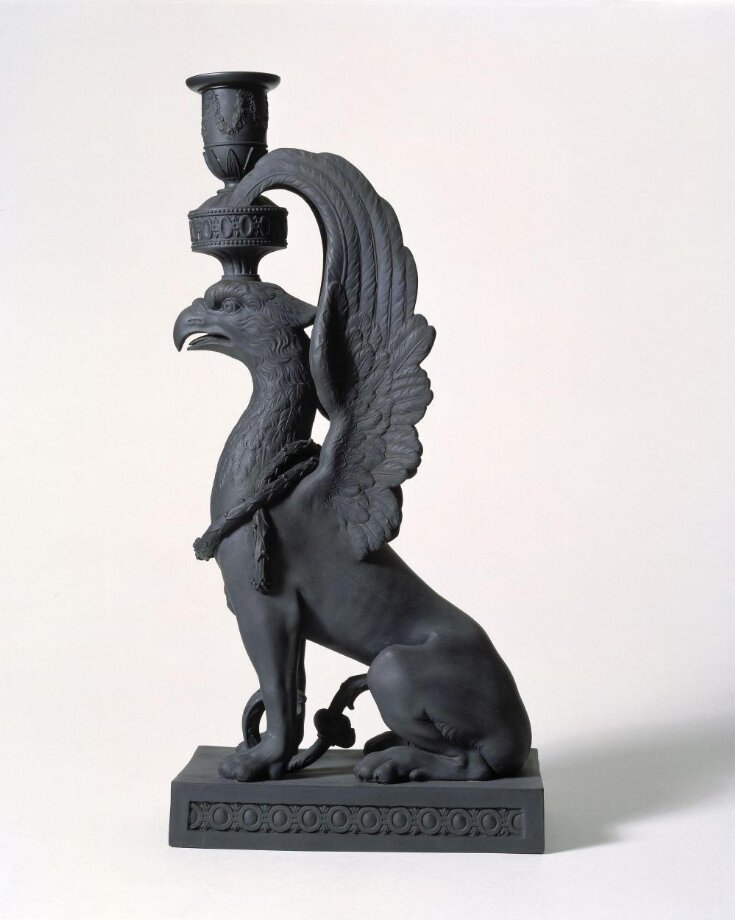

Candlestick
1771 (designed), after 1780 (made)
| Artist/Maker | |
| Place of origin |
Object Type
A painting of an English drawing room shows a pair of these griffin candlesticks set out on a marble chimneypiece, one at each end and facing one another. The painting probably accurately shows how they were intended to be used.
Design & Designing
The candlestick copies an ormolu (gilt bronze) one designed by the architect Sir William Chambers for a client. Chambers lent Josiah Wedgwood (1730-1795) a lead or carved-wood casting model of the candlestick, but Wedgwood had to have this remade for reproduction in pottery. In 1771 he wrote that 'the Griffin Candlestick is alter'd sure enough, for Hackwood [William Hackwood, one of Wedgwood's modellers] was oblig'd to new model it. I hope all the world will not have Mr Chambers's Eyes'. Wedgwood had problems firing the candlestick, complaining that 'the tips of the Griffins wings will not stick to the top of the head as ... in the Lead or Wood pattern', and that 'they all fly off' in the kiln.
People
Sir William Chambers (1723-1796), the King's architect, was an important influence on the design of Wedgwood's ornamental wares. Not only did he did he lend Wedgwood models to copy, but he also advised him on matters of design.
A painting of an English drawing room shows a pair of these griffin candlesticks set out on a marble chimneypiece, one at each end and facing one another. The painting probably accurately shows how they were intended to be used.
Design & Designing
The candlestick copies an ormolu (gilt bronze) one designed by the architect Sir William Chambers for a client. Chambers lent Josiah Wedgwood (1730-1795) a lead or carved-wood casting model of the candlestick, but Wedgwood had to have this remade for reproduction in pottery. In 1771 he wrote that 'the Griffin Candlestick is alter'd sure enough, for Hackwood [William Hackwood, one of Wedgwood's modellers] was oblig'd to new model it. I hope all the world will not have Mr Chambers's Eyes'. Wedgwood had problems firing the candlestick, complaining that 'the tips of the Griffins wings will not stick to the top of the head as ... in the Lead or Wood pattern', and that 'they all fly off' in the kiln.
People
Sir William Chambers (1723-1796), the King's architect, was an important influence on the design of Wedgwood's ornamental wares. Not only did he did he lend Wedgwood models to copy, but he also advised him on matters of design.
Object details
| Categories | |
| Object type | |
| Materials and techniques | Black basalt |
| Brief description | Griffin candlestick, black basalt, made at the factory of Josiah Wedgwood, Etruria, Staffordshire, made after 1780 |
| Physical description | Candlestick of black basalt, in the form of a figure of a griffin seated. The socket is decorated with festoons of flowers and is supported on the head and upraised wings of the griffin; round the neck is entwined a garland. The oblong plinth is moulded with conventional ornament in sunk panels. |
| Dimensions |
|
| Marks and inscriptions | 'WEDGWOOD' (Impressed) |
| Gallery label | British Galleries:
Sir William Chambers, like other Neo-classical architects, designed objects for general use as well as buildings and interiors. This type of candlestick, in the form of a griffin, was first made in gilt-bronze in about 1767. Wedgwood made a Black Basalt version of it in 1771. Such candlesticks were designed to be shown as facing pairs on mantelpieces.(27/03/2003) |
| Credit line | Transferred from the Museum of Practical Geology, Jermyn Street |
| Object history | Based on a design by Sir William Chambers (born in G”teborg, Sweden, 1723, died in London, 1796) Made at Josiah Wedgwood's factory, Etruria, Staffordshire |
| Production | First made 1771; this example made after 1780 |
| Subject depicted | |
| Summary | Object Type A painting of an English drawing room shows a pair of these griffin candlesticks set out on a marble chimneypiece, one at each end and facing one another. The painting probably accurately shows how they were intended to be used. Design & Designing The candlestick copies an ormolu (gilt bronze) one designed by the architect Sir William Chambers for a client. Chambers lent Josiah Wedgwood (1730-1795) a lead or carved-wood casting model of the candlestick, but Wedgwood had to have this remade for reproduction in pottery. In 1771 he wrote that 'the Griffin Candlestick is alter'd sure enough, for Hackwood [William Hackwood, one of Wedgwood's modellers] was oblig'd to new model it. I hope all the world will not have Mr Chambers's Eyes'. Wedgwood had problems firing the candlestick, complaining that 'the tips of the Griffins wings will not stick to the top of the head as ... in the Lead or Wood pattern', and that 'they all fly off' in the kiln. People Sir William Chambers (1723-1796), the King's architect, was an important influence on the design of Wedgwood's ornamental wares. Not only did he did he lend Wedgwood models to copy, but he also advised him on matters of design. |
| Bibliographic reference | Young, Hilary (ed.). The Genius of Wedgwood. London : Victoria & Albert Museum, 1995
C23 |
| Collection | |
| Accession number | 4789-1901 |
About this object record
Explore the Collections contains over a million catalogue records, and over half a million images. It is a working database that includes information compiled over the life of the museum. Some of our records may contain offensive and discriminatory language, or reflect outdated ideas, practice and analysis. We are committed to addressing these issues, and to review and update our records accordingly.
You can write to us to suggest improvements to the record.
Suggest feedback
You can write to us to suggest improvements to the record.
Suggest feedback
| Record created | March 27, 2003 |
| Record URL |
Download as: JSONIIIF Manifest
