Tureen
1819-1820 (hallmarked)
| Artist/Maker | |
| Place of origin |
Object Type
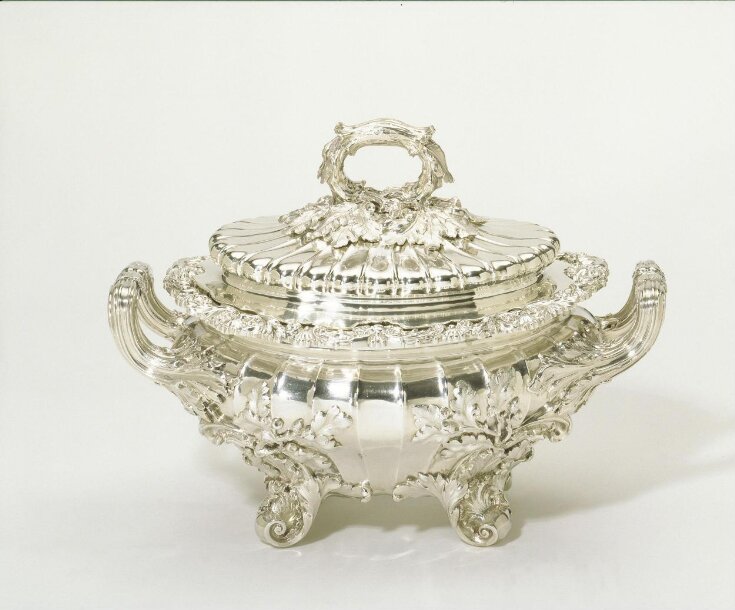
Containers for sauce such as this were, like the sauce they held, a French innovation. A typical dinner service might have four sauce tureens, although as many as ten might be required for the largest and grandest dinners.
Design & Designing
The ornate Rococo style of this tureen, with exuberant naturalistic acorn, oak leaf and shell decoration, and scrolled feet, was advanced taste at the time. Its design proved popular and was made, in some quantity, with minor variations from 1810.
People
The design of this tureen is attributed to Edward Hodges Baily (1788-1867) on the evidence of a drawing in the V&A. Baily was a skilled modeller who trained under the sculptor John Flaxman (1755-1826) and worked for the Royal Goldsmiths, Rundell, Bridge & Rundell, from 1815 to1833. He was appointed chief modeller at Rundell's after Flaxman's death in 1826.
Trading
This tureen was probably sold by Rundell, Bridge & Rundell, the firm which dominated the London silversmithing trade in the period 1800-1830. Paul Storr (1771-1844), whose mark appears on the tureen, was a partner in the business and managed the workshop from 1808 to 1819.
Containers for sauce such as this were, like the sauce they held, a French innovation. A typical dinner service might have four sauce tureens, although as many as ten might be required for the largest and grandest dinners.
Design & Designing
The ornate Rococo style of this tureen, with exuberant naturalistic acorn, oak leaf and shell decoration, and scrolled feet, was advanced taste at the time. Its design proved popular and was made, in some quantity, with minor variations from 1810.
People
The design of this tureen is attributed to Edward Hodges Baily (1788-1867) on the evidence of a drawing in the V&A. Baily was a skilled modeller who trained under the sculptor John Flaxman (1755-1826) and worked for the Royal Goldsmiths, Rundell, Bridge & Rundell, from 1815 to1833. He was appointed chief modeller at Rundell's after Flaxman's death in 1826.
Trading
This tureen was probably sold by Rundell, Bridge & Rundell, the firm which dominated the London silversmithing trade in the period 1800-1830. Paul Storr (1771-1844), whose mark appears on the tureen, was a partner in the business and managed the workshop from 1808 to 1819.
Object details
| Categories | |
| Object type | |
| Parts | This object consists of 3 parts.
|
| Materials and techniques | Silver, the body raised, the handles and feet cast and chased |
| Brief description | Sauce tureen |
| Dimensions |
|
| Marks and inscriptions | Paul Storr at the Dean St workshop of Rundell Bridge and Rundell; Tureen: maker, duty, sterling, date, leopard, plus "1999"; Liner: maker, duty, sterling, date; Lid: maker, date, sterling; Handle: maker, duty, sterling |
| Gallery label | British Galleries:
Regency Classicism could be somewhat severe. Those who followed the Prince Regent's taste for more decorative French styles, often chose designs on the scrolled shapes and naturalistic decorative motifs of the Rococo style that had first been fashionable 80 years earlier.(27/03/2003) |
| Object history | Made by Paul Storr (born in Westminster, 1771, died in Tooting, 1844) probably for the London firm of Rundell, Bridge & Rundell; design attributed to Edward Hodges Baily (born in Bristol, 1788, died in 1867) E.H. Baily ( 1788-1867 ) was a skilled modeller who trained under the sculptor John Flaxman. He worked for the Royal Goldsmiths, Rundell, Bridge and Rundell from 1815 - 1833. He was appointed chief modeller at Rundells after Flaxman's death in 1826.The design of the tureen is attributed to Edward Hodges Baily on the evidence of a drawing in the Prints and Drawings department of the V&A. The ornate rococo style of the tureens was advanced taste at the time. |
| Summary | Object Type Containers for sauce such as this were, like the sauce they held, a French innovation. A typical dinner service might have four sauce tureens, although as many as ten might be required for the largest and grandest dinners. Design & Designing The ornate Rococo style of this tureen, with exuberant naturalistic acorn, oak leaf and shell decoration, and scrolled feet, was advanced taste at the time. Its design proved popular and was made, in some quantity, with minor variations from 1810. People The design of this tureen is attributed to Edward Hodges Baily (1788-1867) on the evidence of a drawing in the V&A. Baily was a skilled modeller who trained under the sculptor John Flaxman (1755-1826) and worked for the Royal Goldsmiths, Rundell, Bridge & Rundell, from 1815 to1833. He was appointed chief modeller at Rundell's after Flaxman's death in 1826. Trading This tureen was probably sold by Rundell, Bridge & Rundell, the firm which dominated the London silversmithing trade in the period 1800-1830. Paul Storr (1771-1844), whose mark appears on the tureen, was a partner in the business and managed the workshop from 1808 to 1819. |
| Bibliographic reference | Charles Oman, "A Problem of Artistic Responsibility: The Firm of Rundell, Bridge and Rundell" in Apollo March 1966 |
| Collection | |
| Accession number | 473 to B-1864 |
About this object record
Explore the Collections contains over a million catalogue records, and over half a million images. It is a working database that includes information compiled over the life of the museum. Some of our records may contain offensive and discriminatory language, or reflect outdated ideas, practice and analysis. We are committed to addressing these issues, and to review and update our records accordingly.
You can write to us to suggest improvements to the record.
Suggest feedback
You can write to us to suggest improvements to the record.
Suggest feedback
| Record created | March 27, 2003 |
| Record URL |
Download as: JSONIIIF Manifest
