Bracket Clock
ca. 1710 (made)
| Artist/Maker | |
| Place of origin |
Object Type
Small clocks such as this example are thought to have been used when travelling. Too large to be used in a carriage, they were designed to be carried from place to place. It has been suggested that they might well have been used on board ship, fitted into a case fixed to the wall of a cabin.
People
Little is known about the maker who signed himself 'Paulet'. A number of clocks with his signature are recorded and he seems to have had wealthy clients. A clock by him in the Metropolitan Museum, New York bears the royal monogram of Queen Anne (ruled 1702-1714). The distinctly Continental style of his clocks and his French name suggest that he was a Huguenot (French Protestant emigré).
Design
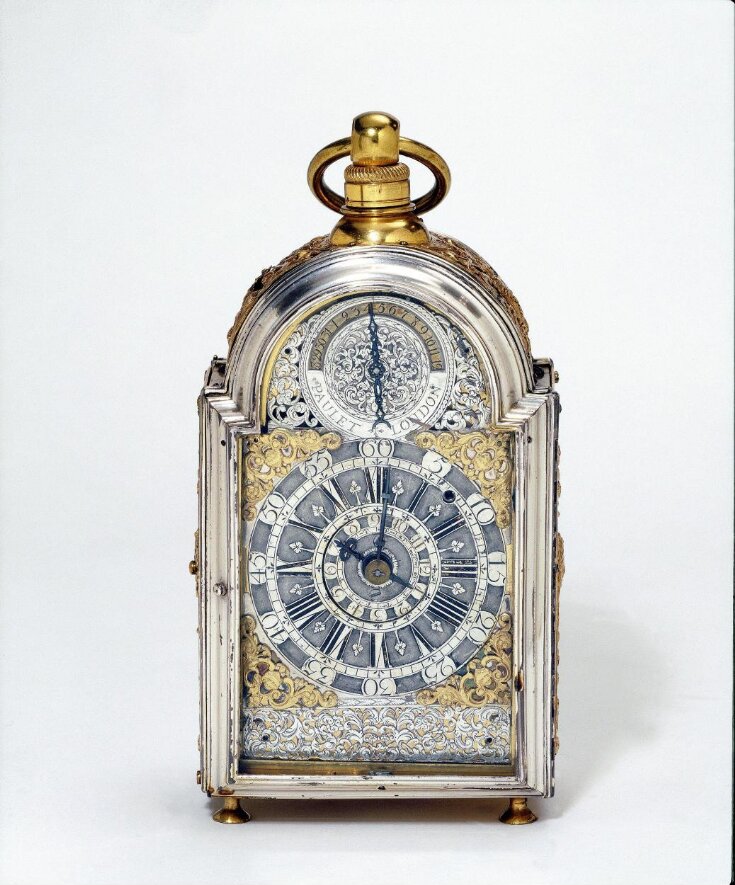
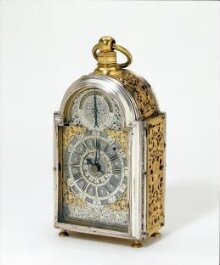
The clock strikes hours in passing and repeats the hours and quarters. The central dial at the front is used to set the alarm, and the pointer on the top dial is for the calendar. The clock was not an eight-day clock; it had to be wound more frequently. The gilt-brass decoration on the sides of the case owes much to the influence of Daniel Marot (1663-1752), a French architect and printmaker active in The Netherlands, whose designs were very fashionable in England when this clock was made.
Small clocks such as this example are thought to have been used when travelling. Too large to be used in a carriage, they were designed to be carried from place to place. It has been suggested that they might well have been used on board ship, fitted into a case fixed to the wall of a cabin.
People
Little is known about the maker who signed himself 'Paulet'. A number of clocks with his signature are recorded and he seems to have had wealthy clients. A clock by him in the Metropolitan Museum, New York bears the royal monogram of Queen Anne (ruled 1702-1714). The distinctly Continental style of his clocks and his French name suggest that he was a Huguenot (French Protestant emigré).
Design
The clock strikes hours in passing and repeats the hours and quarters. The central dial at the front is used to set the alarm, and the pointer on the top dial is for the calendar. The clock was not an eight-day clock; it had to be wound more frequently. The gilt-brass decoration on the sides of the case owes much to the influence of Daniel Marot (1663-1752), a French architect and printmaker active in The Netherlands, whose designs were very fashionable in England when this clock was made.
Object details
| Categories | |
| Object type | |
| Materials and techniques | Chased gilt brass and parcel-gilt silver |
| Brief description | Bracket Clock - Paulet |
| Dimensions |
|
| Gallery label | British Galleries:
GENTLEMAN'S TRAVELLING ACCESSORIES About 1700 British gentry often travelled with extensive luggage. Candlesticks, toilet sets, clocks and eating utensils made travelling more comfortable and were a sign of status. Small pistols were carried in the pocket for personal protection. The clock was probably intended for use at sea, supported in a case on a bracket fixed to a cabin wall.(27/03/2003) |
| Object history | Made in London, the movement signed 'Paulet London' (active about 1710) |
| Summary | Object Type Small clocks such as this example are thought to have been used when travelling. Too large to be used in a carriage, they were designed to be carried from place to place. It has been suggested that they might well have been used on board ship, fitted into a case fixed to the wall of a cabin. People Little is known about the maker who signed himself 'Paulet'. A number of clocks with his signature are recorded and he seems to have had wealthy clients. A clock by him in the Metropolitan Museum, New York bears the royal monogram of Queen Anne (ruled 1702-1714). The distinctly Continental style of his clocks and his French name suggest that he was a Huguenot (French Protestant emigré). Design The clock strikes hours in passing and repeats the hours and quarters. The central dial at the front is used to set the alarm, and the pointer on the top dial is for the calendar. The clock was not an eight-day clock; it had to be wound more frequently. The gilt-brass decoration on the sides of the case owes much to the influence of Daniel Marot (1663-1752), a French architect and printmaker active in The Netherlands, whose designs were very fashionable in England when this clock was made. |
| Collection | |
| Accession number | 420-1869 |
About this object record
Explore the Collections contains over a million catalogue records, and over half a million images. It is a working database that includes information compiled over the life of the museum. Some of our records may contain offensive and discriminatory language, or reflect outdated ideas, practice and analysis. We are committed to addressing these issues, and to review and update our records accordingly.
You can write to us to suggest improvements to the record.
Suggest feedback
You can write to us to suggest improvements to the record.
Suggest feedback
| Record created | March 27, 2003 |
| Record URL |
Download as: JSONIIIF Manifest
