
The Vyvyan Salt
Salt
1592-1593 (hallmarked)
1592-1593 (hallmarked)
| Artist/Maker | |
| Place of origin |
Object Type
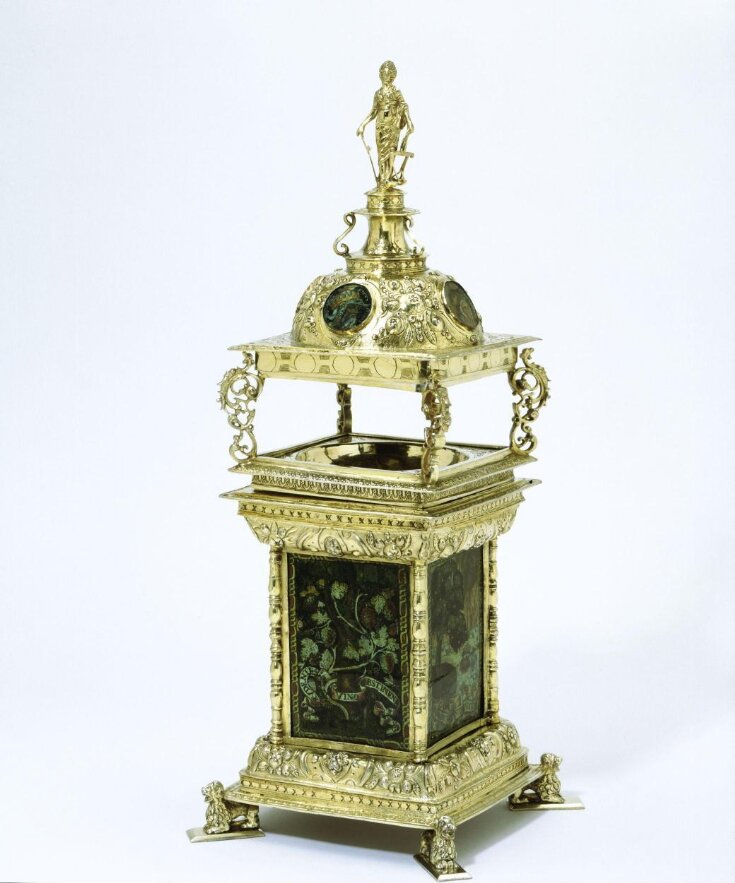
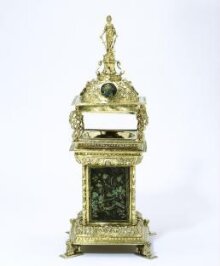
This 'salt' is a large, ceremonial object which would have been placed in front of the head of the household or the guest of honour as a container for salt during a meal. Salts were among the most important pieces of metalwork in a Tudor or Stuart household. They could be made in a variety of styles and sizes and use different materials such as gems, pearls, enamels or crystal and can be used to show wealth and status.
The glass panels are made of verre eglomisé which is a process in which the image is painted on the reverse of the glass and backed with silver or gold foil to make it reflective.
Subjects Depicted
The panels are painted with images from emblem books such as Geoffrey Whitney's A Choice of Emblemes (1586) and Paradin's Devises héroïques. Emblem books were very popular in Europe in the 16th and 17th centuries. They combine pictures and text to present a striking message or moral admonition. The designs shown on this salt include a fruiting vine around a tree, a snake in a strawberry plant and red roses with bees and spiders. Each picture was symbolic: for example, the image of the snake and the strawberry plant warned against flattery and sugared words.
The glass panels are also decorated with portrait heads of Alexander the Great, Julius Caesar, Ninus and Cyrus. A figure of Justice acts as the finial.
People
This salt has been passed down through the Vyvyan family of Trelowarren House, Cornwall since the early 17th century.
This 'salt' is a large, ceremonial object which would have been placed in front of the head of the household or the guest of honour as a container for salt during a meal. Salts were among the most important pieces of metalwork in a Tudor or Stuart household. They could be made in a variety of styles and sizes and use different materials such as gems, pearls, enamels or crystal and can be used to show wealth and status.
The glass panels are made of verre eglomisé which is a process in which the image is painted on the reverse of the glass and backed with silver or gold foil to make it reflective.
Subjects Depicted
The panels are painted with images from emblem books such as Geoffrey Whitney's A Choice of Emblemes (1586) and Paradin's Devises héroïques. Emblem books were very popular in Europe in the 16th and 17th centuries. They combine pictures and text to present a striking message or moral admonition. The designs shown on this salt include a fruiting vine around a tree, a snake in a strawberry plant and red roses with bees and spiders. Each picture was symbolic: for example, the image of the snake and the strawberry plant warned against flattery and sugared words.
The glass panels are also decorated with portrait heads of Alexander the Great, Julius Caesar, Ninus and Cyrus. A figure of Justice acts as the finial.
People
This salt has been passed down through the Vyvyan family of Trelowarren House, Cornwall since the early 17th century.
Object details
| Categories | |
| Object type | |
| Parts | This object consists of 2 parts.
|
| Title | The Vyvyan Salt (popular title) |
| Materials and techniques | Silver gilt, with painted and gilded glass (verre églomisé) |
| Brief description | Tudor silver-gilt salt and cover, English 16th century |
| Physical description | The latin inscriptions are short moral phrases |
| Dimensions |
|
| Gallery label | British Galleries:
Salt was a luxury commodity. It was presented at table in a precious container called simply a 'salt'. Highly ornate silver or silver-gilt salts were considered prestigious gifts by Elizabeth I's courtiers. This large-scale salt follows the shape of a contemporary clock. The painted glass panels are decorated with emblems copied from contemporary books.(27/03/2003) |
| Credit line | Acquired with the assistance of the Goldsmiths' Company, The Art Fund and Edmund A. Phillips |
| Object history | Made in London by an unknown goldsmith; with the mark of WH over a flower in a plain shield Historical significance: The goldsmith's mark is found on a pair of flagons (1592) belonging to Rendcombe Church, Gloucestershire. This extraordinary salt combines certain well-established elements of Elizabethan design, such as the cast animal feet, the canopy and the architectural conception, with an unusually careful execution (for English silver). In addition the inclusion of verre eglomisé panels painted with themes from emblem books (G. Whitney Emblems (1586) and Paradin Devises heroiques) further distinguishes the salt as exceptional in surviving English silver, although emblems are found on Sheldon tapestries and in wall paintings, and the Nine Worthies (whose members varied) had been part of English popular art since the mid-fifteenth century, when they occur in a civic pageant at York. A great salt 'with pictures' at Hardwick in 1601 may have been comparable, but other references to verre eglomisé in English silver are few, although painted glass occurs in several entries in the 1574 royal inventory. Some of these royal pieces were contemporary or near-contemporary acquisitions; others had been in the Jewel House since the time of Henry VIII. This is, however, a decorative technique far more characteristic of Swiss or German goldsmiths' work. (P. Glanville, Silver in Tudor and Early Stuart England, No. 91.) The salt was purchased in 1925 with the assistance of the Worshipful Company of Goldsmiths, the National Art Collections Fund and Mr. Edmund A. Phillips. |
| Summary | Object Type This 'salt' is a large, ceremonial object which would have been placed in front of the head of the household or the guest of honour as a container for salt during a meal. Salts were among the most important pieces of metalwork in a Tudor or Stuart household. They could be made in a variety of styles and sizes and use different materials such as gems, pearls, enamels or crystal and can be used to show wealth and status. The glass panels are made of verre eglomisé which is a process in which the image is painted on the reverse of the glass and backed with silver or gold foil to make it reflective. Subjects Depicted The panels are painted with images from emblem books such as Geoffrey Whitney's A Choice of Emblemes (1586) and Paradin's Devises héroïques. Emblem books were very popular in Europe in the 16th and 17th centuries. They combine pictures and text to present a striking message or moral admonition. The designs shown on this salt include a fruiting vine around a tree, a snake in a strawberry plant and red roses with bees and spiders. Each picture was symbolic: for example, the image of the snake and the strawberry plant warned against flattery and sugared words. The glass panels are also decorated with portrait heads of Alexander the Great, Julius Caesar, Ninus and Cyrus. A figure of Justice acts as the finial. People This salt has been passed down through the Vyvyan family of Trelowarren House, Cornwall since the early 17th century. |
| Collection | |
| Accession number | M.273:1, 2-1925 |
About this object record
Explore the Collections contains over a million catalogue records, and over half a million images. It is a working database that includes information compiled over the life of the museum. Some of our records may contain offensive and discriminatory language, or reflect outdated ideas, practice and analysis. We are committed to addressing these issues, and to review and update our records accordingly.
You can write to us to suggest improvements to the record.
Suggest feedback
You can write to us to suggest improvements to the record.
Suggest feedback
| Record created | June 1, 1998 |
| Record URL |
Download as: JSONIIIF Manifest
