
The Trenchard Bowl
Bowl
1599-1600, 1522-1566 (made)
1599-1600, 1522-1566 (made)
| Artist/Maker | |
| Place of origin |
Object Type
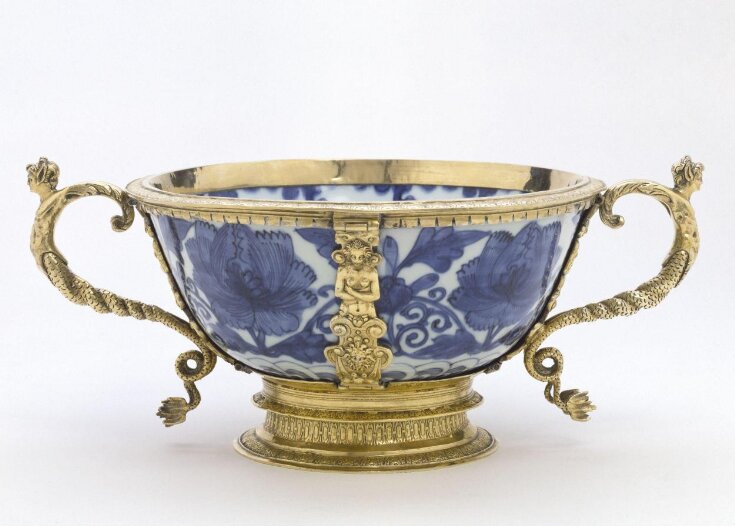
Chinese porcelain was an exotic and highly valued product in 16th-century England. Porcelain was often considered in the same way as such natural curiosities as ostrich eggs, nautilus or trochus shells, serpentine (a hard green stone), coconut or gourd cups, and given expensive silver or gold mounts. This bowl is made of Jia Jing porcelain painted with underglaze blue peonies and fish. The silver-gilt mounts are of high quality, chosen to enhance the value of the piece. It would have made a handsome sideboard ornament or could have been part of a collector's 'cabinet of curiosities'.
Trading
Large quantities of Chinese porcelain were made for export in the kilns of Jingdezhen in Jiangxi Province and traded through south-east Asia and by an overland route through Turkey and into Europe. In 1557 the Portuguese established a trading base in Macau, in southern China, and began to deal in porcelain. As much of this porcelain went directly to Lisbon, it was still extremely rare and highly prized in England, although the activities of English pirates did increase the supply somewhat. The founding of the Dutch East India Company in 1602 led to greater quantities of porcelain entering the market, with a consequent drop in its status and value.
People
By tradition this bowl was a gift from Philip the Fair, Duke of Burgundy (1478-1506) and his wife Joanna 'the Mad' to Sir Thomas Trenchard of Wolverton, Dorset, in gratitude for his hospitality after their ship was wrecked off Weymouth in 1506. In fact, we can tell from the date of the mounts and of the porcelain that it reached England much later, during Elizabeth I's reign (1558-1603), probably as part of a load of porcelain seized from a Spanish ship.
Chinese porcelain was an exotic and highly valued product in 16th-century England. Porcelain was often considered in the same way as such natural curiosities as ostrich eggs, nautilus or trochus shells, serpentine (a hard green stone), coconut or gourd cups, and given expensive silver or gold mounts. This bowl is made of Jia Jing porcelain painted with underglaze blue peonies and fish. The silver-gilt mounts are of high quality, chosen to enhance the value of the piece. It would have made a handsome sideboard ornament or could have been part of a collector's 'cabinet of curiosities'.
Trading
Large quantities of Chinese porcelain were made for export in the kilns of Jingdezhen in Jiangxi Province and traded through south-east Asia and by an overland route through Turkey and into Europe. In 1557 the Portuguese established a trading base in Macau, in southern China, and began to deal in porcelain. As much of this porcelain went directly to Lisbon, it was still extremely rare and highly prized in England, although the activities of English pirates did increase the supply somewhat. The founding of the Dutch East India Company in 1602 led to greater quantities of porcelain entering the market, with a consequent drop in its status and value.
People
By tradition this bowl was a gift from Philip the Fair, Duke of Burgundy (1478-1506) and his wife Joanna 'the Mad' to Sir Thomas Trenchard of Wolverton, Dorset, in gratitude for his hospitality after their ship was wrecked off Weymouth in 1506. In fact, we can tell from the date of the mounts and of the porcelain that it reached England much later, during Elizabeth I's reign (1558-1603), probably as part of a load of porcelain seized from a Spanish ship.
Object details
| Categories | |
| Object type | |
| Title | The Trenchard Bowl (popular title) |
| Materials and techniques | Porcelain, painted in underglaze blue, with silver-gilt mounts |
| Brief description | Jiajing porcelain with gilded silver mounts; the mounts English (London), 1599-1600, maker's mark 'IH', possibly for John Hoffman |
| Physical description | Jiajing porcelain bowl in silver-gilt mounts. The bowl is painted in underglaze blue, the interior with four fish below a border, surrounding a central roundel, the exterior with peonies. The foot-mount rises from a tapered plain ring; an applied wire encloses an applied strip die-struck with pomegranates in foliage. Above this is a slightly concave vertical seamed band which is die-struck with egg and dart, the striking registering on the reverse. A second tapered flange has an applied die-struck strip of pomegranates partly overlaid by a profiled vertical wire. This rises to a flange to which the straps are hinged. The four straps have three-part hinges and are cast as demi-figures surmounting shaped scrollwork panels, each containing a lion mask above a swag on a textured ground. The exterior rim is shaped, pierced and wired below a profiled wire. The interior mount is plain. The tapered rim has an applied strip die-struck with pomegranates as on the foot. The two handles are cast and chased as double scrolls, attached to the central hinge lug. They are formed as genii, their wings terminating below the hinge and their tails entwined. |
| Dimensions |
|
| Style | |
| Marks and inscriptions | Struck on the top section of the foot mount:
maker's mark 'IH' in a shaped shield, possibly for John (Jan) Hoffman; leopard's head crowned, the mark of the London assay office; lion passant, the mark for sterling standard silver; the letter 'B' in a shield, the date letter for the assay year 1599-1600. |
| Gallery label |
|
| Credit line | Acquired with the assistance of the National Heritage Memorial Fund and the Associates from Aspreys |
| Object history | This mounted bowl was purchased by the Museum from a descendant of the Trenchard family of Wolveton House, Charminster, Dorset, in 1983. The bowl is one of two porcelain bowls (the other unmounted), said by Trenchard family tradition to have been part of a gift from Joanna and Philip of Austria to Thomas Trenchard, Sheriff of Dorset, who entertained the royal couple at Wolveton House after their ship was wrecked off Weymouth in 1506. In fact, the bowl reached England much later, in the time of Queen Elizabeth, probably as part of a load of porcelain seized from a Spanish ship. |
| Production | The porcelain bowl Ming Dynasty, Emperor Jiajing (1522-1566); the silver-gilt mounts have a London hallmark for 1599-1600. |
| Subjects depicted | |
| Summary | Object Type Chinese porcelain was an exotic and highly valued product in 16th-century England. Porcelain was often considered in the same way as such natural curiosities as ostrich eggs, nautilus or trochus shells, serpentine (a hard green stone), coconut or gourd cups, and given expensive silver or gold mounts. This bowl is made of Jia Jing porcelain painted with underglaze blue peonies and fish. The silver-gilt mounts are of high quality, chosen to enhance the value of the piece. It would have made a handsome sideboard ornament or could have been part of a collector's 'cabinet of curiosities'. Trading Large quantities of Chinese porcelain were made for export in the kilns of Jingdezhen in Jiangxi Province and traded through south-east Asia and by an overland route through Turkey and into Europe. In 1557 the Portuguese established a trading base in Macau, in southern China, and began to deal in porcelain. As much of this porcelain went directly to Lisbon, it was still extremely rare and highly prized in England, although the activities of English pirates did increase the supply somewhat. The founding of the Dutch East India Company in 1602 led to greater quantities of porcelain entering the market, with a consequent drop in its status and value. People By tradition this bowl was a gift from Philip the Fair, Duke of Burgundy (1478-1506) and his wife Joanna 'the Mad' to Sir Thomas Trenchard of Wolverton, Dorset, in gratitude for his hospitality after their ship was wrecked off Weymouth in 1506. In fact, we can tell from the date of the mounts and of the porcelain that it reached England much later, during Elizabeth I's reign (1558-1603), probably as part of a load of porcelain seized from a Spanish ship. |
| Bibliographic references |
|
| Collection | |
| Accession number | M.945-1983 |
About this object record
Explore the Collections contains over a million catalogue records, and over half a million images. It is a working database that includes information compiled over the life of the museum. Some of our records may contain offensive and discriminatory language, or reflect outdated ideas, practice and analysis. We are committed to addressing these issues, and to review and update our records accordingly.
You can write to us to suggest improvements to the record.
Suggest feedback
You can write to us to suggest improvements to the record.
Suggest feedback
| Record created | June 1, 1998 |
| Record URL |
Download as: JSONIIIF Manifest
