Tapestry
1690-1710 (made)
| Artist/Maker | |
| Place of origin |
Object Type
There was great variety in the late 17th century in the types of wall coverings available to wealthy customers, but tapestry-woven hangings such as this nearly always had pride of place in both private and state apartments, particularly in bedchambers. Sometimes their use was seasonal, for example at Ham House in Surrey, where tapestries covered the walls in winter and woven silk hangings were used in summer.
People
John Vanderbank's workshop, where this tapestry was woven, was the leading English tapestry manufactory in the late 17th century. Vanderbank was Yeoman Arras-maker to the Great Wardrobe, supplying the royal family from his premises in Great Queen Street, Covent Garden, London, from 1689 until his death in 1717.
Design & Designing
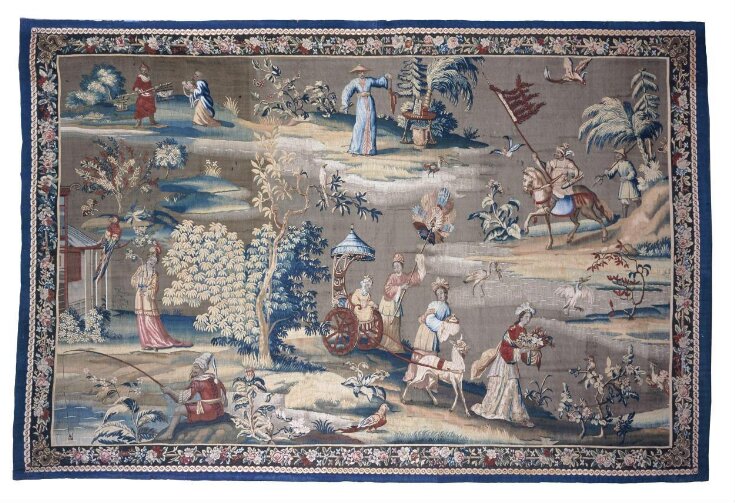
When tapestries such as this were described as 'hangings with India ffigures' the word 'India' included a variety of Asian styles not distinguished from each other at the time. Vanderbank's tapestries of this type include elements of Chinese, Indian and Turkish decoration, with European figures and motifs as well. One of the figures here, the Japanese Priest, comes from an illustration to John Ogilby's translation of Arnold Montanus's Atlas Japannensis, published in London in 1670. The nature of the design, with numerous small motifs apparently randomly juxtaposed, allowed for relatively easy customisation of the tapestries to exactly the dimensions required by the client.
There was great variety in the late 17th century in the types of wall coverings available to wealthy customers, but tapestry-woven hangings such as this nearly always had pride of place in both private and state apartments, particularly in bedchambers. Sometimes their use was seasonal, for example at Ham House in Surrey, where tapestries covered the walls in winter and woven silk hangings were used in summer.
People
John Vanderbank's workshop, where this tapestry was woven, was the leading English tapestry manufactory in the late 17th century. Vanderbank was Yeoman Arras-maker to the Great Wardrobe, supplying the royal family from his premises in Great Queen Street, Covent Garden, London, from 1689 until his death in 1717.
Design & Designing
When tapestries such as this were described as 'hangings with India ffigures' the word 'India' included a variety of Asian styles not distinguished from each other at the time. Vanderbank's tapestries of this type include elements of Chinese, Indian and Turkish decoration, with European figures and motifs as well. One of the figures here, the Japanese Priest, comes from an illustration to John Ogilby's translation of Arnold Montanus's Atlas Japannensis, published in London in 1670. The nature of the design, with numerous small motifs apparently randomly juxtaposed, allowed for relatively easy customisation of the tapestries to exactly the dimensions required by the client.
Object details
| Categories | |
| Object type | |
| Materials and techniques | Woven with wool and silk |
| Brief description | Tapestry 'after the Indian manner' - "Indian Manner - Chinoiserie" |
| Physical description | Tapestry |
| Dimensions |
|
| Gallery label | British Galleries:
During the 1690's John Vanderbank's London workshop supplied Kensington Palace with tapestries similar to these, 'designed after the Indian Manner', that is, with small figures in Asian costume, set against a dark ground. They were highly fashionable for state bedrooms and several matching pieces hung in the bedroom at Melville House.(27/03/2003) |
| Object history | Made in the London workshop of John Vanderbank the elder (active 1683, died in London, 1739) |
| Summary | Object Type There was great variety in the late 17th century in the types of wall coverings available to wealthy customers, but tapestry-woven hangings such as this nearly always had pride of place in both private and state apartments, particularly in bedchambers. Sometimes their use was seasonal, for example at Ham House in Surrey, where tapestries covered the walls in winter and woven silk hangings were used in summer. People John Vanderbank's workshop, where this tapestry was woven, was the leading English tapestry manufactory in the late 17th century. Vanderbank was Yeoman Arras-maker to the Great Wardrobe, supplying the royal family from his premises in Great Queen Street, Covent Garden, London, from 1689 until his death in 1717. Design & Designing When tapestries such as this were described as 'hangings with India ffigures' the word 'India' included a variety of Asian styles not distinguished from each other at the time. Vanderbank's tapestries of this type include elements of Chinese, Indian and Turkish decoration, with European figures and motifs as well. One of the figures here, the Japanese Priest, comes from an illustration to John Ogilby's translation of Arnold Montanus's Atlas Japannensis, published in London in 1670. The nature of the design, with numerous small motifs apparently randomly juxtaposed, allowed for relatively easy customisation of the tapestries to exactly the dimensions required by the client. |
| Collection | |
| Accession number | 402-1906 |
About this object record
Explore the Collections contains over a million catalogue records, and over half a million images. It is a working database that includes information compiled over the life of the museum. Some of our records may contain offensive and discriminatory language, or reflect outdated ideas, practice and analysis. We are committed to addressing these issues, and to review and update our records accordingly.
You can write to us to suggest improvements to the record.
Suggest feedback
You can write to us to suggest improvements to the record.
Suggest feedback
| Record created | March 27, 2003 |
| Record URL |
Download as: JSONIIIF Manifest
